


Opening
14 April 2025
Exhibition Concept
The new National Museum Eighty Years’ War in Groenlo is housed in the historic Calixtus Church, which has stood as a witness to this history since the period of the Eighty Years’ War.
Designer Johan Akkerman and his team, consisting of media producer Paul van der Ham and performer/writer Sara van Gennip, won the original pitch with their exhibition concept in which visitors, equipped with a press card, headphones, and a microphone, take on the role of war correspondents searching for truth within the Eighty Years’ War.
A design studio that had been involved in the development process for three years and had been asked to act as a “flying keeper” subsequently invited Studio Daniel Ament to develop the spatial design and concept, based on Akkerman’s original ideas and bastion-based floor plan.
The spatial concept consists of a bombarded exhibition landscape in which exhibition walls, showcases, and spatial elements appear as fragments functioning as carriers of the collection. Sightlines, plinths, panels, drawers, cabinets, showcases, exhibits, and interactives together form a layered environment in which every detail contributes to the experience of a museum battlefield through which visitors move as war correspondents.
Decor Concept
Historic press conference with participation
Opening
14 April 2025
Exhibition Concept
The new National Museum Eighty Years’ War in Groenlo is housed in the historic Calixtus Church, which has stood as a witness to this history since the period of the Eighty Years’ War.
Designer Johan Akkerman and his team, consisting of media producer Paul van der Ham and performer/writer Sara van Gennip, won the original pitch with their exhibition concept in which visitors, equipped with a press card, headphones, and a microphone, take on the role of war correspondents searching for truth within the Eighty Years’ War.
A design studio that had been involved in the development process for three years and had been asked to act as a “flying keeper” subsequently invited Studio Daniel Ament to develop the spatial design and concept, based on Akkerman’s original ideas and bastion-based floor plan.
The spatial concept consists of a bombarded exhibition landscape in which exhibition walls, showcases, and spatial elements appear as fragments functioning as carriers of the collection. Sightlines, plinths, panels, drawers, cabinets, showcases, exhibits, and interactives together form a layered environment in which every detail contributes to the experience of a museum battlefield through which visitors move as war correspondents.
Decor Concept
Historic press conference with participation


Opening
2022
Exhibition Concept
For Naturalis Biodiversity Center, Studio Daniel Ament developed the “Rexperience,” a museum installation in which narrative, scenography, and technology merge into a single spatial experience.
The assignment was not merely to create a spectacular attraction aimed at drawing a specific audience, but also to add a layer of substantive depth—using accessible, everyday language—to scientific knowledge.
The iconic T. rex, named Trix, excavated by Naturalis, is displayed in the adjacent gallery.
Visitors enter a futuristic time travel agency, followed by a time capsule in which a journey back to 66 million years ago is staged. Light, sound, stereoscopic film, motion, and animatronics are controlled by a show control system and were integrally designed and directed to create a layered and holistic experience.
Guided by a virtual host, a compelling narrative unfolds, culminating in the moment of the meteorite impact. The installation combines immersion with content, connecting education to emotion.
The Rexperience is conceived as an additional museum layer within the broader visitor route.
From content and scenography to sound design and technical integration, the project was designed in-house and realized down to the smallest detail.
Review / Article
Both the design and execution processes are highly complex due to the holistic concept, where every 5 minutes, 25 visitors are guided through a fully automated experiential journey. Light, design, animatronics, film, decor, and effects work seamlessly together to complete the experience.
Set Design
Spectacular time travel to the Cretaceous
Opening
2022
Exhibition Concept
For Naturalis Biodiversity Center, Studio Daniel Ament developed the “Rexperience,” a museum installation in which narrative, scenography, and technology merge into a single spatial experience.
The assignment was not merely to create a spectacular attraction aimed at drawing a specific audience, but also to add a layer of substantive depth—using accessible, everyday language—to scientific knowledge.
The iconic T. rex, named Trix, excavated by Naturalis, is displayed in the adjacent gallery.
Visitors enter a futuristic time travel agency, followed by a time capsule in which a journey back to 66 million years ago is staged. Light, sound, stereoscopic film, motion, and animatronics are controlled by a show control system and were integrally designed and directed to create a layered and holistic experience.
Guided by a virtual host, a compelling narrative unfolds, culminating in the moment of the meteorite impact. The installation combines immersion with content, connecting education to emotion.
The Rexperience is conceived as an additional museum layer within the broader visitor route.
From content and scenography to sound design and technical integration, the project was designed in-house and realized down to the smallest detail.
Review / Article
Both the design and execution processes are highly complex due to the holistic concept, where every 5 minutes, 25 visitors are guided through a fully automated experiential journey. Light, design, animatronics, film, decor, and effects work seamlessly together to complete the experience.
Set Design
Spectacular time travel to the Cretaceous


Opening
2019-09-01
Exhibition Concept
The Earthquake, designed by Studio Daniel Ament, is an intense experience within the hall “The Earth”. In this event, a puppet play about a Japanese mythology explaining earthquakes brings an actual earthquake to life. The puppet theatre begins to collapse, and visitors must find their way out through the debris to escape the peril.
Combining soundscapes, lighting design, and dynamic effects – such as a cracking and moving floor and a falling ceiling – this experience immerses visitors in the destructive force of the earth.
The hall “The Earth” itself is a tribute to the immense power of our planet. Visitors journey through awe-inspiring locations like volcanoes in Hawaii, earthquakes in Japan, and the rifts of Iceland, making the raw force of nature tangible.
Set Design
Realistic natural forces with dynamic effects.
Award
N/A
Opening
2019-09-01
Exhibition Concept
The Earthquake, designed by Studio Daniel Ament, is an intense experience within the hall “The Earth”. In this event, a puppet play about a Japanese mythology explaining earthquakes brings an actual earthquake to life. The puppet theatre begins to collapse, and visitors must find their way out through the debris to escape the peril.
Combining soundscapes, lighting design, and dynamic effects – such as a cracking and moving floor and a falling ceiling – this experience immerses visitors in the destructive force of the earth.
The hall “The Earth” itself is a tribute to the immense power of our planet. Visitors journey through awe-inspiring locations like volcanoes in Hawaii, earthquakes in Japan, and the rifts of Iceland, making the raw force of nature tangible.
Set Design
Realistic natural forces with dynamic effects.
Award
N/A


Opening
August 31, 2019
Exhibition Concept
For an exhibition on prehistory, Studio Daniel Ament designed The Ice Age: an installation in which the ecosystem of the Netherlands around 40,000 years ago can be experienced immersively.
At the center of the space stands a large-scale model of the Netherlands, depicting the landscape as it existed during the last Ice Age, the Weichselian. Using specially developed 3D viewers, visitors suddenly find themselves within this landscape, surrounded by animals, experiencing what was once a frozen scene now brought to life in motion.
From different viewpoints, visitors observe the same cinematic scenes. These scenes are all ecologically interconnected, allowing visitors—through their own observation and exploration—to understand how this ecological system functioned.
The ecosystem is based on the prehistoric “Big Five” that inhabited the landscape: the woolly mammoth, woolly rhinoceros, steppe bison, steppe lion, and cave hyena. Each represents fundamental themes of existence: birth and death, reproduction, migration, hunting, and feeding.
For the flora and fauna represented in the model, Studio Daniel Ament conducted in-depth research in close collaboration with various scientists—down to the level of individual grains of sand and soil composition—and translated this knowledge into the scale of the model.
The walls surrounding the model consist of floor-to-ceiling storage racks, effectively bringing the collection depot into the exhibition space. The fossils displayed within connect the cinematic reconstructions to archaeological evidence, revealing how scientific research has shaped our understanding of this ecosystem.
In the outer zone, between the building walls and the storage structures, lies the domain of scientists. Visitors occasionally see them moving through the space with carts and ladders, retrieving and returning collection items for research.
In this way, The Ice Age unfolds as a layered experience in which imagination and science reinforce one another. The combination of model, film, fossils, and live research demonstrates how knowledge of the past is constructed, while inviting visitors to draw their own connections.
By looking, listening, discovering, and actively participating, visitors gain a new perspective on a vanished landscape that suddenly feels strikingly close.
Set Design
Realistic prehistoric dioramas with film projections
Opening
August 31, 2019
Exhibition Concept
For an exhibition on prehistory, Studio Daniel Ament designed The Ice Age: an installation in which the ecosystem of the Netherlands around 40,000 years ago can be experienced immersively.
At the center of the space stands a large-scale model of the Netherlands, depicting the landscape as it existed during the last Ice Age, the Weichselian. Using specially developed 3D viewers, visitors suddenly find themselves within this landscape, surrounded by animals, experiencing what was once a frozen scene now brought to life in motion.
From different viewpoints, visitors observe the same cinematic scenes. These scenes are all ecologically interconnected, allowing visitors—through their own observation and exploration—to understand how this ecological system functioned.
The ecosystem is based on the prehistoric “Big Five” that inhabited the landscape: the woolly mammoth, woolly rhinoceros, steppe bison, steppe lion, and cave hyena. Each represents fundamental themes of existence: birth and death, reproduction, migration, hunting, and feeding.
For the flora and fauna represented in the model, Studio Daniel Ament conducted in-depth research in close collaboration with various scientists—down to the level of individual grains of sand and soil composition—and translated this knowledge into the scale of the model.
The walls surrounding the model consist of floor-to-ceiling storage racks, effectively bringing the collection depot into the exhibition space. The fossils displayed within connect the cinematic reconstructions to archaeological evidence, revealing how scientific research has shaped our understanding of this ecosystem.
In the outer zone, between the building walls and the storage structures, lies the domain of scientists. Visitors occasionally see them moving through the space with carts and ladders, retrieving and returning collection items for research.
In this way, The Ice Age unfolds as a layered experience in which imagination and science reinforce one another. The combination of model, film, fossils, and live research demonstrates how knowledge of the past is constructed, while inviting visitors to draw their own connections.
By looking, listening, discovering, and actively participating, visitors gain a new perspective on a vanished landscape that suddenly feels strikingly close.
Set Design
Realistic prehistoric dioramas with film projections


Opening
March 29, 2019
Exhibition Concept
Explore six fascinating sea creatures with the whole family in the Sea Monsters exhibition. Take a closer look at the Loch Ness monster, meet the mega-octopus Kraken, a giant crab, and mermaids. There’s also a massive turtle pretending to be an island and even the whale that swallowed Jonah. Sea Monsters is an interactive exhibition at the Maritime Museum in Rotterdam, specially designed for families with children aged 4 and up, where nothing is as it seems.
Set Design
A whimsical underwater world filled with mythical sea creatures
Opening
March 29, 2019
Exhibition Concept
Explore six fascinating sea creatures with the whole family in the Sea Monsters exhibition. Take a closer look at the Loch Ness monster, meet the mega-octopus Kraken, a giant crab, and mermaids. There’s also a massive turtle pretending to be an island and even the whale that swallowed Jonah. Sea Monsters is an interactive exhibition at the Maritime Museum in Rotterdam, specially designed for families with children aged 4 and up, where nothing is as it seems.
Set Design
A whimsical underwater world filled with mythical sea creatures


Opening
April 20, 2018
Exhibition Concept
For Helmond Castle, Studio Daniel Ament developed Castle on Fire: a narrative and theatrical installation in the castle attic, a space that had been closed to the public for nearly 700 years.
The project demonstrates how heritage presentation can transform from static explanation into a sensory and dramaturgical experience in which history becomes tangible.
The concept The Castle’s Nightmare formed the dramaturgical foundation. Instead of a linear historical reconstruction, a layered narrative was created in the form of a “whodunit.”
Visitors wander through the imagination of the castle itself, where shadows, voices, and memories guide them across creaking floors, ancient beams, and hidden passages.
The existing interior was not concealed, but used as a scenographic foundation.
Lighting design, sound design, and special effects heighten the tension and mark the transition between reality and dream. Historical facts and fictional layers are carefully interwoven, culminating in the fire as the climax.
Film elements, spatial interventions, and theatrical effects were developed as part of one integrated design process.
Set Design
The nightmare of the castle
Creative Team
Special FX: Studio Daniel Ament
Soundscape: Wim Conradi
Lighting Design: Tom Verheijen
AV Design: Rapenburg Plaza
Opening
April 20, 2018
Exhibition Concept
For Helmond Castle, Studio Daniel Ament developed Castle on Fire: a narrative and theatrical installation in the castle attic, a space that had been closed to the public for nearly 700 years.
The project demonstrates how heritage presentation can transform from static explanation into a sensory and dramaturgical experience in which history becomes tangible.
The concept The Castle’s Nightmare formed the dramaturgical foundation. Instead of a linear historical reconstruction, a layered narrative was created in the form of a “whodunit.”
Visitors wander through the imagination of the castle itself, where shadows, voices, and memories guide them across creaking floors, ancient beams, and hidden passages.
The existing interior was not concealed, but used as a scenographic foundation.
Lighting design, sound design, and special effects heighten the tension and mark the transition between reality and dream. Historical facts and fictional layers are carefully interwoven, culminating in the fire as the climax.
Film elements, spatial interventions, and theatrical effects were developed as part of one integrated design process.
Set Design
The nightmare of the castle
Creative Team
Special FX: Studio Daniel Ament
Soundscape: Wim Conradi
Lighting Design: Tom Verheijen
AV Design: Rapenburg Plaza


Opening
November 1, 2017
Exhibition Concept
Fake news! Filter bubbles! Everyone is a journalist! The impact of the daily news flow is greater than ever. The exhibition News or Nonsense at the Museum of Beeld & Geluid takes visitors on an interactive journey through the phenomenon of fake news. Let Eva Cleven and Lex Uiting guide you out of your filter bubble, create your own clickbait, and hold up a mirror to yourself.
The exhibition explores the influence of fake news and the media that spread it, asking: what is real and what is fake? Learn how fact-checkers, news outlets, and schools fight against trolls, clickbait factories, and vlogging fakers. Discover how you can deal with fake news and the power of critical thinking.
Set Design
An interactive mirror on the media landscape
Opening
November 1, 2017
Exhibition Concept
Fake news! Filter bubbles! Everyone is a journalist! The impact of the daily news flow is greater than ever. The exhibition News or Nonsense at the Museum of Beeld & Geluid takes visitors on an interactive journey through the phenomenon of fake news. Let Eva Cleven and Lex Uiting guide you out of your filter bubble, create your own clickbait, and hold up a mirror to yourself.
The exhibition explores the influence of fake news and the media that spread it, asking: what is real and what is fake? Learn how fact-checkers, news outlets, and schools fight against trolls, clickbait factories, and vlogging fakers. Discover how you can deal with fake news and the power of critical thinking.
Set Design
An interactive mirror on the media landscape


Opening
January 16, 2017
Exhibition Concept
For Humanity House, Studio Daniel Ament developed an exhibition in which migration is presented not primarily as statistics or political discourse, but as a human experience.
The spatial and conceptual structure is built around three pillars: conflict, flight, and arrival. This tripartite structure forms both the dramaturgical line and the physical routing of the exhibition.
Visitors move not only thematically, but emotionally through these phases.
At the core are eight personal stories of refugees. Their experiences are conveyed not abstractly, but through familiar elements from everyday life: a stuffed toy, a hobby, a friendship, a memory of home.
These small details form the bridge between visitor and storyteller, making complex geopolitical realities tangible.
What does conflict mean on a global scale? When is someone defined as a refugee according to international standards? How do personal experiences relate to global statistics?
Data on displaced populations, residence permits, and historical developments are integrated into the spatial scenography. Data and personal narratives are deliberately interwoven.
Lighting, sound, and spatial transitions mark the different phases—from disruption to arrival. Visitors experience contrasts between uncertainty and stability, loss and perspective.
The result is an exhibition that both informs and fosters empathy.
Content, dramaturgy, design, and audiovisual media were developed as one integrated system, aiming to create a layered audience experience in which knowledge and emotion reinforce each other.
Set Design
Living in a transport crate
Opening
January 16, 2017
Exhibition Concept
For Humanity House, Studio Daniel Ament developed an exhibition in which migration is presented not primarily as statistics or political discourse, but as a human experience.
The spatial and conceptual structure is built around three pillars: conflict, flight, and arrival. This tripartite structure forms both the dramaturgical line and the physical routing of the exhibition.
Visitors move not only thematically, but emotionally through these phases.
At the core are eight personal stories of refugees. Their experiences are conveyed not abstractly, but through familiar elements from everyday life: a stuffed toy, a hobby, a friendship, a memory of home.
These small details form the bridge between visitor and storyteller, making complex geopolitical realities tangible.
What does conflict mean on a global scale? When is someone defined as a refugee according to international standards? How do personal experiences relate to global statistics?
Data on displaced populations, residence permits, and historical developments are integrated into the spatial scenography. Data and personal narratives are deliberately interwoven.
Lighting, sound, and spatial transitions mark the different phases—from disruption to arrival. Visitors experience contrasts between uncertainty and stability, loss and perspective.
The result is an exhibition that both informs and fosters empathy.
Content, dramaturgy, design, and audiovisual media were developed as one integrated system, aiming to create a layered audience experience in which knowledge and emotion reinforce each other.
Set Design
Living in a transport crate


Opening
May 15, 2016, National Tour
Exhibition Concept
WeAreData (launched May 15, 2016) is a traveling installation that makes the public debate on data, privacy, and security spatially tangible.
At a time when technological developments increasingly normalize the collection and analysis of personal data, the project raises a fundamental question: what do we reveal, and when?
Commissioned by initiator and producer Tijl Akkermans, Studio Daniel Ament designed the Mirror Room: an immersive space in which the visitor becomes the subject of analysis.
Rather than discussing Big Data abstractly, the installation makes the physical and emotional dimensions of data collection visible.
Using sensors and cameras, the installation registers subtle visitor responses. Gaze direction, micro-expressions, and emotional signals are measured and fed back afterward.
The software, developed by VicarVision, uses FaceReader technology to analyze facial expressions, revealing not only that data is collected, but how deeply personal this analysis can be.
The spatial design reinforces this concept. Reflective surfaces, screens, and controlled lighting conditions create an environment in which observing and being observed converge.
Visitors experience a subtle shift in control: from observer to observed.
Set Design
Interactive installation
Opening
May 15, 2016, National Tour
Exhibition Concept
WeAreData (launched May 15, 2016) is a traveling installation that makes the public debate on data, privacy, and security spatially tangible.
At a time when technological developments increasingly normalize the collection and analysis of personal data, the project raises a fundamental question: what do we reveal, and when?
Commissioned by initiator and producer Tijl Akkermans, Studio Daniel Ament designed the Mirror Room: an immersive space in which the visitor becomes the subject of analysis.
Rather than discussing Big Data abstractly, the installation makes the physical and emotional dimensions of data collection visible.
Using sensors and cameras, the installation registers subtle visitor responses. Gaze direction, micro-expressions, and emotional signals are measured and fed back afterward.
The software, developed by VicarVision, uses FaceReader technology to analyze facial expressions, revealing not only that data is collected, but how deeply personal this analysis can be.
The spatial design reinforces this concept. Reflective surfaces, screens, and controlled lighting conditions create an environment in which observing and being observed converge.
Visitors experience a subtle shift in control: from observer to observed.
Set Design
Interactive installation

Opening
17-12-2015
Exhibition Concept
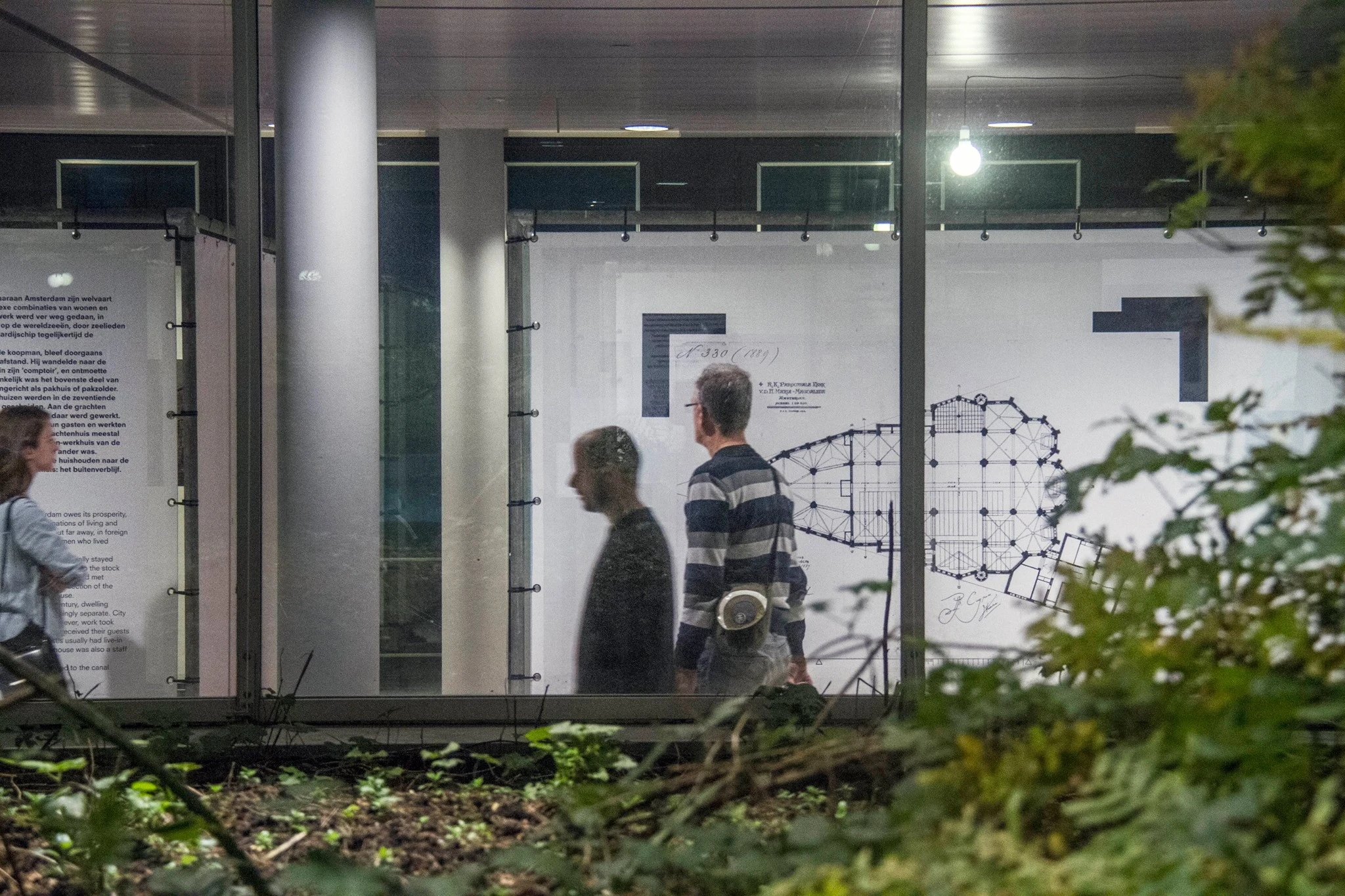
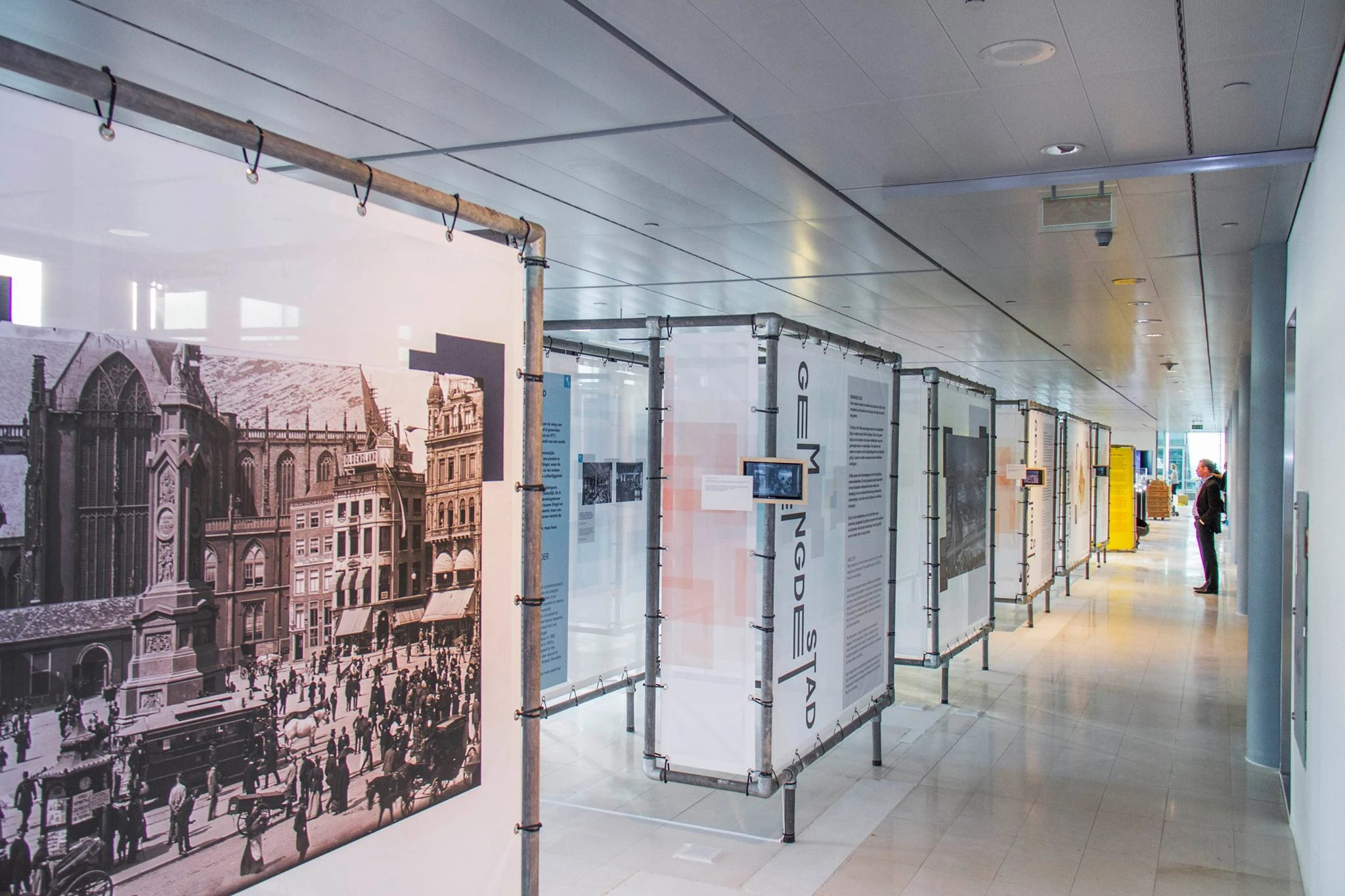
For the Architecture Center Amsterdam, Studio Daniel Ament developed Working Apart Together: an exhibition exploring the relationship between living and working as a societal and urban design challenge.
The starting point was a simple opposition: living and working as separate domains. The exhibition demonstrates that while this division has historical roots, it has never been absolute.
From home-based studios to large-scale industrial zones, and from hybrid urban blocks to new live-work concepts, the interaction between these spheres proves fundamental to urban development.
Amsterdam serves as the underlying case: how do regulations, changing housing preferences, economic structures, and mobility influence the relationship between functions? And how does this translate into the physical city?
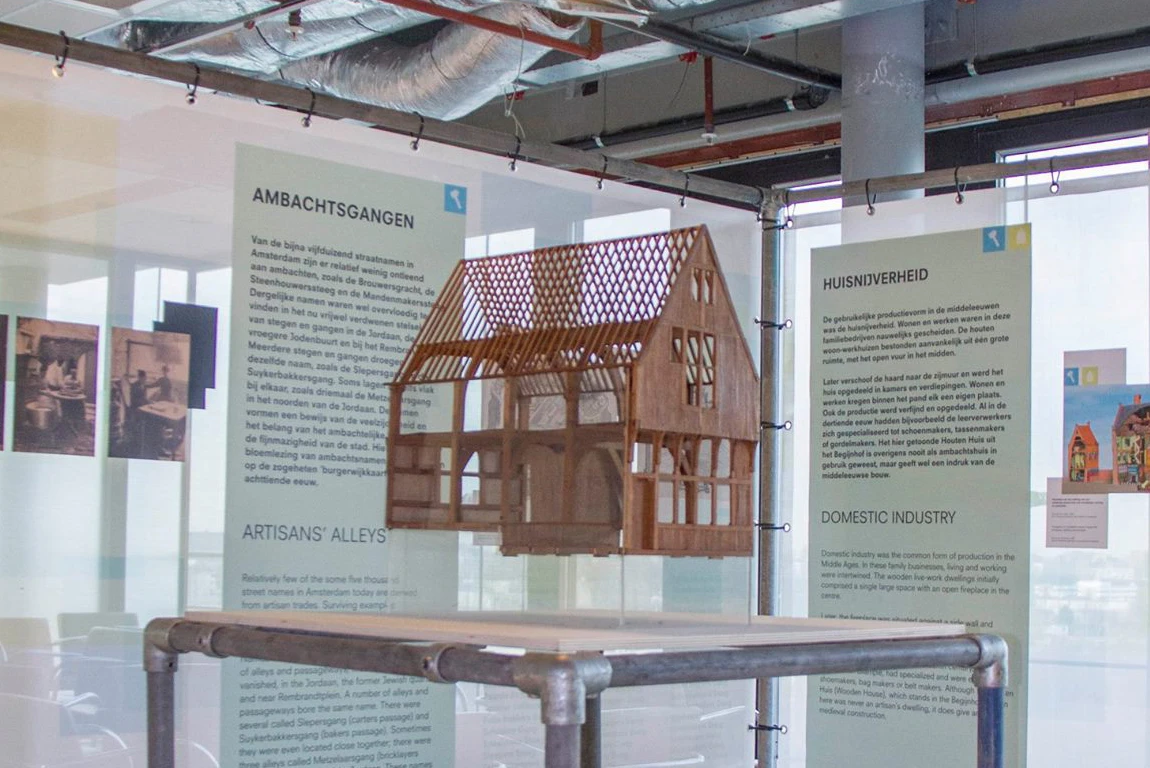
The spatial design is conceived as a three-dimensional analysis. Diagrams, models, maps, and audiovisual layers are interwoven.
Visitors gain insight into how design decisions directly affect everyday life and urban dynamics.
Lighting, graphic elements, and spatial interventions structure the narrative, making abstract regulatory processes tangible and perceptible.
From concept to realization, the project was developed in-house, integrating analytical content, graphic design, and technical execution into one coherent whole.
Set Design
Exhibition design focused on the interplay between living and working
Opening
17-12-2015
Exhibition Concept
For the Architecture Center Amsterdam, Studio Daniel Ament developed Working Apart Together: an exhibition exploring the relationship between living and working as a societal and urban design challenge.
The starting point was a simple opposition: living and working as separate domains. The exhibition demonstrates that while this division has historical roots, it has never been absolute.
From home-based studios to large-scale industrial zones, and from hybrid urban blocks to new live-work concepts, the interaction between these spheres proves fundamental to urban development.
Amsterdam serves as the underlying case: how do regulations, changing housing preferences, economic structures, and mobility influence the relationship between functions? And how does this translate into the physical city?
The spatial design is conceived as a three-dimensional analysis. Diagrams, models, maps, and audiovisual layers are interwoven.
Visitors gain insight into how design decisions directly affect everyday life and urban dynamics.
Lighting, graphic elements, and spatial interventions structure the narrative, making abstract regulatory processes tangible and perceptible.
From concept to realization, the project was developed in-house, integrating analytical content, graphic design, and technical execution into one coherent whole.
Set Design
Exhibition design focused on the interplay between living and working


Opening
28 march 2014
Exhibition Concept
Stories of manor residents and their impact
Review / Article “On Friday, March 28, 2014, Museum Nienoord will open the new exhibition Hidden Stories on the upper floor of the manor. The exhibition tells the exciting stories of the manor, its residents, and their influence on the surrounding landscape through images and sound—stories that have remained hidden for a long time. Visitors can follow the three families who ruled the surrounding areas as lords of Nienoord. Special animated films for both young and old bring the past to life in a creative way. Visitors will also learn about the wealth that once existed in Nienoord, as well as the turbulent times, wars, and personal dramas. Additionally, some myths are debunked, such as the myth of the 1850 fire that supposedly severely damaged the manor. There are many activities for children, including learning a court dance, discovering how peat forms underground, and hearing the walls speak about the past.
The exhibition was designed by Daniel Ament, who has previously designed exhibitions for the Rijksmuseum and the Tropenmuseum. His design for Museum Nienoord gives the upper floor of the manor a contemporary touch. Instead of period rooms, modern audiovisual techniques are used, distinguishing the manor from other estates in Groningen. This new exhibition becomes a permanent part of Museum Nienoord, showcasing the museum’s new identity as a Groninger country estate of distinction, where regional cultural history has a natural place alongside the unique national carriage collection.” — Infoleek, 20-03-2014
Set Design
If the walls could talk
Opening
28 march 2014
Exhibition Concept
Stories of manor residents and their impact
Review / Article “On Friday, March 28, 2014, Museum Nienoord will open the new exhibition Hidden Stories on the upper floor of the manor. The exhibition tells the exciting stories of the manor, its residents, and their influence on the surrounding landscape through images and sound—stories that have remained hidden for a long time. Visitors can follow the three families who ruled the surrounding areas as lords of Nienoord. Special animated films for both young and old bring the past to life in a creative way. Visitors will also learn about the wealth that once existed in Nienoord, as well as the turbulent times, wars, and personal dramas. Additionally, some myths are debunked, such as the myth of the 1850 fire that supposedly severely damaged the manor. There are many activities for children, including learning a court dance, discovering how peat forms underground, and hearing the walls speak about the past.
The exhibition was designed by Daniel Ament, who has previously designed exhibitions for the Rijksmuseum and the Tropenmuseum. His design for Museum Nienoord gives the upper floor of the manor a contemporary touch. Instead of period rooms, modern audiovisual techniques are used, distinguishing the manor from other estates in Groningen. This new exhibition becomes a permanent part of Museum Nienoord, showcasing the museum’s new identity as a Groninger country estate of distinction, where regional cultural history has a natural place alongside the unique national carriage collection.” — Infoleek, 20-03-2014
Set Design
If the walls could talk


Opening
08-01-2014, het Rijks
Exhibition Concept
Following the exhibition “You & the Golden Age,” the Rijksmuseum expanded upon the concept of the ‘Society of Rijksgeheimen,’ which consists of eccentric scientists and historians living and working within the exhibition. One of the society’s members invented the ‘Vanallesreiniger,’ used by the cleaner Ali Dingendoek. The actual Vanallesreiniger was designed by Studio Daniel Ament.
Set Design
All-purpose cleaner
Opening
08-01-2014, het Rijks
Exhibition Concept
Following the exhibition “You & the Golden Age,” the Rijksmuseum expanded upon the concept of the ‘Society of Rijksgeheimen,’ which consists of eccentric scientists and historians living and working within the exhibition. One of the society’s members invented the ‘Vanallesreiniger,’ used by the cleaner Ali Dingendoek. The actual Vanallesreiniger was designed by Studio Daniel Ament.
Set Design
All-purpose cleaner




Exhibition Concept
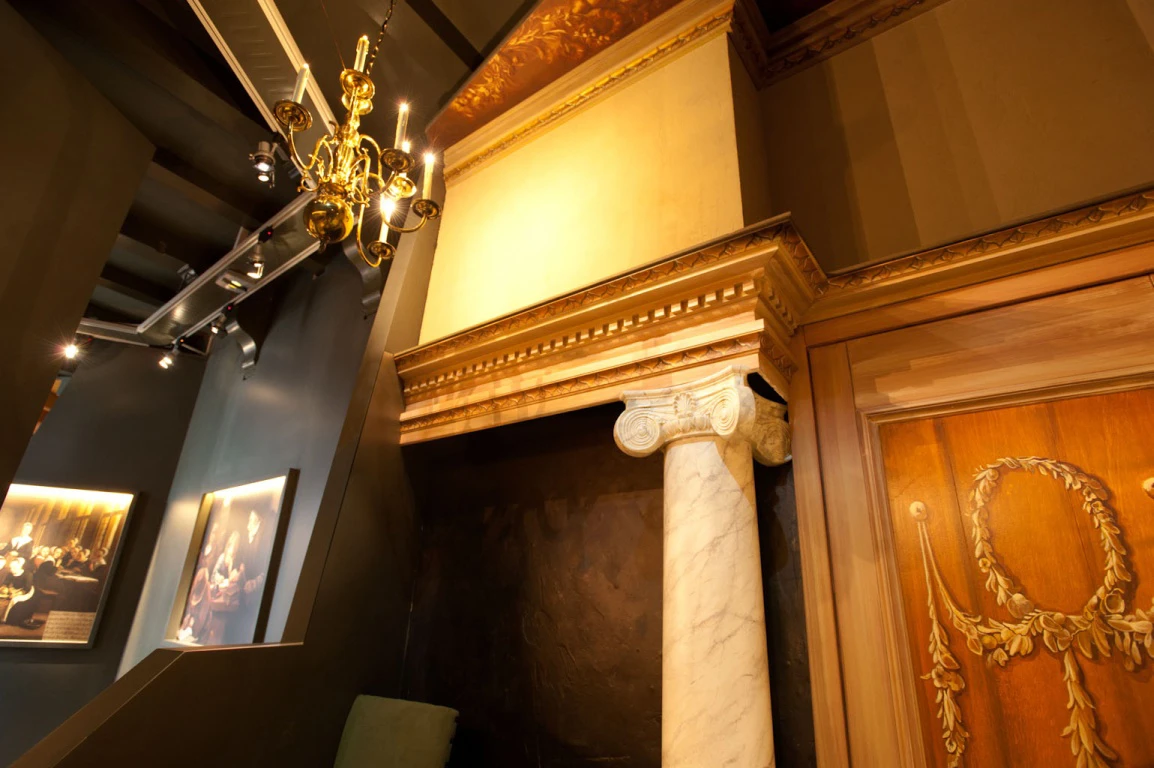
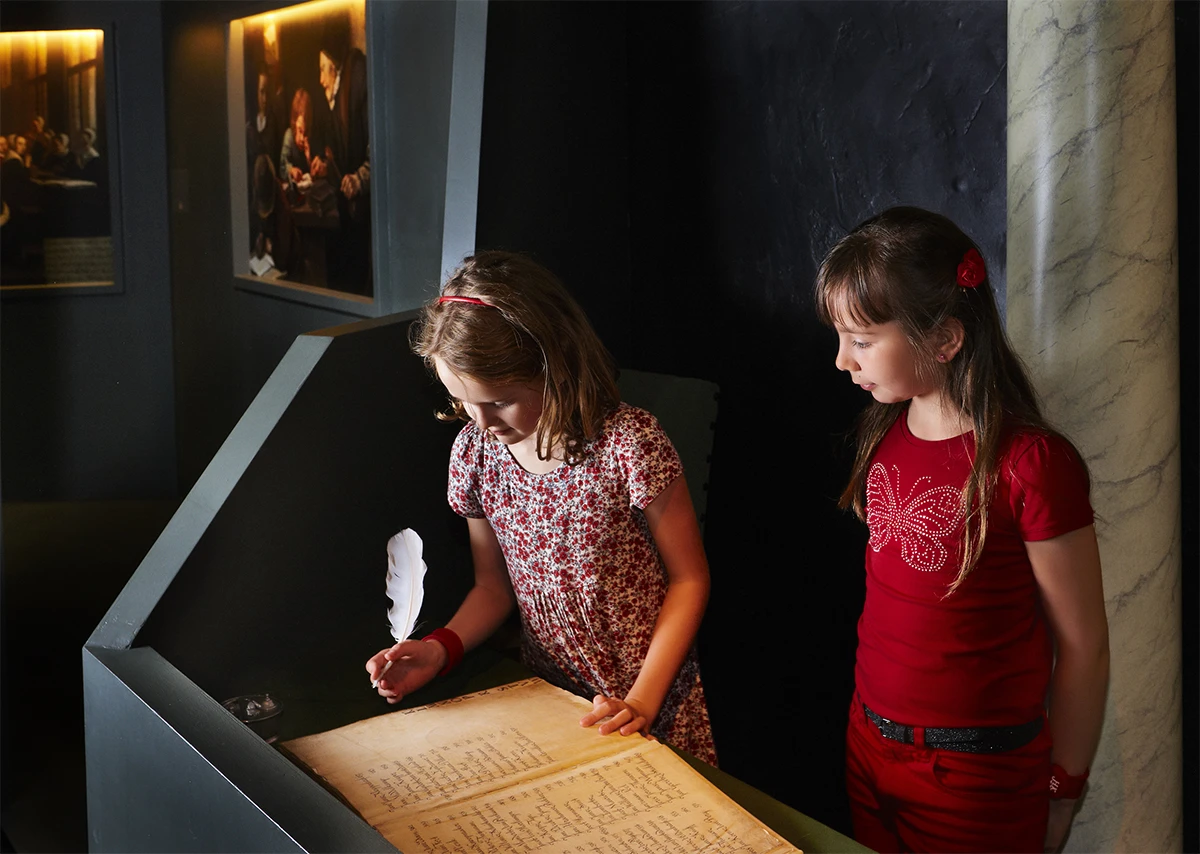
In collaboration with the Rijksmuseum, Studio Daniel Ament developed the curriculum-replacing program You & the Dutch Golden Age: an educational installation in which history is not simply told, but actively explored.
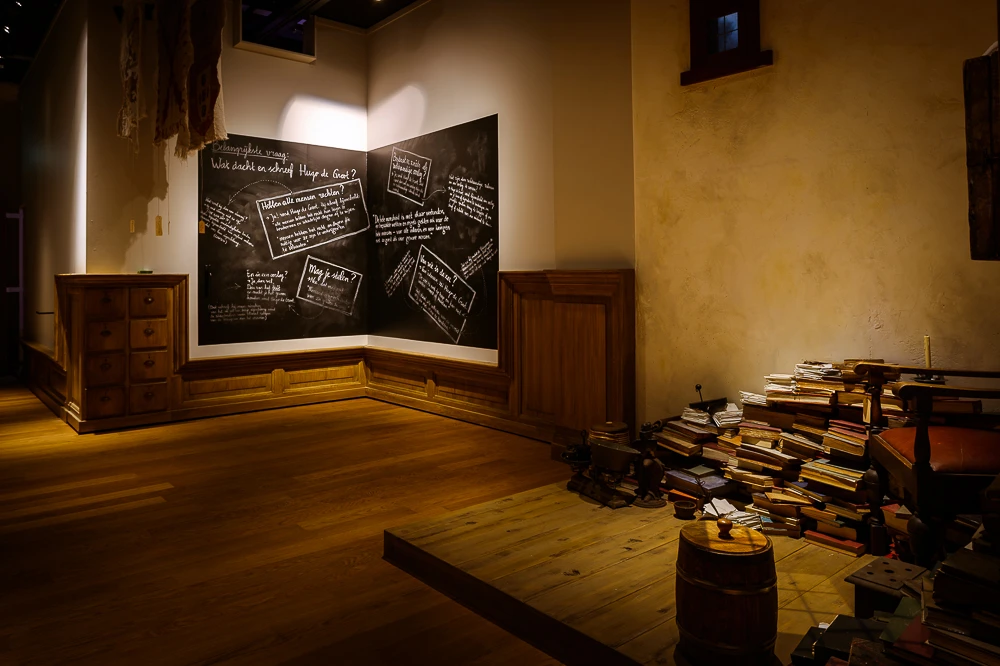
During the development of the spatial concept, we created a fictional narrative: during the renovation, when walls were demolished, a so-called secret society was discovered.
The installation approaches the Dutch Golden Age as a layered journey of discovery. Students are not spectators, but participants. By stepping into the roles of various historical figures, they reconstruct the period from multiple perspectives.
They encounter Rembrandt van Rijn and, as it were, step inside his mind: seeing through his eyes and hearing through his ears. In this way, they experience dramatic moments from his life up close, such as the birth of his son, the death of his wife, and the creation of The Night Watch. They relive Hugo Grotius’s escape in the book chest and experience the hardships of the Behouden Huys during the expedition to Nova Zembla.
Without realizing it, the students ultimately arrive at a hidden 17th-century theatre that emerges from the wall, where they perform stories for one another—half on stage, while the other half operates the theatre technology.
Scenography, lighting, sound, movement, animatronics, and interactive elements were integrally designed to elevate the educational program into a spatial experience. Museum objects functioned not as illustrations, but as anchor points. By linking physical experience with critical reflection, the result is a history lesson that combines analysis and imagination.
From concept development to spatial execution, the project was realized in-house, with content, dramaturgy, and technology designed as one cohesive system.
Award
On March 27, 2014, the educational program You & the Golden Age won the Best Practice Award, as well as the NOT innovation awards, both public and jury prizes.
Set Design Concept
A hidden space
Opening: April 9, 2014
Exhibition Concept
In collaboration with the Rijksmuseum, Studio Daniel Ament developed the curriculum-replacing program You & the Dutch Golden Age: an educational installation in which history is not simply told, but actively explored.
During the development of the spatial concept, we created a fictional narrative: during the renovation, when walls were demolished, a so-called secret society was discovered.
The installation approaches the Dutch Golden Age as a layered journey of discovery. Students are not spectators, but participants. By stepping into the roles of various historical figures, they reconstruct the period from multiple perspectives.
They encounter Rembrandt van Rijn and, as it were, step inside his mind: seeing through his eyes and hearing through his ears. In this way, they experience dramatic moments from his life up close, such as the birth of his son, the death of his wife, and the creation of The Night Watch. They relive Hugo Grotius’s escape in the book chest and experience the hardships of the Behouden Huys during the expedition to Nova Zembla.
Without realizing it, the students ultimately arrive at a hidden 17th-century theatre that emerges from the wall, where they perform stories for one another—half on stage, while the other half operates the theatre technology.
Scenography, lighting, sound, movement, animatronics, and interactive elements were integrally designed to elevate the educational program into a spatial experience. Museum objects functioned not as illustrations, but as anchor points. By linking physical experience with critical reflection, the result is a history lesson that combines analysis and imagination.
From concept development to spatial execution, the project was realized in-house, with content, dramaturgy, and technology designed as one cohesive system.
Award
On March 27, 2014, the educational program You & the Golden Age won the Best Practice Award, as well as the NOT innovation awards, both public and jury prizes.
Set Design Concept
A hidden space
Opening: April 9, 2014




Opening
June 15, 2011
Exhibition Concept
The Little Orphanage was a children’s presentation at the Amsterdam Museum, specially created for families with children aged 4 and up, which brings life in the 17th-century Civic Orphanage to life in an exciting way.
Scenario
The visitors report to the doorman, but he is not there for a moment. While they wait for him, they are whispered to through the cracks in the floor above them. It is Jurriaan, a little orphan boy. He has a secret and a problem and asks the visitors to help him. To do so, they must sneak inside before the doorman returns. Jurriaan completes carpentry training and may end up working at the VOC shipyard if he does not receive adoptive parents, but he cannot believe that his parents might no longer exist. He has all sorts of clues to this effect and asks the visitor to help search in areas of the orphanage where he is not allowed to go. How does this end?
Script
The visitors must set out unseen, so hold your breath and be completely silent. With a special token on a wristband (RFID tag), the visitors bring objects to life by whispering, learn about life in the orphanage and the customs of the past, and receive hints, answers, and instructions from the objects on an individual basis. A complex show-control system runs that precisely tracks what an individual visitor already knows and determines, per individual, which information the visitor will hear at the next whispering object that is activated. In this way, the visitor becomes part of the story on a dramaturgical level. For the very youngest visitors, there are all kinds of crawl-throughs and sneak-throughs where they discover hidden (stuffed) animals in a fabulous setting, end up behind paintings in walls and cupboards, and can secretly spy on each other, while children aged 7 and up go on an adventure with the orphan boy Jurriaan to find his parents.
Review / Article
“In a tasteful decor designed with much love and an eye for detail, the small sub-stories in the thematically arranged discovery corners, together with small puzzles, form the puzzle pieces for the big story.” — Jury Report Golden Heron Awards 2012
Award
Nomination Golden Heron 2012 for meticulousness and creativity on a small budget
Decor Concept
Fragments of the Past
Opening
June 15, 2011
Exhibition Concept
The Little Orphanage was a children’s presentation at the Amsterdam Museum, specially created for families with children aged 4 and up, which brings life in the 17th-century Civic Orphanage to life in an exciting way.
Scenario
The visitors report to the doorman, but he is not there for a moment. While they wait for him, they are whispered to through the cracks in the floor above them. It is Jurriaan, a little orphan boy. He has a secret and a problem and asks the visitors to help him. To do so, they must sneak inside before the doorman returns. Jurriaan completes carpentry training and may end up working at the VOC shipyard if he does not receive adoptive parents, but he cannot believe that his parents might no longer exist. He has all sorts of clues to this effect and asks the visitor to help search in areas of the orphanage where he is not allowed to go. How does this end?
Script
The visitors must set out unseen, so hold your breath and be completely silent. With a special token on a wristband (RFID tag), the visitors bring objects to life by whispering, learn about life in the orphanage and the customs of the past, and receive hints, answers, and instructions from the objects on an individual basis. A complex show-control system runs that precisely tracks what an individual visitor already knows and determines, per individual, which information the visitor will hear at the next whispering object that is activated. In this way, the visitor becomes part of the story on a dramaturgical level. For the very youngest visitors, there are all kinds of crawl-throughs and sneak-throughs where they discover hidden (stuffed) animals in a fabulous setting, end up behind paintings in walls and cupboards, and can secretly spy on each other, while children aged 7 and up go on an adventure with the orphan boy Jurriaan to find his parents.
Review / Article
“In a tasteful decor designed with much love and an eye for detail, the small sub-stories in the thematically arranged discovery corners, together with small puzzles, form the puzzle pieces for the big story.” — Jury Report Golden Heron Awards 2012
Award
Nomination Golden Heron 2012 for meticulousness and creativity on a small budget
Decor Concept
Fragments of the Past


Opening
October 9, 2009
Exhibition Concept
For the former Tropenmuseum (now Wereldmuseum), Studio Daniel Ament, together with the Tropenmuseum Junior team, developed The Qi of China: an interactive exhibition in which culture is presented as a living practice.
At its core is the concept of Qi, the energy that, according to Chinese tradition, flows through everything and everyone.
Through participation, abstract philosophical concepts are made physically tangible for school groups (ages 6–13) and families across three different programs.
Nothing in this exhibition is behind glass. Objects and spaces are part of an active parcours in which visitors act, move, and create.
Spaces such as a tea house, calligraphy studio, umbrella factory, traditional Chinese medicine room, afterlife space, Feng Shui office, restaurant kitchen, karaoke room, and Kung Fu city parcours function as scenographic environments where cultural practices are experienced.
Visitors engage in activities such as tai chi, kung fu, Feng Shui design, calligraphy, karaoke, cooking, and healing—each contributing to the flow of Qi.
Facilitators act not only as guides, but as performers within the spatial narrative.
A key element was the integration of media and participation: the so-called Qi jump was filmed and linked to an online game, extending the experience beyond the physical exhibition.
Set Design
Air of concrete.
Opening
October 9, 2009
Exhibition Concept
For the former Tropenmuseum (now Wereldmuseum), Studio Daniel Ament, together with the Tropenmuseum Junior team, developed The Qi of China: an interactive exhibition in which culture is presented as a living practice.
At its core is the concept of Qi, the energy that, according to Chinese tradition, flows through everything and everyone.
Through participation, abstract philosophical concepts are made physically tangible for school groups (ages 6–13) and families across three different programs.
Nothing in this exhibition is behind glass. Objects and spaces are part of an active parcours in which visitors act, move, and create.
Spaces such as a tea house, calligraphy studio, umbrella factory, traditional Chinese medicine room, afterlife space, Feng Shui office, restaurant kitchen, karaoke room, and Kung Fu city parcours function as scenographic environments where cultural practices are experienced.
Visitors engage in activities such as tai chi, kung fu, Feng Shui design, calligraphy, karaoke, cooking, and healing—each contributing to the flow of Qi.
Facilitators act not only as guides, but as performers within the spatial narrative.
A key element was the integration of media and participation: the so-called Qi jump was filmed and linked to an online game, extending the experience beyond the physical exhibition.
Set Design
Air of concrete.


Opening
November 15, 2008
Exhibition Concept
The Marco Polo in Amsterdam project by the Dutch Opera, led by Anthony Heidweiller, brings art into the community through mini-operas and choir projects. With a focus on the city’s diversity and intercultural connections, activities ranged from music performances and cultural encounters to a Silk Route Bus featuring opera music and documentary screenings.
Studio Daniel Ament was loaned a city bus, with the condition that it had to be returned in its exact original form post-project. They transformed it into a reflective vehicle that mirrored its surroundings, blending in like a chameleon, and capturing the attention of passersby. Inside, visitors were welcomed with coffee and invited to explore mini-documentaries through view boxes, showcasing projects where various schools collaborated intensely with international musicians from key Silk Route regions. At the back of the bus, a small cinema allowed visitors to experience the full documentary of the performances.
Set Design Concept
Community art: connecting art within the city.
Award
Winner of the National Events Prize for Most Innovative Event in 2008.
Opening
November 15, 2008
Exhibition Concept
The Marco Polo in Amsterdam project by the Dutch Opera, led by Anthony Heidweiller, brings art into the community through mini-operas and choir projects. With a focus on the city’s diversity and intercultural connections, activities ranged from music performances and cultural encounters to a Silk Route Bus featuring opera music and documentary screenings.
Studio Daniel Ament was loaned a city bus, with the condition that it had to be returned in its exact original form post-project. They transformed it into a reflective vehicle that mirrored its surroundings, blending in like a chameleon, and capturing the attention of passersby. Inside, visitors were welcomed with coffee and invited to explore mini-documentaries through view boxes, showcasing projects where various schools collaborated intensely with international musicians from key Silk Route regions. At the back of the bus, a small cinema allowed visitors to experience the full documentary of the performances.
Set Design Concept
Community art: connecting art within the city.
Award
Winner of the National Events Prize for Most Innovative Event in 2008.


Opening
November 15, 2008
Exhibition Concept
The Marco Polo in Amsterdam project by the Dutch Opera, led by Anthony Heidweiller, brings art into the community through mini-operas and choir projects. The focus is on the city’s diversity and intercultural connections. From the Zeedijk to the Silk Route, activities include music performances, cultural encounters, a Silk Route bus featuring opera music and documentary screenings, and a Song Pillar installed at various semi-public locations. Passersby are invited to spontaneously sing, record, and become part of the “vocal map” of the Netherlands. Studio Daniel Ament translated this challenge into a functional installation, designing the Song Pillar to be intuitive and inviting for these locations, encouraging participants to sing wholeheartedly while subtly experiencing that their voice became quieter to the surrounding area as they approached the pillar.
Set Design Concept
Community art: connecting art within the city.
Award
Winner of the National Events Prize for Most Innovative Event in 2005.
Opening
November 15, 2008
Exhibition Concept
The Marco Polo in Amsterdam project by the Dutch Opera, led by Anthony Heidweiller, brings art into the community through mini-operas and choir projects. The focus is on the city’s diversity and intercultural connections. From the Zeedijk to the Silk Route, activities include music performances, cultural encounters, a Silk Route bus featuring opera music and documentary screenings, and a Song Pillar installed at various semi-public locations. Passersby are invited to spontaneously sing, record, and become part of the “vocal map” of the Netherlands. Studio Daniel Ament translated this challenge into a functional installation, designing the Song Pillar to be intuitive and inviting for these locations, encouraging participants to sing wholeheartedly while subtly experiencing that their voice became quieter to the surrounding area as they approached the pillar.
Set Design Concept
Community art: connecting art within the city.
Award
Winner of the National Events Prize for Most Innovative Event in 2005.


Opening
April 1, 2008
Exhibition Concept
An exhibition full of stories about love, trickery, and courage. This is a true family exhibition. Young and old can listen to boundless stories of love, trickery, and courage.
The three universal themes of love, trickery, and courage are central in the interactive exhibition Journey of Stories. Discover more about the cunning animals Kantjil and Anansi, or put on the headphones and listen to the story of the brave Hanuman and the beautiful Sita. We hope you take these stories with you and pass them on.
Set Design
Interactive and immersive.
Opening
April 1, 2008
Exhibition Concept
An exhibition full of stories about love, trickery, and courage. This is a true family exhibition. Young and old can listen to boundless stories of love, trickery, and courage.
The three universal themes of love, trickery, and courage are central in the interactive exhibition Journey of Stories. Discover more about the cunning animals Kantjil and Anansi, or put on the headphones and listen to the story of the brave Hanuman and the beautiful Sita. We hope you take these stories with you and pass them on.
Set Design
Interactive and immersive.


Opening
September 28, 2006
Exhibition Concept
For the former Tropenmuseum (now Wereldmuseum), Studio Daniel Ament, together with the Tropenmuseum Junior team, developed The Qi of China: an interactive exhibition in which culture is presented as a living practice.
At its core is the concept of Qi, the energy that, according to Chinese tradition, flows through everything and everyone.
Through participation, abstract philosophical concepts are made physically tangible for school groups (ages 6–13) and families across three different programs.
Nothing in this exhibition is behind glass. Objects and spaces are part of an active parcours in which visitors act, move, and create.
Spaces such as a tea house, calligraphy studio, umbrella factory, traditional Chinese medicine room, afterlife space, Feng Shui office, restaurant kitchen, karaoke room, and Kung Fu city parcours function as scenographic environments where cultural practices are experienced.
Visitors engage in activities such as tai chi, kung fu, Feng Shui design, calligraphy, karaoke, cooking, and healing—each contributing to the flow of Qi.
Facilitators act not only as guides, but as performers within the spatial narrative.
A key element was the integration of media and participation: the so-called Qi jump was filmed and linked to an online game, extending the experience beyond the physical exhibition.
Set Design
Interweaving of formal and informal economy
Additional Information
The exhibition is accompanied by the book Dancing on One Leg, which takes readers on a journey to find a star in the city. The book is filled with photographs and offers a deeper look into life in Bombay.
Opening
September 28, 2006
Exhibition Concept
For the former Tropenmuseum (now Wereldmuseum), Studio Daniel Ament, together with the Tropenmuseum Junior team, developed The Qi of China: an interactive exhibition in which culture is presented as a living practice.
At its core is the concept of Qi, the energy that, according to Chinese tradition, flows through everything and everyone.
Through participation, abstract philosophical concepts are made physically tangible for school groups (ages 6–13) and families across three different programs.
Nothing in this exhibition is behind glass. Objects and spaces are part of an active parcours in which visitors act, move, and create.
Spaces such as a tea house, calligraphy studio, umbrella factory, traditional Chinese medicine room, afterlife space, Feng Shui office, restaurant kitchen, karaoke room, and Kung Fu city parcours function as scenographic environments where cultural practices are experienced.
Visitors engage in activities such as tai chi, kung fu, Feng Shui design, calligraphy, karaoke, cooking, and healing—each contributing to the flow of Qi.
Facilitators act not only as guides, but as performers within the spatial narrative.
A key element was the integration of media and participation: the so-called Qi jump was filmed and linked to an online game, extending the experience beyond the physical exhibition.
Set Design
Interweaving of formal and informal economy
Additional Information
The exhibition is accompanied by the book Dancing on One Leg, which takes readers on a journey to find a star in the city. The book is filled with photographs and offers a deeper look into life in Bombay.


Opening
6 May 2006
Exhibition Concept
Layla & Majnun tells the story of Qays, also known as Majnun, and his unattainable love for Layla al-Aamiriya. After her father refuses their marriage, Majnun wanders the desert, writing poems out of love sickness. The exhibition employs interactive technology: when a visitor takes a seat, the storyteller appears on a screen, with relevant parts of the story highlighted visually. The narration is delivered through speakers near the visitor’s ears from the seat itself, ensuring that the sound remains localized, keeping the exhibition space free from repetitive storytelling noise.
Set Design Concept
Interactive storytelling
Opening
6 May 2006
Exhibition Concept
Layla & Majnun tells the story of Qays, also known as Majnun, and his unattainable love for Layla al-Aamiriya. After her father refuses their marriage, Majnun wanders the desert, writing poems out of love sickness. The exhibition employs interactive technology: when a visitor takes a seat, the storyteller appears on a screen, with relevant parts of the story highlighted visually. The narration is delivered through speakers near the visitor’s ears from the seat itself, ensuring that the sound remains localized, keeping the exhibition space free from repetitive storytelling noise.
Set Design Concept
Interactive storytelling
Opening
2006-02-15
Exhibition Concept
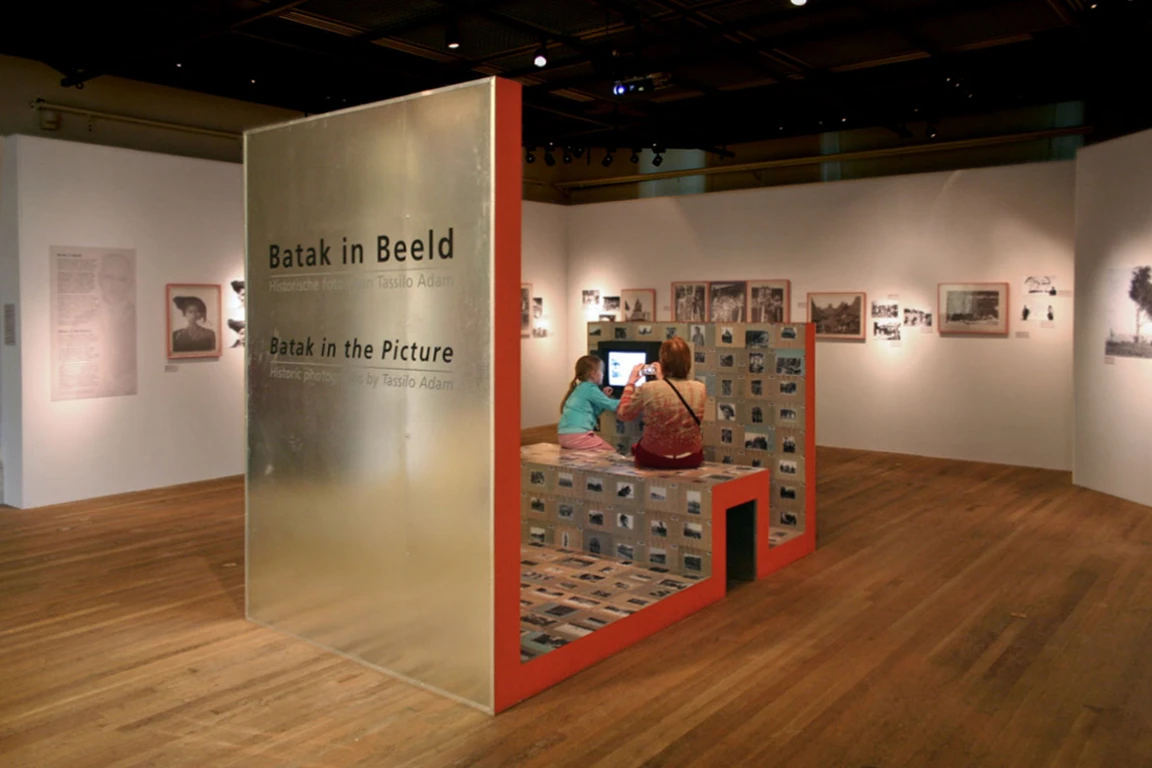
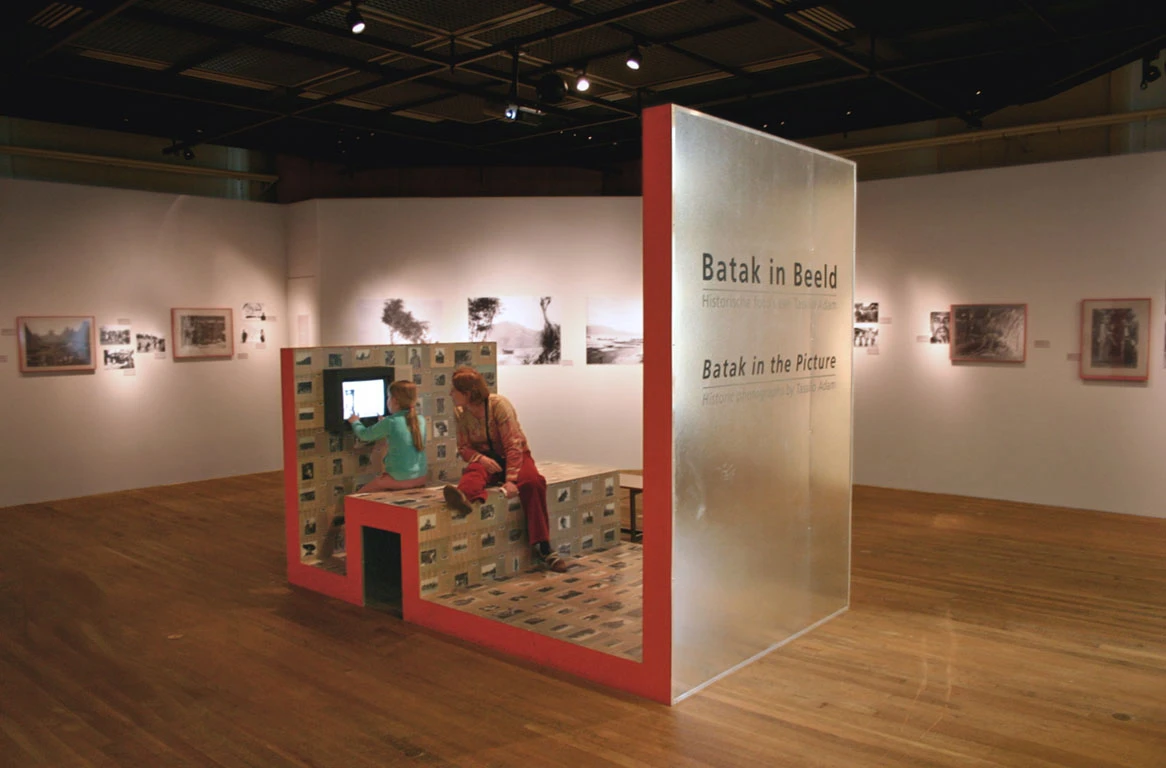
The photo exhibition “Batak in Focus” highlights the work of Tasilo Adam, a photographer renowned for documenting the Batak culture. Located in the Tropenmuseum, the exhibition provides a unique glimpse into the traditions, landscapes, and daily practices of the Batak community. The exhibition design emphasizes the visual narrative, bringing the historical photographs to life through thoughtful presentation.
Set Design
Historical photography in a contemporary design.
Opening
2006-02-15
Exhibition Concept
The photo exhibition “Batak in Focus” highlights the work of Tasilo Adam, a photographer renowned for documenting the Batak culture. Located in the Tropenmuseum, the exhibition provides a unique glimpse into the traditions, landscapes, and daily practices of the Batak community. The exhibition design emphasizes the visual narrative, bringing the historical photographs to life through thoughtful presentation.
Set Design
Historical photography in a contemporary design.


Opening
15 February 2006
Exhibition Concept
An exhibition about the influences of Western culture on the Batak community of Sumatra. Presented at the Tropenmuseum (KIT), this exhibition highlights the rich textile culture of the Batak people living in the region around Lake Toba in North Sumatra, Indonesia.
Set Design
Connection between culture and textiles.
Curator
Sandra Niessen, PhD (Leiden University, 1985)
Background
Sandra Niessen is a Canadian/Dutch cultural anthropologist. Her fieldwork focuses primarily on the clothing culture of the Batak people and the influence of Western culture on their traditions and practices.
Opening
15 February 2006
Exhibition Concept
An exhibition about the influences of Western culture on the Batak community of Sumatra. Presented at the Tropenmuseum (KIT), this exhibition highlights the rich textile culture of the Batak people living in the region around Lake Toba in North Sumatra, Indonesia.
Set Design
Connection between culture and textiles.
Curator
Sandra Niessen, PhD (Leiden University, 1985)
Background
Sandra Niessen is a Canadian/Dutch cultural anthropologist. Her fieldwork focuses primarily on the clothing culture of the Batak people and the influence of Western culture on their traditions and practices.


Opening
2005-11-09
Exhibition Concept
The “Ark of Hope” is a wooden chest created in 2001 by designer and painter Sally Linder to house the Earth Charter document. On its five panels are a series of paintings depicting artistic representations of Air, Water, Fire, Spirit, and Earth.
In the Kartini wing of the Wereldmuseum Amsterdam, Studio Daniel Ament designed a seating, exhibition, and activity corner within the pre-existing spatial concept based on the ‘golden grid,’ with “The Ark of Hope” as the central focus. This space invites visitors to engage with the message of the Earth Charter and delve into themes of sustainability and connection.
Opening
2005-11-09
Exhibition Concept
The “Ark of Hope” is a wooden chest created in 2001 by designer and painter Sally Linder to house the Earth Charter document. On its five panels are a series of paintings depicting artistic representations of Air, Water, Fire, Spirit, and Earth.
In the Kartini wing of the Wereldmuseum Amsterdam, Studio Daniel Ament designed a seating, exhibition, and activity corner within the pre-existing spatial concept based on the ‘golden grid,’ with “The Ark of Hope” as the central focus. This space invites visitors to engage with the message of the Earth Charter and delve into themes of sustainability and connection.


Opening
2005-05-15
Exhibition Concept
The exhibition “Kids at Iran” is part of a cultural exchange project between children from Amsterdam and Tehran, organized by Tropenmuseum Junior. The project was conducted via the internet, and the results of the collaborative efforts were showcased in the museum.
Through a website with video calling, children from Iran and the Netherlands gained insight into each other’s lives. Over two and a half years, kids from Amsterdam and Tehran wrote, chatted, and interacted via webcam. They asked each other questions, shared photos and videos about their lives, and expressed their ideas on everyday life themes through animations, paintings, and sculptures. These creative outputs were exhibited in the museum showcases.
Set Design
Cultural exchange through children’s art.
Opening
2005-05-15
Exhibition Concept
The exhibition “Kids at Iran” is part of a cultural exchange project between children from Amsterdam and Tehran, organized by Tropenmuseum Junior. The project was conducted via the internet, and the results of the collaborative efforts were showcased in the museum.
Through a website with video calling, children from Iran and the Netherlands gained insight into each other’s lives. Over two and a half years, kids from Amsterdam and Tehran wrote, chatted, and interacted via webcam. They asked each other questions, shared photos and videos about their lives, and expressed their ideas on everyday life themes through animations, paintings, and sculptures. These creative outputs were exhibited in the museum showcases.
Set Design
Cultural exchange through children’s art.




Opening
2004-10-21
Exhibition Concept
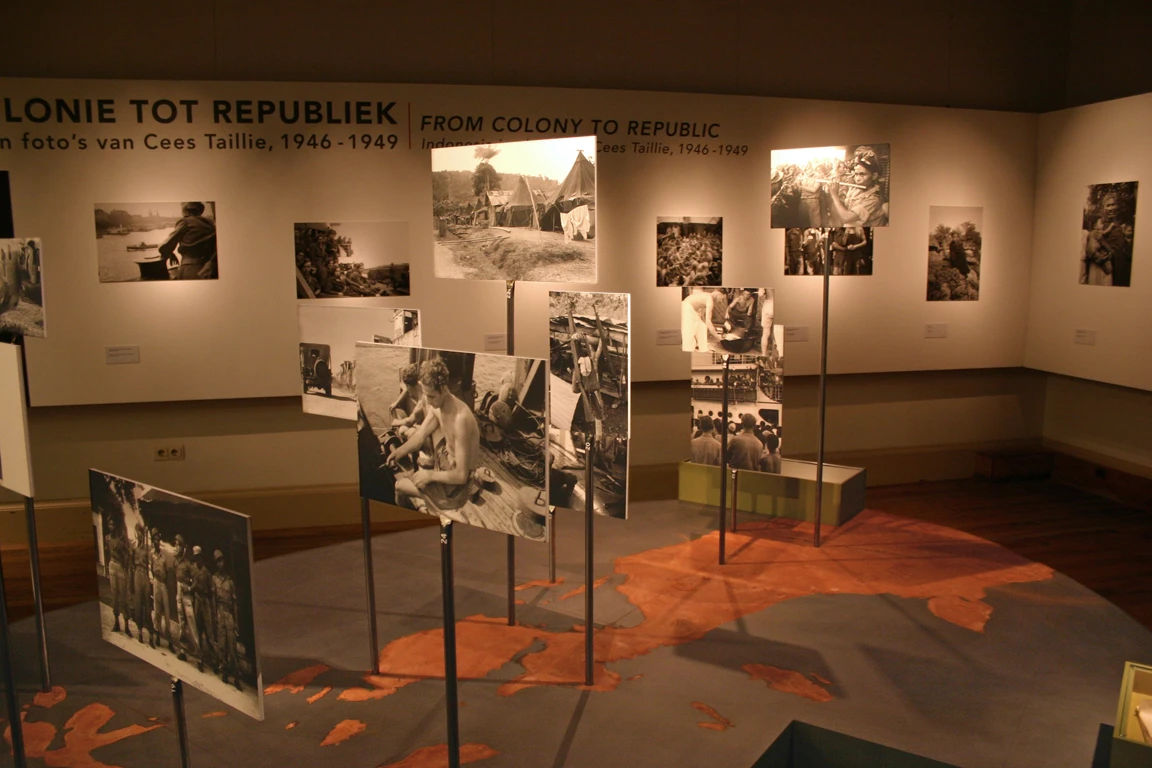
The exhibition “From Colony to Republic” showcases the work of military photographer Tallie, who documented the transition from colony to republic. Hosted at the Tropenmuseum, the photo and object exhibition provides a historical perspective on this transformative period, featuring compelling images that highlight the political, social, and cultural changes of the time. The exhibition design combines visual and tactile elements to bring the complexity of this era to life.
Set Design
Depicting the transition from colony to republic.
Opening
2004-10-21
Exhibition Concept
The exhibition “From Colony to Republic” showcases the work of military photographer Tallie, who documented the transition from colony to republic. Hosted at the Tropenmuseum, the photo and object exhibition provides a historical perspective on this transformative period, featuring compelling images that highlight the political, social, and cultural changes of the time. The exhibition design combines visual and tactile elements to bring the complexity of this era to life.
Set Design
Depicting the transition from colony to republic.


Opening
2004-07-10
Exhibition Concept
The overview exhibition of the Tropenmuseum provides a unique perspective on the museum’s rich and diverse collection. The spatial design and activity development are specially crafted to actively engage visitors with the stories behind the displayed objects. The exhibition combines modern and traditional elements to highlight the cultural and historical significance of the collection.
Set Design
Interaction between space, objects, and visitors.
Opening
2004-07-10
Exhibition Concept
The overview exhibition of the Tropenmuseum provides a unique perspective on the museum’s rich and diverse collection. The spatial design and activity development are specially crafted to actively engage visitors with the stories behind the displayed objects. The exhibition combines modern and traditional elements to highlight the cultural and historical significance of the collection.
Set Design
Interaction between space, objects, and visitors.

Opening
2003
Exhibition Concept
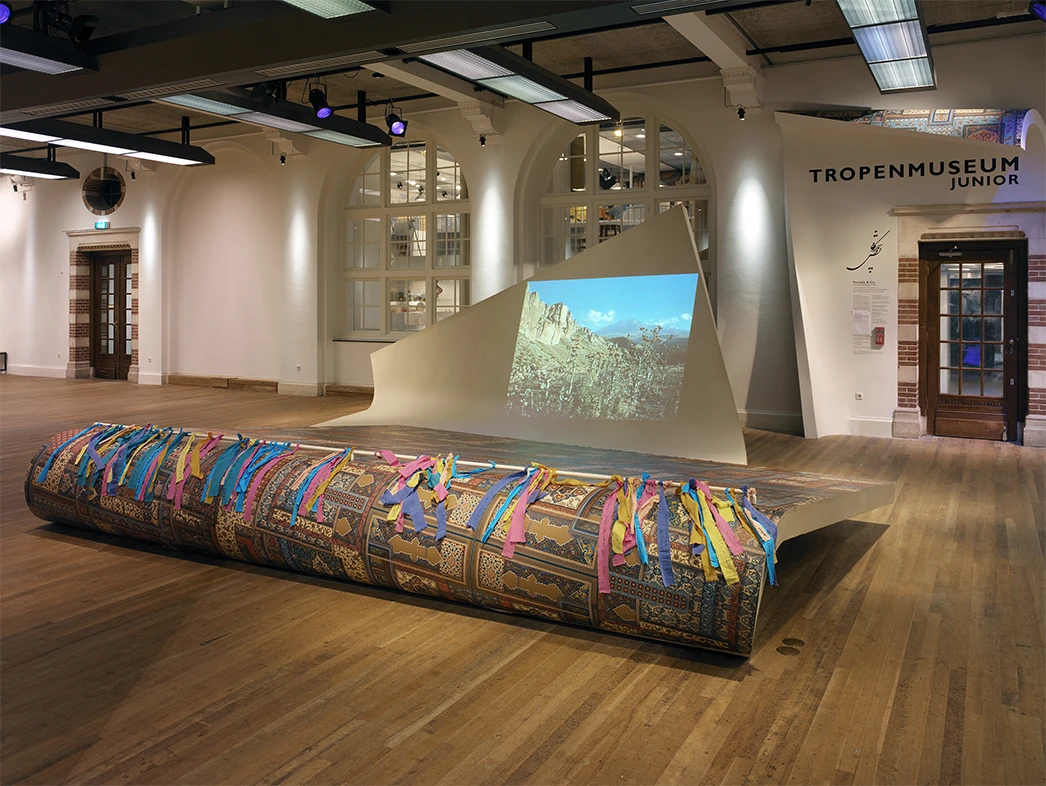
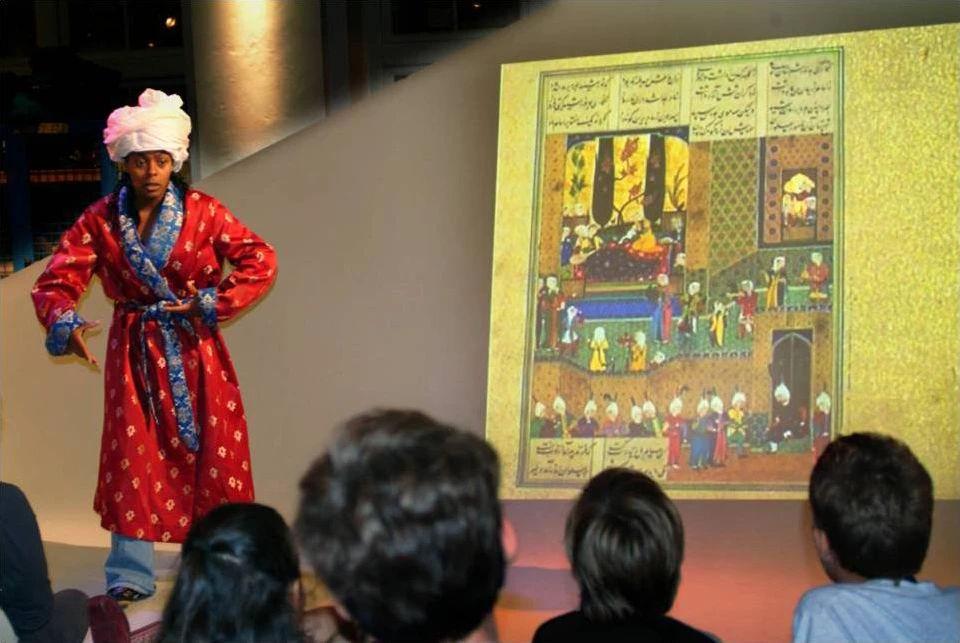
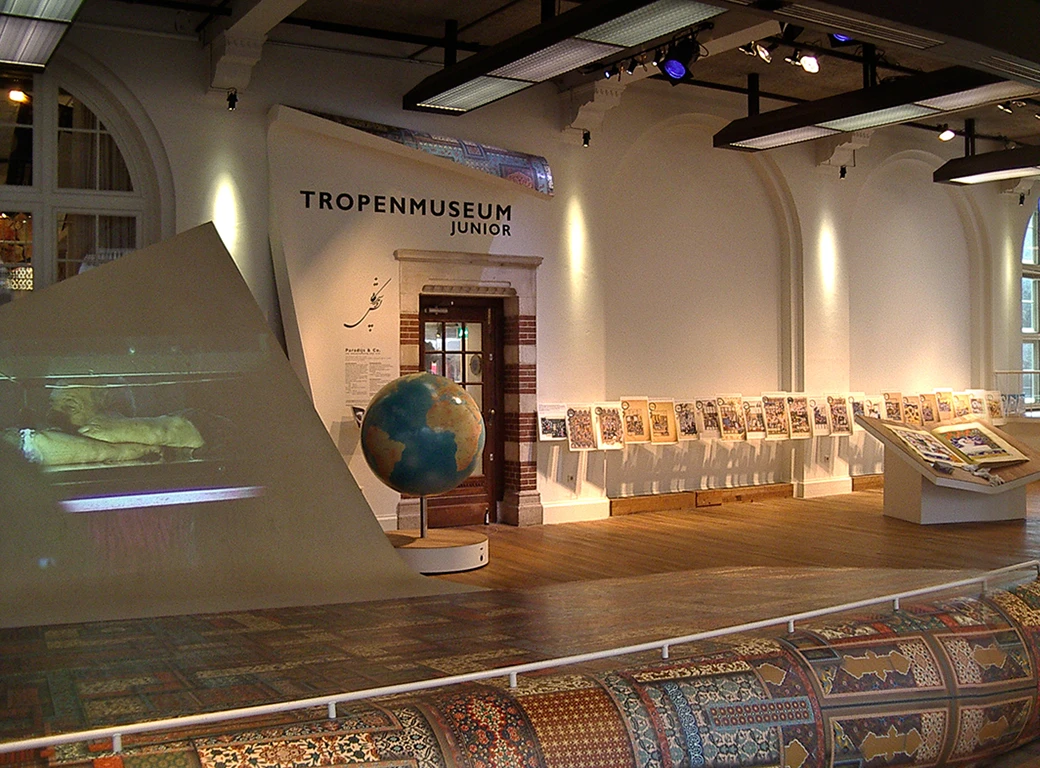
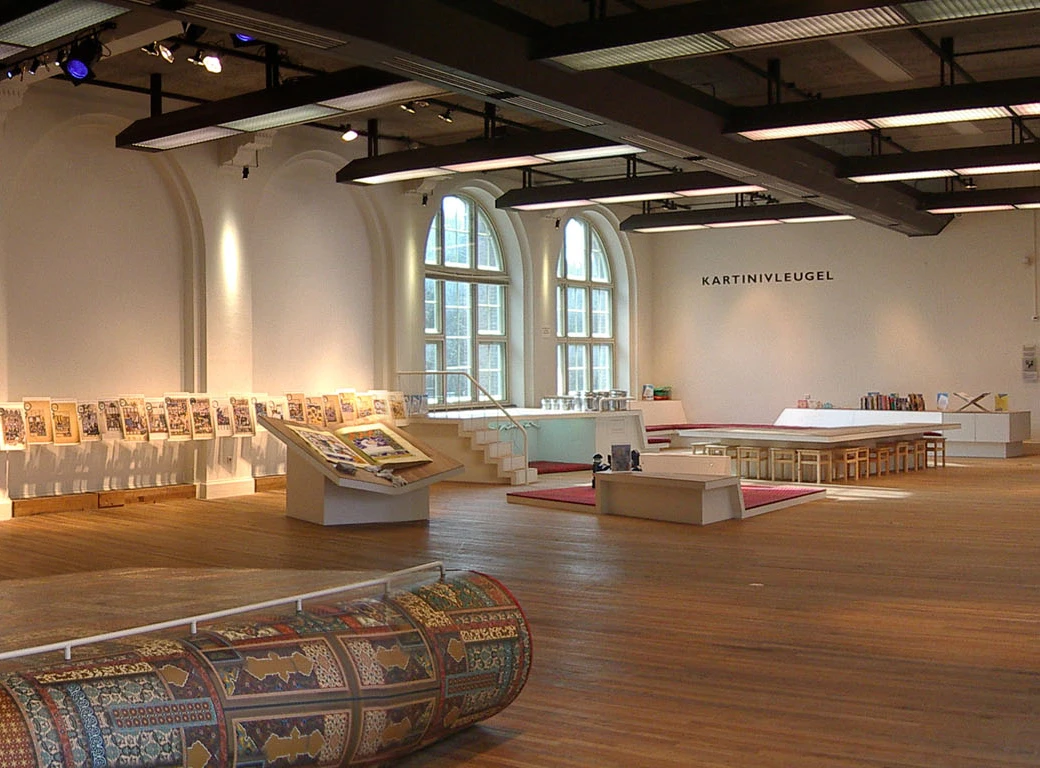
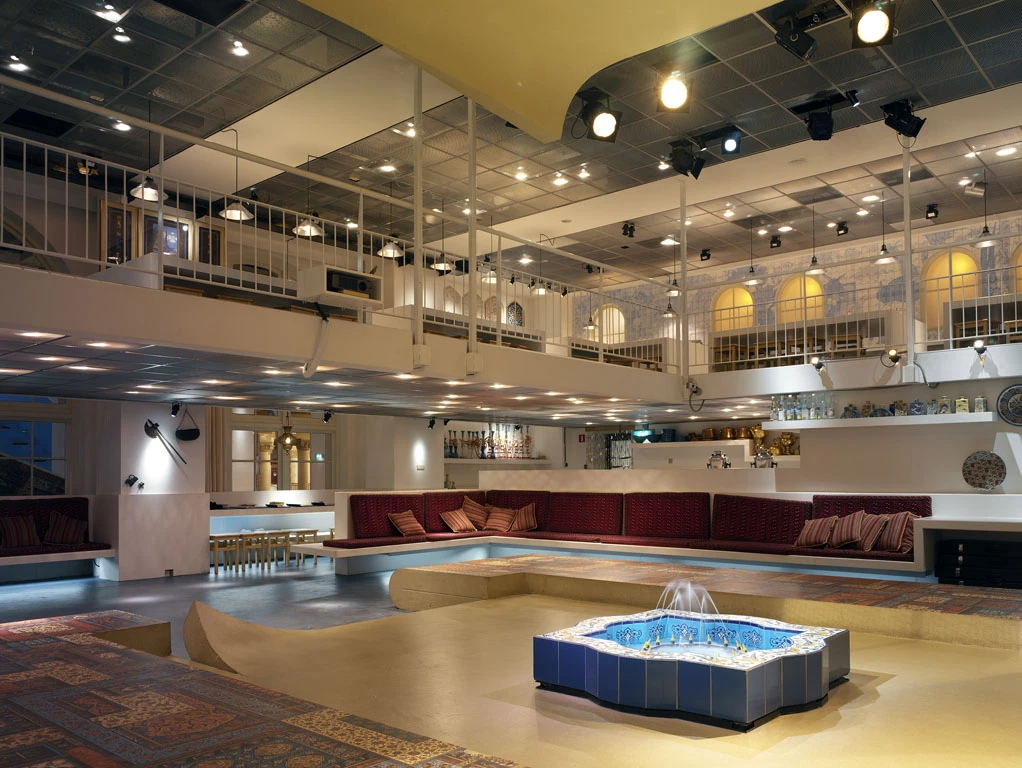
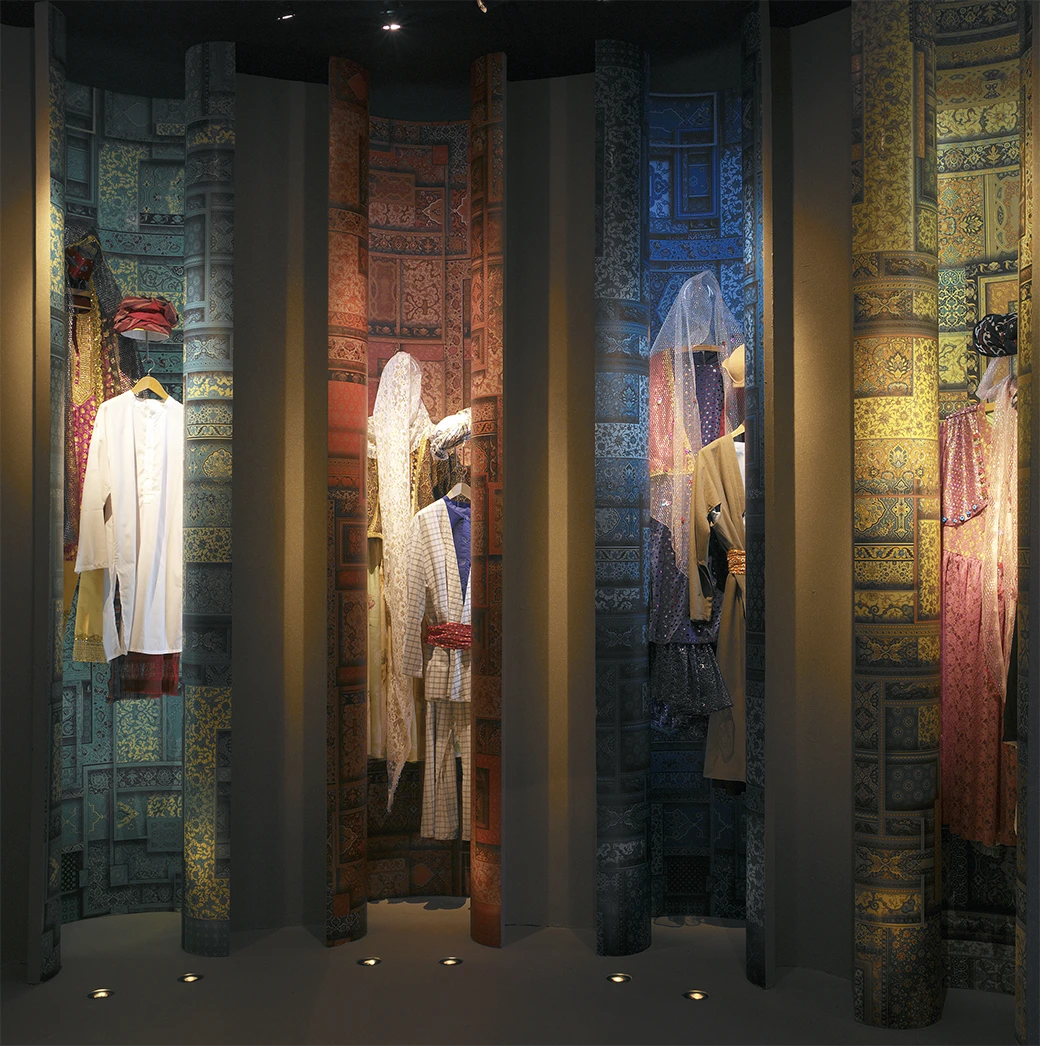
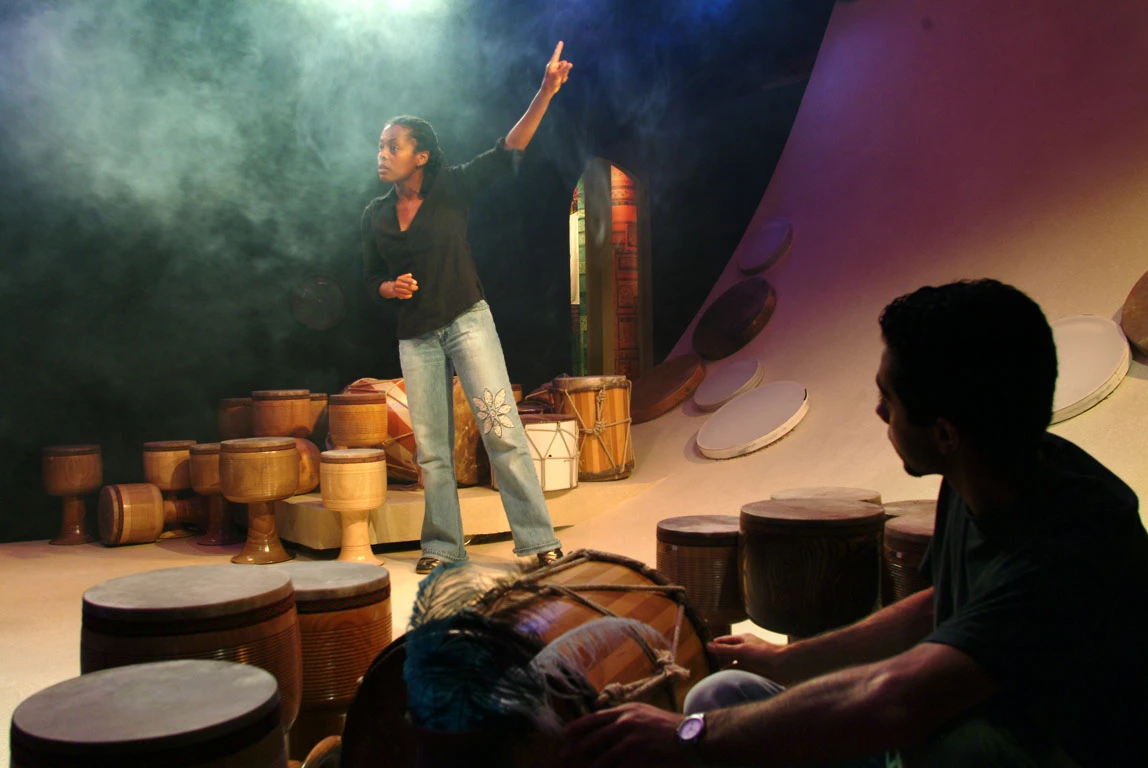
Paradise&Co is an exhibition about Iran, delving deep into history, with pre-Islamic Persia as a major source of inspiration. The seven regions of Iran are highlighted, and the Shahnameh, a poetry collection for kings, provides many of the stories for the exhibition.
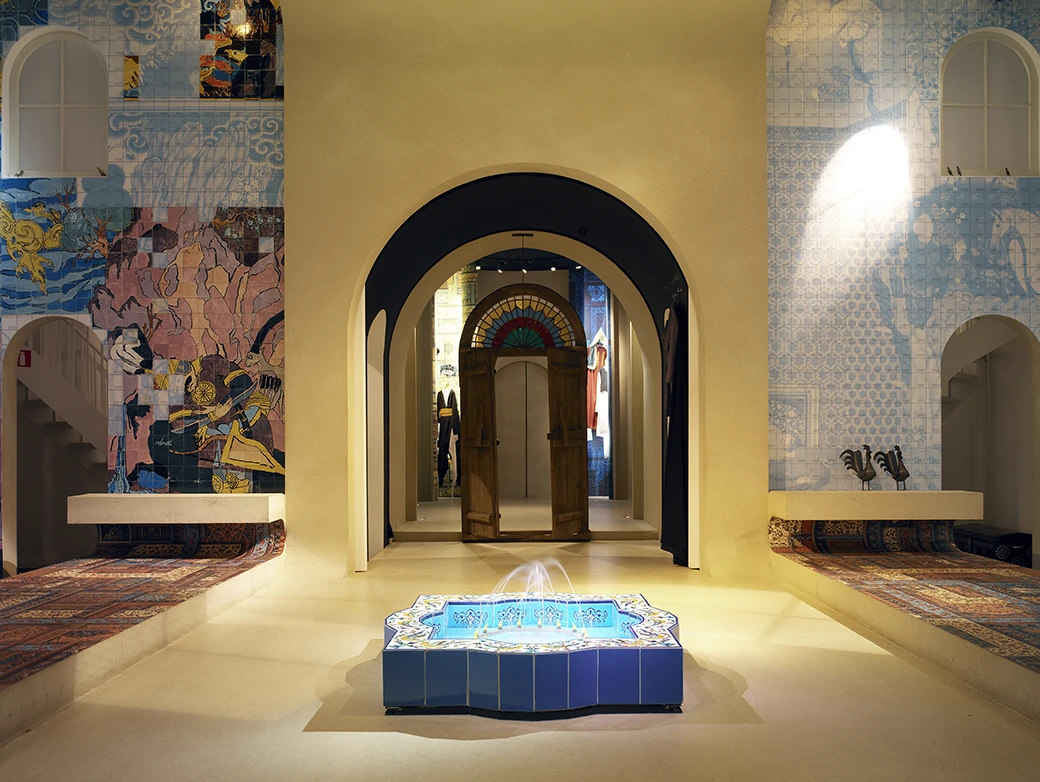
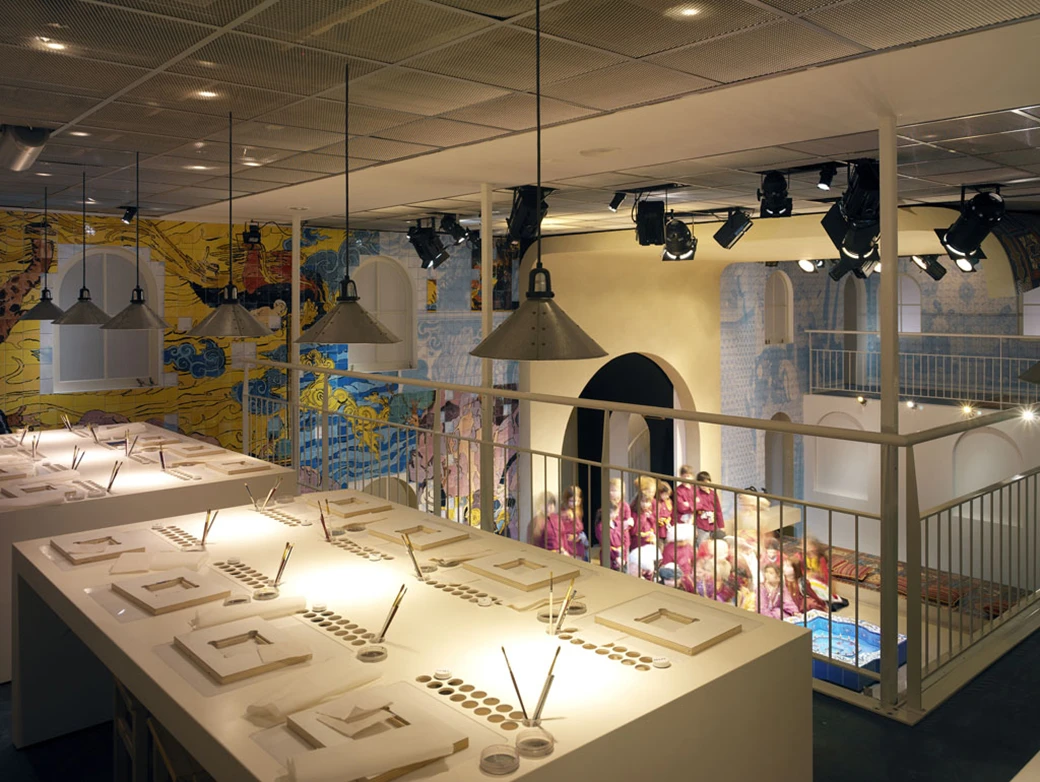
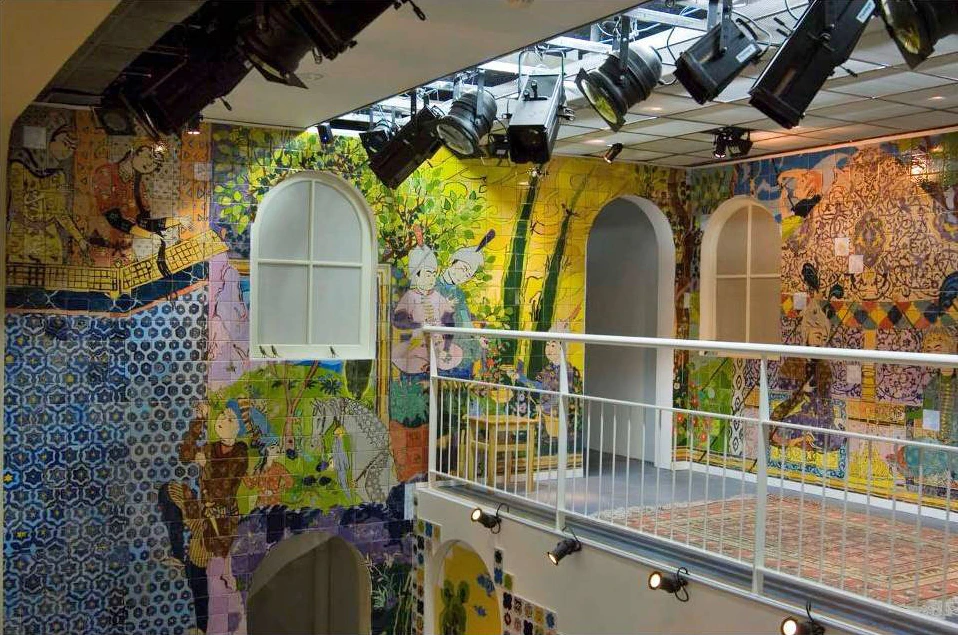
In Amsterdam’s (formerly) Tropenmuseum Junior (now Wereldmuseum Junior), a tile artwork is growing. The museum walls are covered with scenes from the Shahnameh, a thousand-year-old Persian epic by the poet Ferdosi. In faint blue lines, like a pre-printed cross-stitch embroidery pattern, elegant miniatures are blown up to wall size.
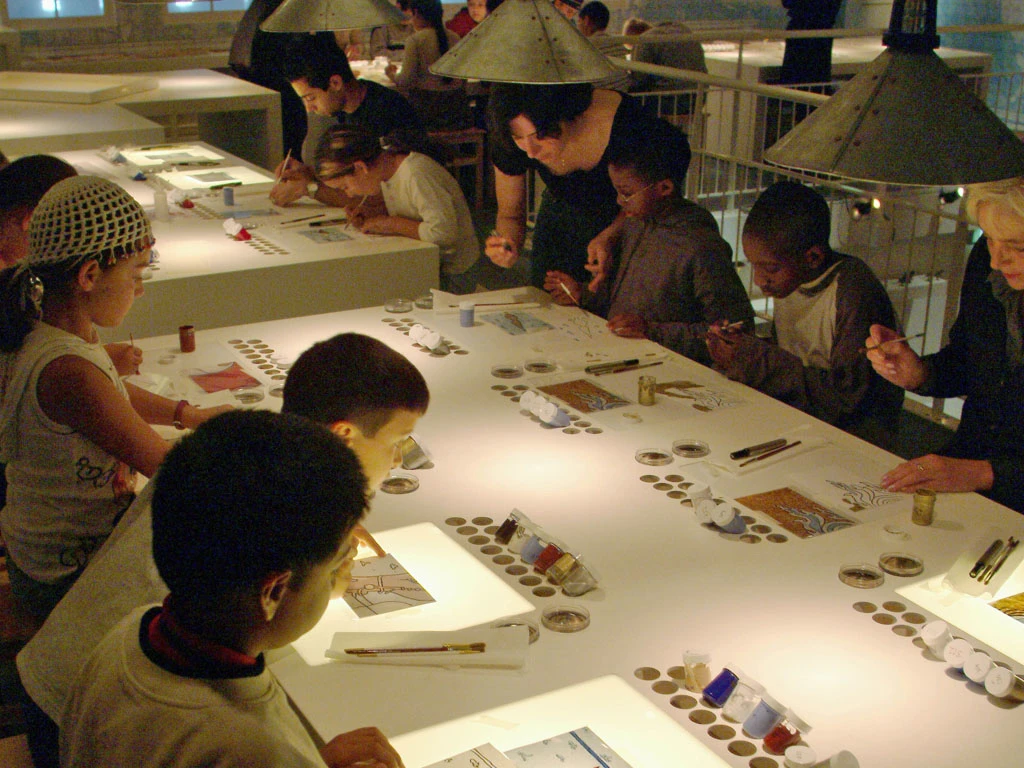
The six thousand tiles are painted by children from all over the Netherlands in the temporary workshop, using pigments and glaze specifically intended for that precise square decimeter. According to the plan, the tiled wall would be completed in 2.5 years, coinciding with the end of the Paradise&Co exhibition.
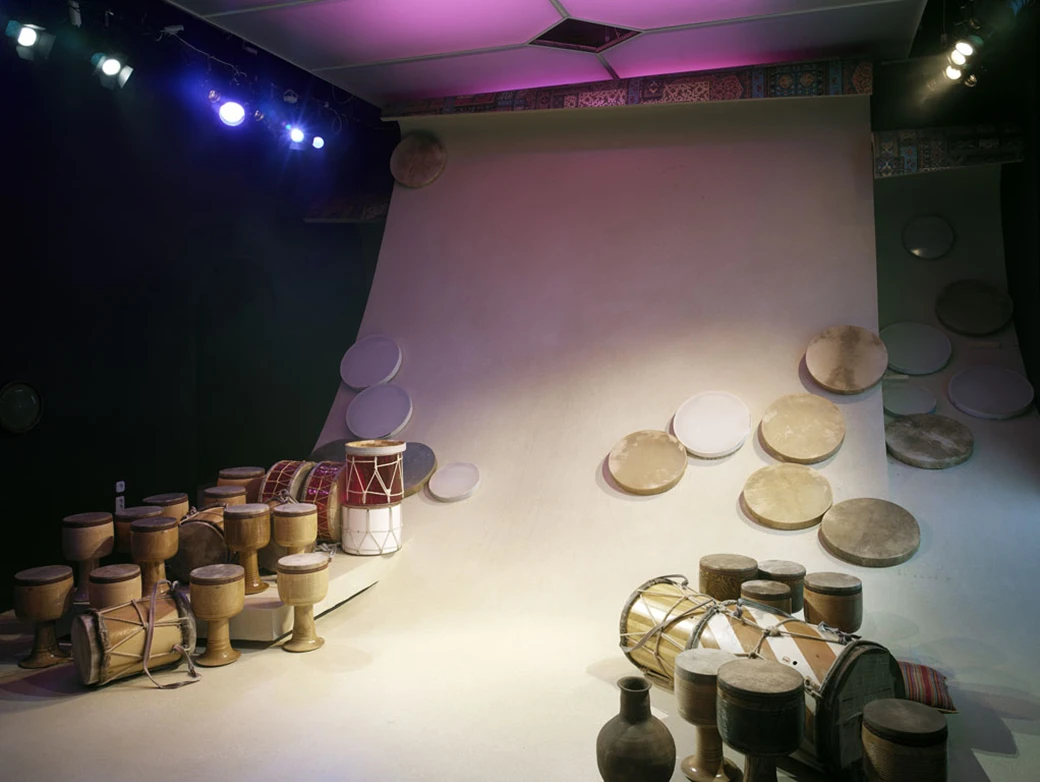
Thousands of children beat drums in awkward rhythms, experienced wearing a veil, baked chickpea cookies in the reconstructed teahouse, practiced calligraphy, listened to stories, and sang a song in Farsi: «Beautiful flower, open up, darling, it’s spring». These activities allowed the children to engage all their senses to learn about Iran.
This aligns with the approach of Tropenmuseum Junior: always searching for «forms where objects, intangible culture, stories, activities, and children can be brought together in the most beautiful way possible».
Set Design
Tile artwork of 6,000 child-glazed tiles.
Opening
2003
Exhibition Concept
Paradise&Co is an exhibition about Iran, delving deep into history, with pre-Islamic Persia as a major source of inspiration. The seven regions of Iran are highlighted, and the Shahnameh, a poetry collection for kings, provides many of the stories for the exhibition.
In Amsterdam’s (formerly) Tropenmuseum Junior (now Wereldmuseum Junior), a tile artwork is growing. The museum walls are covered with scenes from the Shahnameh, a thousand-year-old Persian epic by the poet Ferdosi. In faint blue lines, like a pre-printed cross-stitch embroidery pattern, elegant miniatures are blown up to wall size.
The six thousand tiles are painted by children from all over the Netherlands in the temporary workshop, using pigments and glaze specifically intended for that precise square decimeter. According to the plan, the tiled wall would be completed in 2.5 years, coinciding with the end of the Paradise&Co exhibition.
Thousands of children beat drums in awkward rhythms, experienced wearing a veil, baked chickpea cookies in the reconstructed teahouse, practiced calligraphy, listened to stories, and sang a song in Farsi: «Beautiful flower, open up, darling, it’s spring». These activities allowed the children to engage all their senses to learn about Iran.
This aligns with the approach of Tropenmuseum Junior: always searching for «forms where objects, intangible culture, stories, activities, and children can be brought together in the most beautiful way possible».
Set Design
Tile artwork of 6,000 child-glazed tiles.