


Opening
2020-01-01
Concept
This project is a pioneering work in self-building and sustainability, achieving net-zero energy through the integration of wind, water, and sunlight as natural energy sources. It combines architectural aesthetics with technical innovations, such as a greenhouse with plant filters for air purification, rainwater management, an energy-generating facade, and the use of varying solar angles to heat the building in winter and cool it in summer.
As the gap between nature and urban dwellers grows, this project introduces innovative solutions to bridge that divide. It integrates nature into the daily lives of city residents, bringing it into their living spaces.
Opening
2020-01-01
Concept
This project is a pioneering work in self-building and sustainability, achieving net-zero energy through the integration of wind, water, and sunlight as natural energy sources. It combines architectural aesthetics with technical innovations, such as a greenhouse with plant filters for air purification, rainwater management, an energy-generating facade, and the use of varying solar angles to heat the building in winter and cool it in summer.
As the gap between nature and urban dwellers grows, this project introduces innovative solutions to bridge that divide. It integrates nature into the daily lives of city residents, bringing it into their living spaces.


Opening
August 31, 2019
Exhibition Concept
For an exhibition on prehistory, Studio Daniel Ament designed The Ice Age: an installation in which the ecosystem of the Netherlands around 40,000 years ago can be experienced immersively.
At the center of the space stands a large-scale model of the Netherlands, depicting the landscape as it existed during the last Ice Age, the Weichselian. Using specially developed 3D viewers, visitors suddenly find themselves within this landscape, surrounded by animals, experiencing what was once a frozen scene now brought to life in motion.
From different viewpoints, visitors observe the same cinematic scenes. These scenes are all ecologically interconnected, allowing visitors—through their own observation and exploration—to understand how this ecological system functioned.
The ecosystem is based on the prehistoric “Big Five” that inhabited the landscape: the woolly mammoth, woolly rhinoceros, steppe bison, steppe lion, and cave hyena. Each represents fundamental themes of existence: birth and death, reproduction, migration, hunting, and feeding.
For the flora and fauna represented in the model, Studio Daniel Ament conducted in-depth research in close collaboration with various scientists—down to the level of individual grains of sand and soil composition—and translated this knowledge into the scale of the model.
The walls surrounding the model consist of floor-to-ceiling storage racks, effectively bringing the collection depot into the exhibition space. The fossils displayed within connect the cinematic reconstructions to archaeological evidence, revealing how scientific research has shaped our understanding of this ecosystem.
In the outer zone, between the building walls and the storage structures, lies the domain of scientists. Visitors occasionally see them moving through the space with carts and ladders, retrieving and returning collection items for research.
In this way, The Ice Age unfolds as a layered experience in which imagination and science reinforce one another. The combination of model, film, fossils, and live research demonstrates how knowledge of the past is constructed, while inviting visitors to draw their own connections.
By looking, listening, discovering, and actively participating, visitors gain a new perspective on a vanished landscape that suddenly feels strikingly close.
Set Design
Realistic prehistoric dioramas with film projections
Opening
August 31, 2019
Exhibition Concept
For an exhibition on prehistory, Studio Daniel Ament designed The Ice Age: an installation in which the ecosystem of the Netherlands around 40,000 years ago can be experienced immersively.
At the center of the space stands a large-scale model of the Netherlands, depicting the landscape as it existed during the last Ice Age, the Weichselian. Using specially developed 3D viewers, visitors suddenly find themselves within this landscape, surrounded by animals, experiencing what was once a frozen scene now brought to life in motion.
From different viewpoints, visitors observe the same cinematic scenes. These scenes are all ecologically interconnected, allowing visitors—through their own observation and exploration—to understand how this ecological system functioned.
The ecosystem is based on the prehistoric “Big Five” that inhabited the landscape: the woolly mammoth, woolly rhinoceros, steppe bison, steppe lion, and cave hyena. Each represents fundamental themes of existence: birth and death, reproduction, migration, hunting, and feeding.
For the flora and fauna represented in the model, Studio Daniel Ament conducted in-depth research in close collaboration with various scientists—down to the level of individual grains of sand and soil composition—and translated this knowledge into the scale of the model.
The walls surrounding the model consist of floor-to-ceiling storage racks, effectively bringing the collection depot into the exhibition space. The fossils displayed within connect the cinematic reconstructions to archaeological evidence, revealing how scientific research has shaped our understanding of this ecosystem.
In the outer zone, between the building walls and the storage structures, lies the domain of scientists. Visitors occasionally see them moving through the space with carts and ladders, retrieving and returning collection items for research.
In this way, The Ice Age unfolds as a layered experience in which imagination and science reinforce one another. The combination of model, film, fossils, and live research demonstrates how knowledge of the past is constructed, while inviting visitors to draw their own connections.
By looking, listening, discovering, and actively participating, visitors gain a new perspective on a vanished landscape that suddenly feels strikingly close.
Set Design
Realistic prehistoric dioramas with film projections


Opening
March 29, 2019
Exhibition Concept
Explore six fascinating sea creatures with the whole family in the Sea Monsters exhibition. Take a closer look at the Loch Ness monster, meet the mega-octopus Kraken, a giant crab, and mermaids. There’s also a massive turtle pretending to be an island and even the whale that swallowed Jonah. Sea Monsters is an interactive exhibition at the Maritime Museum in Rotterdam, specially designed for families with children aged 4 and up, where nothing is as it seems.
Set Design
A whimsical underwater world filled with mythical sea creatures
Opening
March 29, 2019
Exhibition Concept
Explore six fascinating sea creatures with the whole family in the Sea Monsters exhibition. Take a closer look at the Loch Ness monster, meet the mega-octopus Kraken, a giant crab, and mermaids. There’s also a massive turtle pretending to be an island and even the whale that swallowed Jonah. Sea Monsters is an interactive exhibition at the Maritime Museum in Rotterdam, specially designed for families with children aged 4 and up, where nothing is as it seems.
Set Design
A whimsical underwater world filled with mythical sea creatures


Opening
May 15, 2016, National Tour
Exhibition Concept
WeAreData (launched May 15, 2016) is a traveling installation that makes the public debate on data, privacy, and security spatially tangible.
At a time when technological developments increasingly normalize the collection and analysis of personal data, the project raises a fundamental question: what do we reveal, and when?
Commissioned by initiator and producer Tijl Akkermans, Studio Daniel Ament designed the Mirror Room: an immersive space in which the visitor becomes the subject of analysis.
Rather than discussing Big Data abstractly, the installation makes the physical and emotional dimensions of data collection visible.
Using sensors and cameras, the installation registers subtle visitor responses. Gaze direction, micro-expressions, and emotional signals are measured and fed back afterward.
The software, developed by VicarVision, uses FaceReader technology to analyze facial expressions, revealing not only that data is collected, but how deeply personal this analysis can be.
The spatial design reinforces this concept. Reflective surfaces, screens, and controlled lighting conditions create an environment in which observing and being observed converge.
Visitors experience a subtle shift in control: from observer to observed.
Set Design
Interactive installation
Opening
May 15, 2016, National Tour
Exhibition Concept
WeAreData (launched May 15, 2016) is a traveling installation that makes the public debate on data, privacy, and security spatially tangible.
At a time when technological developments increasingly normalize the collection and analysis of personal data, the project raises a fundamental question: what do we reveal, and when?
Commissioned by initiator and producer Tijl Akkermans, Studio Daniel Ament designed the Mirror Room: an immersive space in which the visitor becomes the subject of analysis.
Rather than discussing Big Data abstractly, the installation makes the physical and emotional dimensions of data collection visible.
Using sensors and cameras, the installation registers subtle visitor responses. Gaze direction, micro-expressions, and emotional signals are measured and fed back afterward.
The software, developed by VicarVision, uses FaceReader technology to analyze facial expressions, revealing not only that data is collected, but how deeply personal this analysis can be.
The spatial design reinforces this concept. Reflective surfaces, screens, and controlled lighting conditions create an environment in which observing and being observed converge.
Visitors experience a subtle shift in control: from observer to observed.
Set Design
Interactive installation


Opening
28 march 2014
Exhibition Concept
Stories of manor residents and their impact
Review / Article “On Friday, March 28, 2014, Museum Nienoord will open the new exhibition Hidden Stories on the upper floor of the manor. The exhibition tells the exciting stories of the manor, its residents, and their influence on the surrounding landscape through images and sound—stories that have remained hidden for a long time. Visitors can follow the three families who ruled the surrounding areas as lords of Nienoord. Special animated films for both young and old bring the past to life in a creative way. Visitors will also learn about the wealth that once existed in Nienoord, as well as the turbulent times, wars, and personal dramas. Additionally, some myths are debunked, such as the myth of the 1850 fire that supposedly severely damaged the manor. There are many activities for children, including learning a court dance, discovering how peat forms underground, and hearing the walls speak about the past.
The exhibition was designed by Daniel Ament, who has previously designed exhibitions for the Rijksmuseum and the Tropenmuseum. His design for Museum Nienoord gives the upper floor of the manor a contemporary touch. Instead of period rooms, modern audiovisual techniques are used, distinguishing the manor from other estates in Groningen. This new exhibition becomes a permanent part of Museum Nienoord, showcasing the museum’s new identity as a Groninger country estate of distinction, where regional cultural history has a natural place alongside the unique national carriage collection.” — Infoleek, 20-03-2014
Set Design
If the walls could talk
Opening
28 march 2014
Exhibition Concept
Stories of manor residents and their impact
Review / Article “On Friday, March 28, 2014, Museum Nienoord will open the new exhibition Hidden Stories on the upper floor of the manor. The exhibition tells the exciting stories of the manor, its residents, and their influence on the surrounding landscape through images and sound—stories that have remained hidden for a long time. Visitors can follow the three families who ruled the surrounding areas as lords of Nienoord. Special animated films for both young and old bring the past to life in a creative way. Visitors will also learn about the wealth that once existed in Nienoord, as well as the turbulent times, wars, and personal dramas. Additionally, some myths are debunked, such as the myth of the 1850 fire that supposedly severely damaged the manor. There are many activities for children, including learning a court dance, discovering how peat forms underground, and hearing the walls speak about the past.
The exhibition was designed by Daniel Ament, who has previously designed exhibitions for the Rijksmuseum and the Tropenmuseum. His design for Museum Nienoord gives the upper floor of the manor a contemporary touch. Instead of period rooms, modern audiovisual techniques are used, distinguishing the manor from other estates in Groningen. This new exhibition becomes a permanent part of Museum Nienoord, showcasing the museum’s new identity as a Groninger country estate of distinction, where regional cultural history has a natural place alongside the unique national carriage collection.” — Infoleek, 20-03-2014
Set Design
If the walls could talk


In première
February 21, 2014, Schouwburg Utrecht
Synopsis
Teerling is a theatrical production by Claudia de Breij, directed by Ruut Weissman. The show combines De Breij’s personal stories with visually impressive set designs. Themes range from personal life stories to larger societal issues.
Review
“In what is arguably the most beautiful set design of this cabaret season – which also includes a tribute to her hero Herman van Veen – De Breij tells her small and big stories.” Trouw (Rinske Wels), February 25, 2014
“It is a critical but contagiously optimistic speech, nestled in a stunning set and adorned with numerous surprises, small jokes, and intelligent connections.” Parool (Mike Preek), February 25, 2014
“In a spectacular set, she once again delivers a flawless program with themes that matter, never losing sight of the current events.” Telegraaf (Esther Kleuver), February 24, 2014
Set Design
Spectacular and visually stunning
Director
Ruut Weissman
Cast
Claudia de Breij
In première
February 21, 2014, Schouwburg Utrecht
Synopsis
Teerling is a theatrical production by Claudia de Breij, directed by Ruut Weissman. The show combines De Breij’s personal stories with visually impressive set designs. Themes range from personal life stories to larger societal issues.
Review
“In what is arguably the most beautiful set design of this cabaret season – which also includes a tribute to her hero Herman van Veen – De Breij tells her small and big stories.” Trouw (Rinske Wels), February 25, 2014
“It is a critical but contagiously optimistic speech, nestled in a stunning set and adorned with numerous surprises, small jokes, and intelligent connections.” Parool (Mike Preek), February 25, 2014
“In a spectacular set, she once again delivers a flawless program with themes that matter, never losing sight of the current events.” Telegraaf (Esther Kleuver), February 24, 2014
Set Design
Spectacular and visually stunning
Director
Ruut Weissman
Cast
Claudia de Breij


Opening
08-01-2014, het Rijks
Exhibition Concept
Following the exhibition “You & the Golden Age,” the Rijksmuseum expanded upon the concept of the ‘Society of Rijksgeheimen,’ which consists of eccentric scientists and historians living and working within the exhibition. One of the society’s members invented the ‘Vanallesreiniger,’ used by the cleaner Ali Dingendoek. The actual Vanallesreiniger was designed by Studio Daniel Ament.
Set Design
All-purpose cleaner
Opening
08-01-2014, het Rijks
Exhibition Concept
Following the exhibition “You & the Golden Age,” the Rijksmuseum expanded upon the concept of the ‘Society of Rijksgeheimen,’ which consists of eccentric scientists and historians living and working within the exhibition. One of the society’s members invented the ‘Vanallesreiniger,’ used by the cleaner Ali Dingendoek. The actual Vanallesreiniger was designed by Studio Daniel Ament.
Set Design
All-purpose cleaner




Exhibition Concept
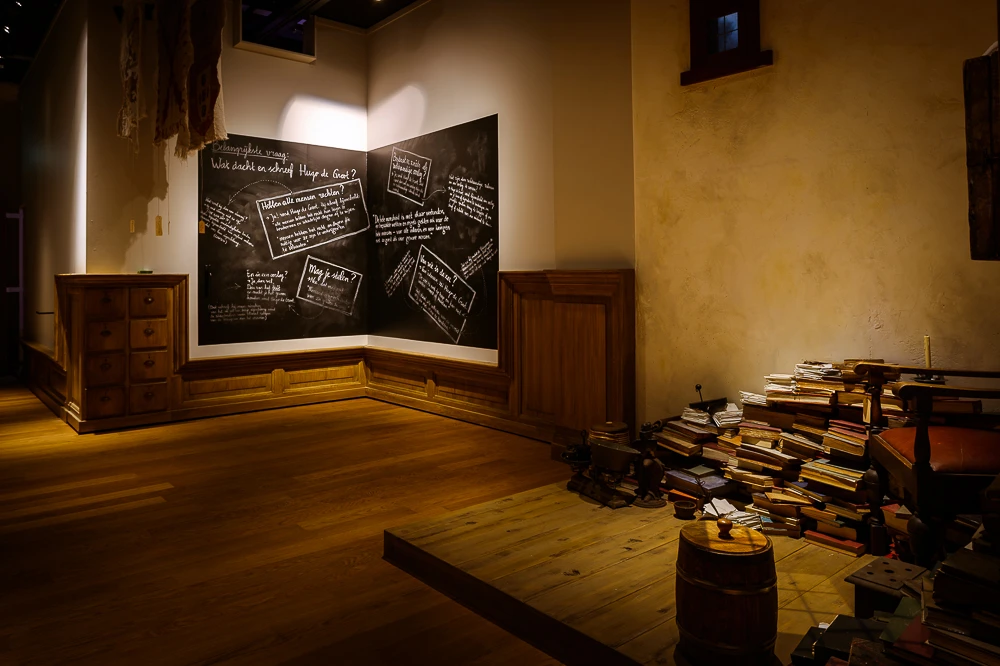
In collaboration with the Rijksmuseum, Studio Daniel Ament developed the curriculum-replacing program You & the Dutch Golden Age: an educational installation in which history is not simply told, but actively explored.
During the development of the spatial concept, we created a fictional narrative: during the renovation, when walls were demolished, a so-called secret society was discovered.
The installation approaches the Dutch Golden Age as a layered journey of discovery. Students are not spectators, but participants. By stepping into the roles of various historical figures, they reconstruct the period from multiple perspectives.
They encounter Rembrandt van Rijn and, as it were, step inside his mind: seeing through his eyes and hearing through his ears. In this way, they experience dramatic moments from his life up close, such as the birth of his son, the death of his wife, and the creation of The Night Watch. They relive Hugo Grotius’s escape in the book chest and experience the hardships of the Behouden Huys during the expedition to Nova Zembla.
Without realizing it, the students ultimately arrive at a hidden 17th-century theatre that emerges from the wall, where they perform stories for one another—half on stage, while the other half operates the theatre technology.
Scenography, lighting, sound, movement, animatronics, and interactive elements were integrally designed to elevate the educational program into a spatial experience. Museum objects functioned not as illustrations, but as anchor points. By linking physical experience with critical reflection, the result is a history lesson that combines analysis and imagination.
From concept development to spatial execution, the project was realized in-house, with content, dramaturgy, and technology designed as one cohesive system.
Award
On March 27, 2014, the educational program You & the Golden Age won the Best Practice Award, as well as the NOT innovation awards, both public and jury prizes.
Set Design Concept
A hidden space
Opening: April 9, 2014
Exhibition Concept
In collaboration with the Rijksmuseum, Studio Daniel Ament developed the curriculum-replacing program You & the Dutch Golden Age: an educational installation in which history is not simply told, but actively explored.
During the development of the spatial concept, we created a fictional narrative: during the renovation, when walls were demolished, a so-called secret society was discovered.
The installation approaches the Dutch Golden Age as a layered journey of discovery. Students are not spectators, but participants. By stepping into the roles of various historical figures, they reconstruct the period from multiple perspectives.
They encounter Rembrandt van Rijn and, as it were, step inside his mind: seeing through his eyes and hearing through his ears. In this way, they experience dramatic moments from his life up close, such as the birth of his son, the death of his wife, and the creation of The Night Watch. They relive Hugo Grotius’s escape in the book chest and experience the hardships of the Behouden Huys during the expedition to Nova Zembla.
Without realizing it, the students ultimately arrive at a hidden 17th-century theatre that emerges from the wall, where they perform stories for one another—half on stage, while the other half operates the theatre technology.
Scenography, lighting, sound, movement, animatronics, and interactive elements were integrally designed to elevate the educational program into a spatial experience. Museum objects functioned not as illustrations, but as anchor points. By linking physical experience with critical reflection, the result is a history lesson that combines analysis and imagination.
From concept development to spatial execution, the project was realized in-house, with content, dramaturgy, and technology designed as one cohesive system.
Award
On March 27, 2014, the educational program You & the Golden Age won the Best Practice Award, as well as the NOT innovation awards, both public and jury prizes.
Set Design Concept
A hidden space
Opening: April 9, 2014


Synopsis
An Iranian woman, who fled her country after her beloved was murdered during the early days of the revolution, seeks revenge on the former Empress of Persia (Iran), Farah Diba. She poses as a journalist and manages to secure an interview with the Empress. However, the truth seems to be different than she initially thought.
Set concept
A continuously shifting reality.
Premiere October 19, 2012
Production & Direction
The Glasshouse/Kees Roorda
Premiered on 19-10-2012
Featuring
Liz Snoijink
Harriët Stroet
Ali Wishka
Synopsis
An Iranian woman, who fled her country after her beloved was murdered during the early days of the revolution, seeks revenge on the former Empress of Persia (Iran), Farah Diba. She poses as a journalist and manages to secure an interview with the Empress. However, the truth seems to be different than she initially thought.
Set concept
A continuously shifting reality.
Premiere October 19, 2012
Production & Direction
The Glasshouse/Kees Roorda
Premiered on 19-10-2012
Featuring
Liz Snoijink
Harriët Stroet
Ali Wishka


Broeikas was a graduation performance of the 2011/2012 graduation year Theatre School. AHK. Under the direction of Stephen Liebman, Harold Pinter’s ‘Hot House’ script was adapted.
Synopsis
The professionalism and even sanity of the institution’s director, Roote, are undermined by his subordinates: the efficient and ambitious Gibbs, the aptly named alcoholic Lush, and Miss Cutts, Roote’s calculating and shrewd mistress who is also involved with Gibbs. After the reported murder of one patient and the rape and resulting pregnancy of another, Roote orders Gibbs to find the perpetrator(s), who it appears is Roote himself, and Gibbs supplants his boss as administrator of the corrupt “rest home,” whose inmates converge upon the staff, resulting in mayhem.
Meaning
The play has been interpreted as a searingly comic indictment of institutional bureaucracy; its black comedy and absurdism exposing hierarchical power structures anticipate Pinter’s later, more overtly political dramatic sketches and plays, such as “The New World Order” (1983), “One for the Road” (1984), and “Mountain Language” (1988).
Cast
Stephen Liebman
Britte Lachner
Geza Weiss
Sinan Eroglu
Beau Scheider
Jip Smit
Set concept
The inner world of Roote.
Broeikas was a graduation performance of the 2011/2012 graduation year Theatre School. AHK. Under the direction of Stephen Liebman, Harold Pinter’s ‘Hot House’ script was adapted.
Synopsis
The professionalism and even sanity of the institution’s director, Roote, are undermined by his subordinates: the efficient and ambitious Gibbs, the aptly named alcoholic Lush, and Miss Cutts, Roote’s calculating and shrewd mistress who is also involved with Gibbs. After the reported murder of one patient and the rape and resulting pregnancy of another, Roote orders Gibbs to find the perpetrator(s), who it appears is Roote himself, and Gibbs supplants his boss as administrator of the corrupt “rest home,” whose inmates converge upon the staff, resulting in mayhem.
Meaning
The play has been interpreted as a searingly comic indictment of institutional bureaucracy; its black comedy and absurdism exposing hierarchical power structures anticipate Pinter’s later, more overtly political dramatic sketches and plays, such as “The New World Order” (1983), “One for the Road” (1984), and “Mountain Language” (1988).
Cast
Stephen Liebman
Britte Lachner
Geza Weiss
Sinan Eroglu
Beau Scheider
Jip Smit
Set concept
The inner world of Roote.


Premiere
01-03-2012
Review
Review by Joukje Akveld
Published: March 27, 2012
Seen: March 26, 2012, DeLaMar Amsterdam
That little dance by Thomas Acda. How he bounces around the stage like a happy puppy. How he spins and twirls, swinging his hip into the air. How he skips, whirls, flutters, flaps, and leaps – as if he loves nothing more. All to the enchanting sounds of “Hoor de wind waait door de bomen,” performed by Gordon (yes, indeed). That dance can be written into the history of cabaret.
It’s a bit of a fremdkörper in “’t Heerst,” this exuberant choreography in the new theater show by Acda and De Munnik. The show actually deals with quite serious matters: people trying to catch their breath in a society that just keeps moving forward. Indifference, no longer listening to each other, avoiding responsibilities.
Thomas Acda and Paul de Munnik chose a theatrical setting to bring their story to light: the eye of an apocalyptic storm, where everything has come to a standstill. The Ford they were driving, the cow flying through the air, the man, the umbrella – everything is frozen in a visually exuberant set by Daniel Ament. As contemporary versions of Vladimir and Estragon from Beckett’s “Waiting for Godot” (high shoes, big coats, bowler hats), the duo stands still and passes the time with nonsensical games, aimless wandering, philosophical reflections, and wistful listening songs. It’s pure cabaret: a balanced mix of music and personal stories with a theatrical touch.
What becomes clear again in this sixth theater program is that Acda is the real actor of the two, the comedian, who manages to infuse humor even in casually messing around with a walking stick. Just as he did in his song about the prostitute Esmee, he now conducts a cleverly thought-out conversation with an invisible listener, where you only hear his half of the dialogue. Moments later, he loses himself in an incomparable monologue about sex with Zwarte Piet and what that does to a child’s soul.
His seemingly casual chatter is full of linguistically humorous asides. De Munnik is the sounding board, the friendly giant who occasionally tries to make a point but never insistently stands his ground. He is the rock that is not blown over by Acda’s capriciousness and more importantly: he is the musical counterpoint. Without De Munnik’s sonorous voice, there is no harmonious unity, no soulful polyphony, no beautifully quieting piano solos.
“’t Heerst” is not fundamentally different from what Acda and De Munnik did in their previous programs, not innovative as you might hope after so many years of collaboration, but the craftsmanship of this feel-good theater show seeps through in every aspect. From the guitar playing of the hidden David Middelhoff in the set to the mild irony with which they poke fun at each other and themselves. From the musically and lyrically beautiful “Jij hoort bij mij” to the fine James Taylor adaptation. And that little dance, it deserves an extra star.
Director
Ruut Weissmann
Cast
Thomas Acda
Paul de Munnik
David Middelhoff
Premiere
01-03-2012
Review
Review by Joukje Akveld
Published: March 27, 2012
Seen: March 26, 2012, DeLaMar Amsterdam
That little dance by Thomas Acda. How he bounces around the stage like a happy puppy. How he spins and twirls, swinging his hip into the air. How he skips, whirls, flutters, flaps, and leaps – as if he loves nothing more. All to the enchanting sounds of “Hoor de wind waait door de bomen,” performed by Gordon (yes, indeed). That dance can be written into the history of cabaret.
It’s a bit of a fremdkörper in “’t Heerst,” this exuberant choreography in the new theater show by Acda and De Munnik. The show actually deals with quite serious matters: people trying to catch their breath in a society that just keeps moving forward. Indifference, no longer listening to each other, avoiding responsibilities.
Thomas Acda and Paul de Munnik chose a theatrical setting to bring their story to light: the eye of an apocalyptic storm, where everything has come to a standstill. The Ford they were driving, the cow flying through the air, the man, the umbrella – everything is frozen in a visually exuberant set by Daniel Ament. As contemporary versions of Vladimir and Estragon from Beckett’s “Waiting for Godot” (high shoes, big coats, bowler hats), the duo stands still and passes the time with nonsensical games, aimless wandering, philosophical reflections, and wistful listening songs. It’s pure cabaret: a balanced mix of music and personal stories with a theatrical touch.
What becomes clear again in this sixth theater program is that Acda is the real actor of the two, the comedian, who manages to infuse humor even in casually messing around with a walking stick. Just as he did in his song about the prostitute Esmee, he now conducts a cleverly thought-out conversation with an invisible listener, where you only hear his half of the dialogue. Moments later, he loses himself in an incomparable monologue about sex with Zwarte Piet and what that does to a child’s soul.
His seemingly casual chatter is full of linguistically humorous asides. De Munnik is the sounding board, the friendly giant who occasionally tries to make a point but never insistently stands his ground. He is the rock that is not blown over by Acda’s capriciousness and more importantly: he is the musical counterpoint. Without De Munnik’s sonorous voice, there is no harmonious unity, no soulful polyphony, no beautifully quieting piano solos.
“’t Heerst” is not fundamentally different from what Acda and De Munnik did in their previous programs, not innovative as you might hope after so many years of collaboration, but the craftsmanship of this feel-good theater show seeps through in every aspect. From the guitar playing of the hidden David Middelhoff in the set to the mild irony with which they poke fun at each other and themselves. From the musically and lyrically beautiful “Jij hoort bij mij” to the fine James Taylor adaptation. And that little dance, it deserves an extra star.
Director
Ruut Weissmann
Cast
Thomas Acda
Paul de Munnik
David Middelhoff


In première
October 17th, 2012
Synopsis
Aap and Bear is a bold road trip through Wim Hofman’s ABC book. In this physical and captivating show filled with hilarious confrontations, absurd dialogues, and unexpected spectacle, Aap and Bear are on a quest for a mysterious treasure. Along the way, they encounter various monosyllabic things and animals, in an adventure that starts with A and ends with Z.
Review
“With cabaret-style flair, Raaijmakers and Geerlings race through the letters of the alphabet. Slapstick, humor, clever dialogue, letter jokes at kindergarten level, philosophical bits, puppetry, and visual spectacle – it all breathes an original and fresh energy.”
— VSCD Youth Theater Jury
“Rarely has the alphabet been approached as unconventionally as by the young theater makers Job Raaijmakers and René Geerlings.”
— Het Parool (Joukje Akveld), ★★★★
“Hilarious mime art at the highest level.”
— De Volkskrant (Annette Embrechts), ★★★★
Set Design
All the letters of the alphabet
Director
Martin Hofstra
Cast
Job Raaijmakers
René Geerlings
In première
October 17th, 2012
Synopsis
Aap and Bear is a bold road trip through Wim Hofman’s ABC book. In this physical and captivating show filled with hilarious confrontations, absurd dialogues, and unexpected spectacle, Aap and Bear are on a quest for a mysterious treasure. Along the way, they encounter various monosyllabic things and animals, in an adventure that starts with A and ends with Z.
Review
“With cabaret-style flair, Raaijmakers and Geerlings race through the letters of the alphabet. Slapstick, humor, clever dialogue, letter jokes at kindergarten level, philosophical bits, puppetry, and visual spectacle – it all breathes an original and fresh energy.”
— VSCD Youth Theater Jury
“Rarely has the alphabet been approached as unconventionally as by the young theater makers Job Raaijmakers and René Geerlings.”
— Het Parool (Joukje Akveld), ★★★★
“Hilarious mime art at the highest level.”
— De Volkskrant (Annette Embrechts), ★★★★
Set Design
All the letters of the alphabet
Director
Martin Hofstra
Cast
Job Raaijmakers
René Geerlings


In première
September 2011
Synopsis
In Fugu betreedt de ‘koningin van de mime’, Karina Holla, het podium samen met de Japanse danser Kenzo Kusuda. Het gedachtegoed van Kafka en Murakami komt samen in een verhaal over leven, ziekte, liefde, en dood, waarbij genezing en verzoening centraal staan. De titel Fugu verwijst naar de giftige kogelvis, maar kan ook worden uitgesproken als Fuku, wat geluk betekent. Karina Holla speelt al vijfentwintig jaar een belangrijke rol in het mimetheater.
Decorconcept
Minimalistisch en symbolisch
Regie
Rob Ligthert
Choreografie
Kenzo Kusuda & Karina Holla
Lichtontwerp
Andre Pronk
Fotografie
Ben van Duin & Andre Pronk
In première
September 2011
Synopsis
In Fugu betreedt de ‘koningin van de mime’, Karina Holla, het podium samen met de Japanse danser Kenzo Kusuda. Het gedachtegoed van Kafka en Murakami komt samen in een verhaal over leven, ziekte, liefde, en dood, waarbij genezing en verzoening centraal staan. De titel Fugu verwijst naar de giftige kogelvis, maar kan ook worden uitgesproken als Fuku, wat geluk betekent. Karina Holla speelt al vijfentwintig jaar een belangrijke rol in het mimetheater.
Decorconcept
Minimalistisch en symbolisch
Regie
Rob Ligthert
Choreografie
Kenzo Kusuda & Karina Holla
Lichtontwerp
Andre Pronk
Fotografie
Ben van Duin & Andre Pronk


In première
March 10, 2016, Theater De Flint, Amersfoort
Synopsis
In High Season, Lenette van Dongen, with humor and self-deprecation, tackles the collective pressure to be happy. After her thorough cleaning in NIKÈ, she finally gets to go on vacation but quickly becomes lost in a parade of inflatable crocodiles, coolers, and flip-flops. Lenette challenges the façade of forced joy and explores the difference between happiness and contentment. Her performance is filled with hilarious observations and touching moments.
Review
Volkskrant (****):
“Lenette van Dongen comes uncomfortably close to answering big questions with her program. With an attractive combination of coarse language and charm, Van Dongen keeps the audience fully engaged.”
“Strong punchline. She expertly plays on the familiarity of daily clumsiness. Joke after joke after joke, leading to a near-constant wave of laughter in the hall.”
“A master tamer.”
Telegraaf (****):
“Lenette van Dongen shines in High Season. High Season is a captivating show. Van Dongen effortlessly captivates the audience with her eighth program.”
NRC (****):
“Everyone truly happy every day. When it comes to everyday inconveniences and daily worries, Lenette van Dongen is often at her best. That’s once again evident in her new program High Season. There aren’t many who can do it like she does: effortlessly switching between exuberant and subtle. Waves of hilarity.”
Trouw:
“Van Dongen’s show is a highlight. Few of her fellow comedians master the art of interaction with the audience as she does. Such courage. And how quick-witted!”
Set Design
An impossible-to-climb mountain
In première
March 10, 2016, Theater De Flint, Amersfoort
Synopsis
In High Season, Lenette van Dongen, with humor and self-deprecation, tackles the collective pressure to be happy. After her thorough cleaning in NIKÈ, she finally gets to go on vacation but quickly becomes lost in a parade of inflatable crocodiles, coolers, and flip-flops. Lenette challenges the façade of forced joy and explores the difference between happiness and contentment. Her performance is filled with hilarious observations and touching moments.
Review
Volkskrant (****):
“Lenette van Dongen comes uncomfortably close to answering big questions with her program. With an attractive combination of coarse language and charm, Van Dongen keeps the audience fully engaged.”
“Strong punchline. She expertly plays on the familiarity of daily clumsiness. Joke after joke after joke, leading to a near-constant wave of laughter in the hall.”
“A master tamer.”
Telegraaf (****):
“Lenette van Dongen shines in High Season. High Season is a captivating show. Van Dongen effortlessly captivates the audience with her eighth program.”
NRC (****):
“Everyone truly happy every day. When it comes to everyday inconveniences and daily worries, Lenette van Dongen is often at her best. That’s once again evident in her new program High Season. There aren’t many who can do it like she does: effortlessly switching between exuberant and subtle. Waves of hilarity.”
Trouw:
“Van Dongen’s show is a highlight. Few of her fellow comedians master the art of interaction with the audience as she does. Such courage. And how quick-witted!”
Set Design
An impossible-to-climb mountain

In première
January 28, 2011
Synopsis
In search of oil, geologist Herbert Kahmer, his wife Eva, and engineer Edgar Bron find themselves in an imaginary third-world country plagued by war and inhabited by reindeer, mosquitoes, and nomads. Most of the natural resources have already been extracted by multinationals, but the remaining bit of oil must still be taken.
While the men spend three years searching for oil, Eva waits in a provincial town, living in fear of attacks. She resides in the basement of their home, surrounded by alcohol, her helper Gomua, and a guilty conscience. On the day the men finally strike oil, catastrophe ensues.
Explanation of the Effect
Due to excessive drinking, the story increasingly feels as though it is being seen through the lens of a delirium. Gomua cries on the couch as Eva lashes out at her. She becomes increasingly aggressive and storms towards Gomua, who cowers in fear of being struck. But when Eva grabs her shoulder, suddenly, it is another woman.
Set Design
Set design: Bernhard Hammer
Special FX: Daniel Ament
Director
Theu Boermans
Cast
Tamar van den Dop
Marcel Hensema
Myranda Jongeling
Eva Marie de Waal
Joris Smit
In première
January 28, 2011
Synopsis
In search of oil, geologist Herbert Kahmer, his wife Eva, and engineer Edgar Bron find themselves in an imaginary third-world country plagued by war and inhabited by reindeer, mosquitoes, and nomads. Most of the natural resources have already been extracted by multinationals, but the remaining bit of oil must still be taken.
While the men spend three years searching for oil, Eva waits in a provincial town, living in fear of attacks. She resides in the basement of their home, surrounded by alcohol, her helper Gomua, and a guilty conscience. On the day the men finally strike oil, catastrophe ensues.
Explanation of the Effect
Due to excessive drinking, the story increasingly feels as though it is being seen through the lens of a delirium. Gomua cries on the couch as Eva lashes out at her. She becomes increasingly aggressive and storms towards Gomua, who cowers in fear of being struck. But when Eva grabs her shoulder, suddenly, it is another woman.
Set Design
Set design: Bernhard Hammer
Special FX: Daniel Ament
Director
Theu Boermans
Cast
Tamar van den Dop
Marcel Hensema
Myranda Jongeling
Eva Marie de Waal
Joris Smit


Campaign Image for the SP
An oversized scouring sponge as a campaign prop commissioned by the graphic design agency Thonik.
Campaign Image for the SP
An oversized scouring sponge as a campaign prop commissioned by the graphic design agency Thonik.


Premiere
February 12, 2010
Synopsis
With merely the image of an opening scene in which a child on a tricycle with a porcelain head is shattered by a demon and the theme of “jealousy,” Daniel developed the concept of designing a scenography where one enters the other side of the mirror as a metaphor for the unconscious mental space within our ego. In this reality, we only see what a sliver of light falls upon, with the context consistently disappearing into the great nothingness. As with almost every set by Daniel, this set also represents the protagonist’s interior, in which even the dark side or antagonist of the self is portrayed.
Set Design Concept
Imagining the unconscious space
Direction
Jakop Ahlbom
Lighting Design
In collaboration with Stefan Dijkman
Premiere
February 12, 2010
Synopsis
With merely the image of an opening scene in which a child on a tricycle with a porcelain head is shattered by a demon and the theme of “jealousy,” Daniel developed the concept of designing a scenography where one enters the other side of the mirror as a metaphor for the unconscious mental space within our ego. In this reality, we only see what a sliver of light falls upon, with the context consistently disappearing into the great nothingness. As with almost every set by Daniel, this set also represents the protagonist’s interior, in which even the dark side or antagonist of the self is portrayed.
Set Design Concept
Imagining the unconscious space
Direction
Jakop Ahlbom
Lighting Design
In collaboration with Stefan Dijkman


Opening
October 9, 2009
Exhibition Concept
For the former Tropenmuseum (now Wereldmuseum), Studio Daniel Ament, together with the Tropenmuseum Junior team, developed The Qi of China: an interactive exhibition in which culture is presented as a living practice.
At its core is the concept of Qi, the energy that, according to Chinese tradition, flows through everything and everyone.
Through participation, abstract philosophical concepts are made physically tangible for school groups (ages 6–13) and families across three different programs.
Nothing in this exhibition is behind glass. Objects and spaces are part of an active parcours in which visitors act, move, and create.
Spaces such as a tea house, calligraphy studio, umbrella factory, traditional Chinese medicine room, afterlife space, Feng Shui office, restaurant kitchen, karaoke room, and Kung Fu city parcours function as scenographic environments where cultural practices are experienced.
Visitors engage in activities such as tai chi, kung fu, Feng Shui design, calligraphy, karaoke, cooking, and healing—each contributing to the flow of Qi.
Facilitators act not only as guides, but as performers within the spatial narrative.
A key element was the integration of media and participation: the so-called Qi jump was filmed and linked to an online game, extending the experience beyond the physical exhibition.
Set Design
Air of concrete.
Opening
October 9, 2009
Exhibition Concept
For the former Tropenmuseum (now Wereldmuseum), Studio Daniel Ament, together with the Tropenmuseum Junior team, developed The Qi of China: an interactive exhibition in which culture is presented as a living practice.
At its core is the concept of Qi, the energy that, according to Chinese tradition, flows through everything and everyone.
Through participation, abstract philosophical concepts are made physically tangible for school groups (ages 6–13) and families across three different programs.
Nothing in this exhibition is behind glass. Objects and spaces are part of an active parcours in which visitors act, move, and create.
Spaces such as a tea house, calligraphy studio, umbrella factory, traditional Chinese medicine room, afterlife space, Feng Shui office, restaurant kitchen, karaoke room, and Kung Fu city parcours function as scenographic environments where cultural practices are experienced.
Visitors engage in activities such as tai chi, kung fu, Feng Shui design, calligraphy, karaoke, cooking, and healing—each contributing to the flow of Qi.
Facilitators act not only as guides, but as performers within the spatial narrative.
A key element was the integration of media and participation: the so-called Qi jump was filmed and linked to an online game, extending the experience beyond the physical exhibition.
Set Design
Air of concrete.


Premiere
2004-11-11
Synopsis
Joaquim Sabaté, a Catalan choreographer renowned in the Netherlands, transitioned to singing after twenty years in the dance world, specializing as a countertenor. Following a successful international tour, Sabaté now presents Ballo Cantabile in Barcelona, a choreographic work performed by himself and soprano Elena de Vega. The performance is accompanied by two live musicians, offering a modern interpretation of music from Italian Baroque masters.
Set Design
Modern interpretation of baroque forms.
Direction
Joaquim Sabaté
Cast
Joaquim Sabaté (concept, countertenor voice)
Elena de Vega (soprano voice)
Israël Golani (theorbo)
Eva Reiter (gamba-viola)
Creative Team
Costume: Françoise Magrangeas
Set Design: Daan Ament
Video: Roberta Marques
Editing: Caroline Dokter
Technical Support: Ingeborg Slaats
Production: Kees Koeman
Production Assistant: Mariken van Sitteren
Premiere
2004-11-11
Synopsis
Joaquim Sabaté, a Catalan choreographer renowned in the Netherlands, transitioned to singing after twenty years in the dance world, specializing as a countertenor. Following a successful international tour, Sabaté now presents Ballo Cantabile in Barcelona, a choreographic work performed by himself and soprano Elena de Vega. The performance is accompanied by two live musicians, offering a modern interpretation of music from Italian Baroque masters.
Set Design
Modern interpretation of baroque forms.
Direction
Joaquim Sabaté
Cast
Joaquim Sabaté (concept, countertenor voice)
Elena de Vega (soprano voice)
Israël Golani (theorbo)
Eva Reiter (gamba-viola)
Creative Team
Costume: Françoise Magrangeas
Set Design: Daan Ament
Video: Roberta Marques
Editing: Caroline Dokter
Technical Support: Ingeborg Slaats
Production: Kees Koeman
Production Assistant: Mariken van Sitteren