
Premiere
1 March 2026
Synopsis
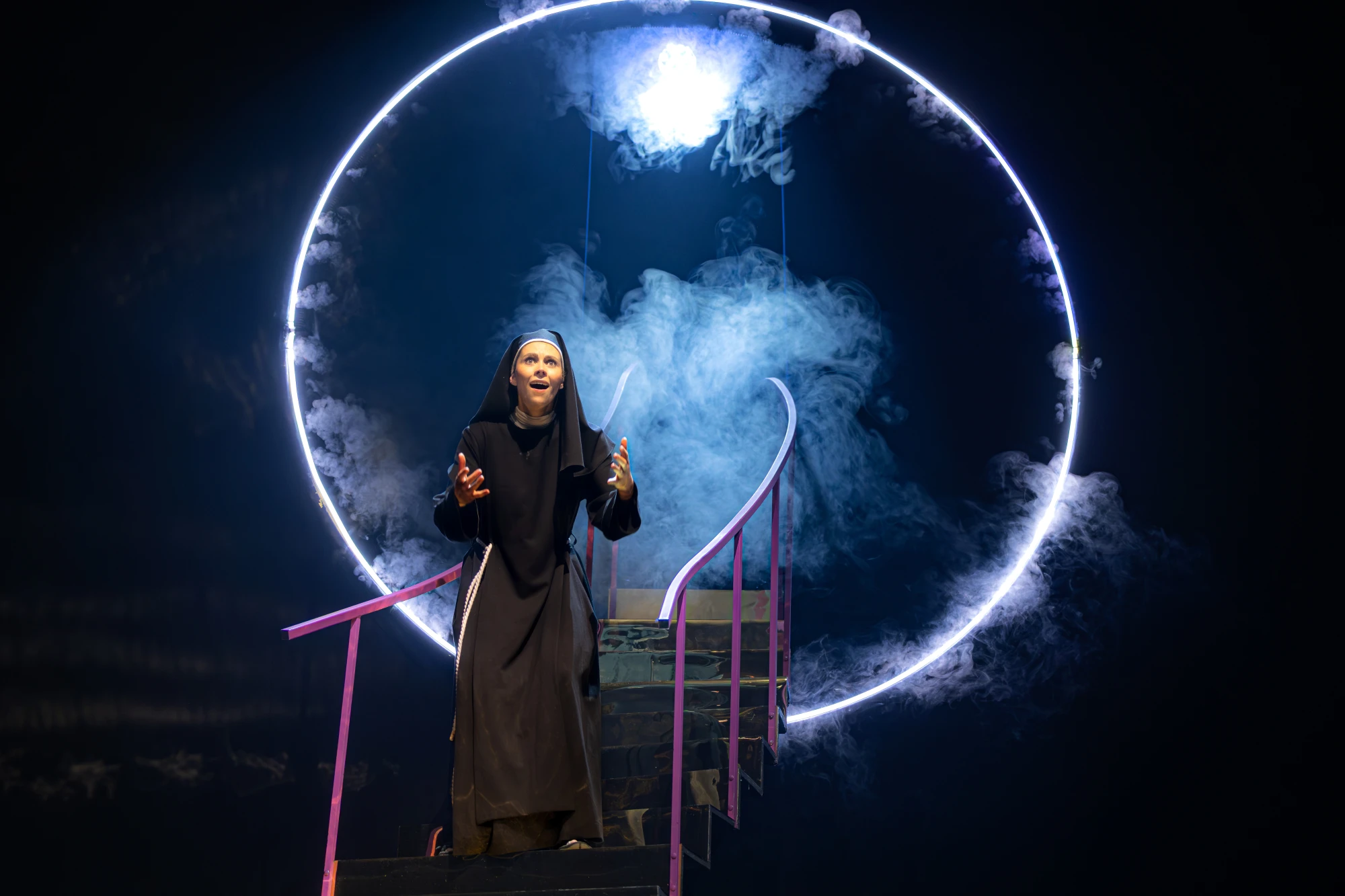
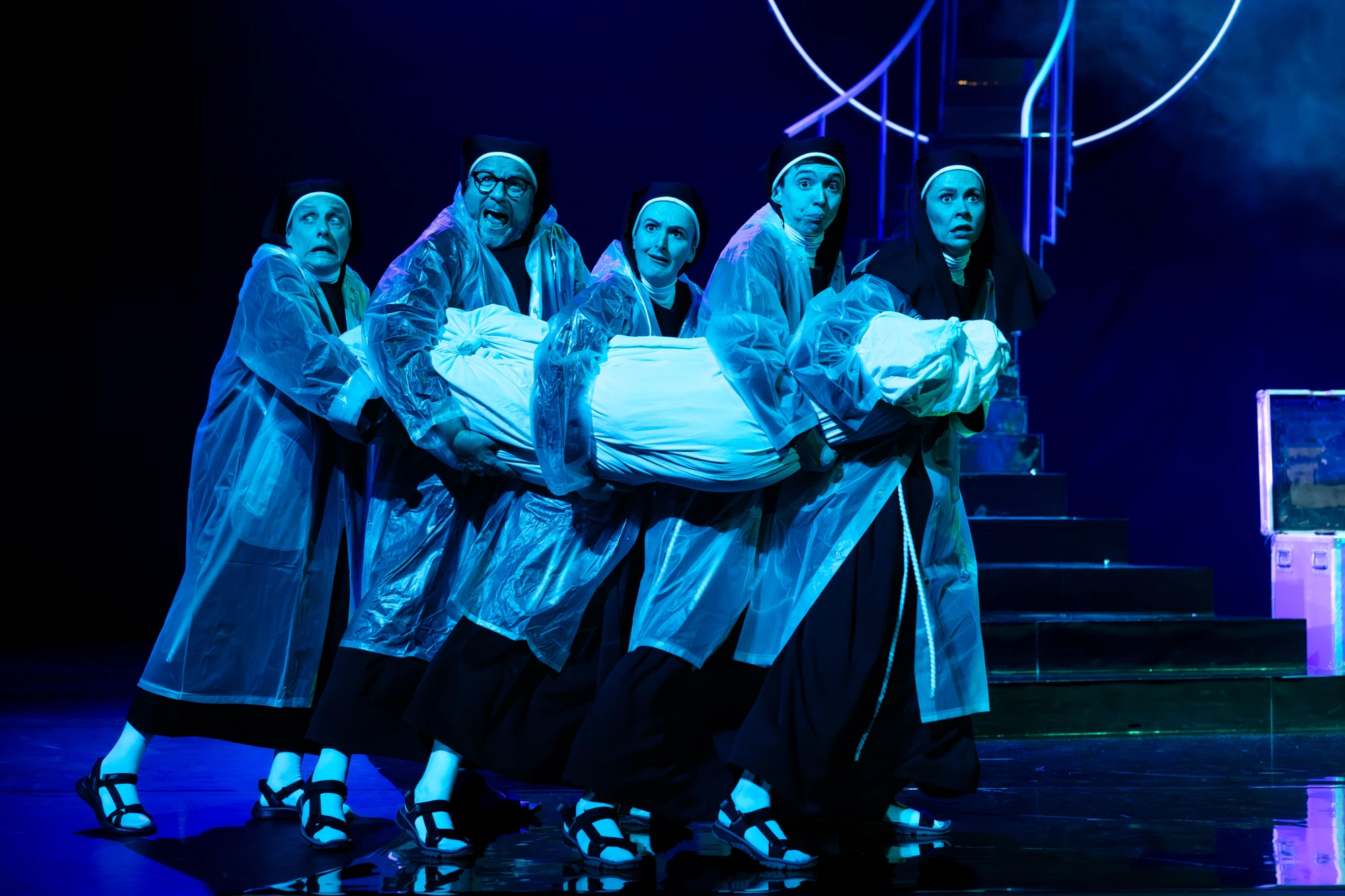
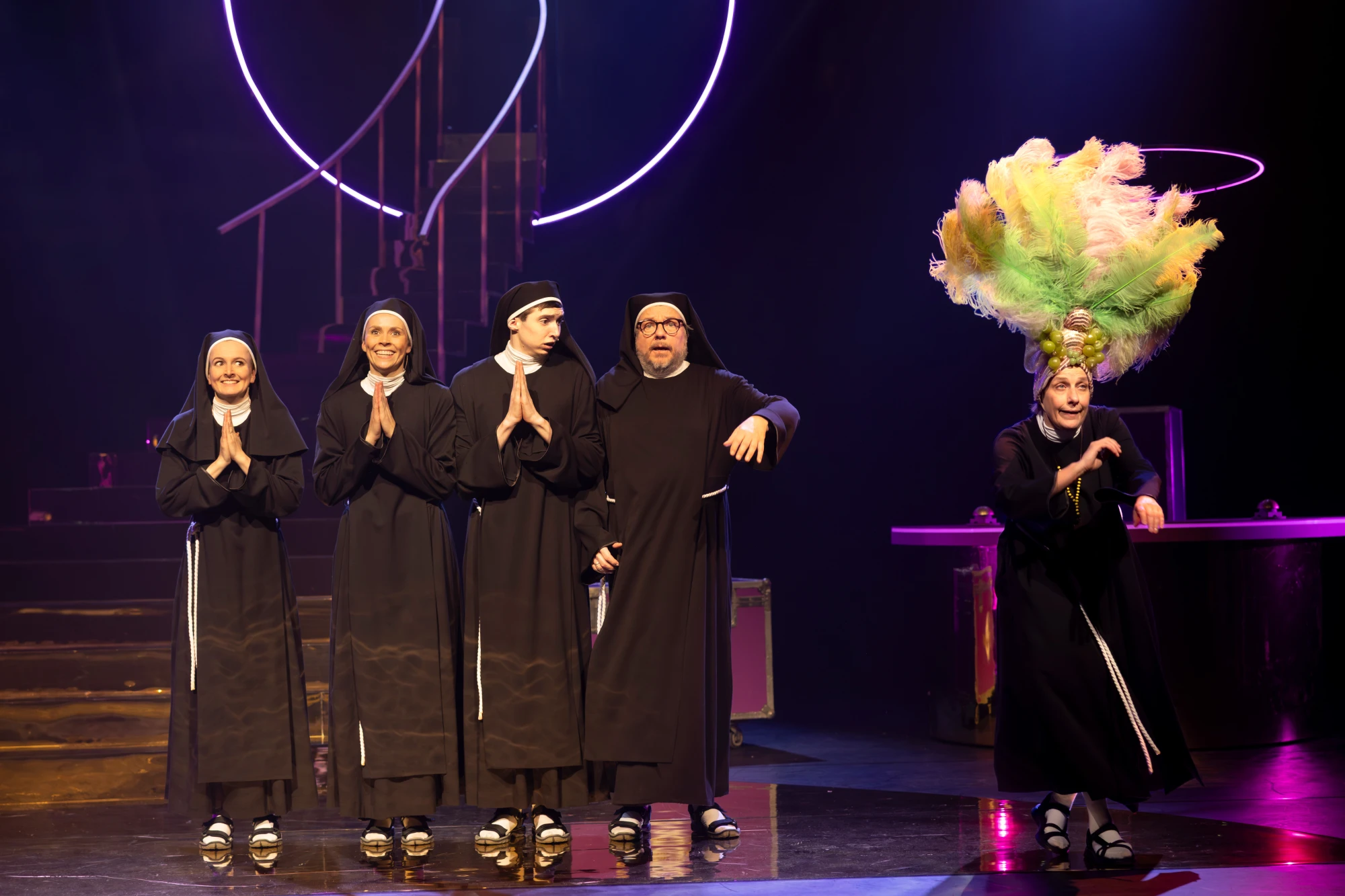
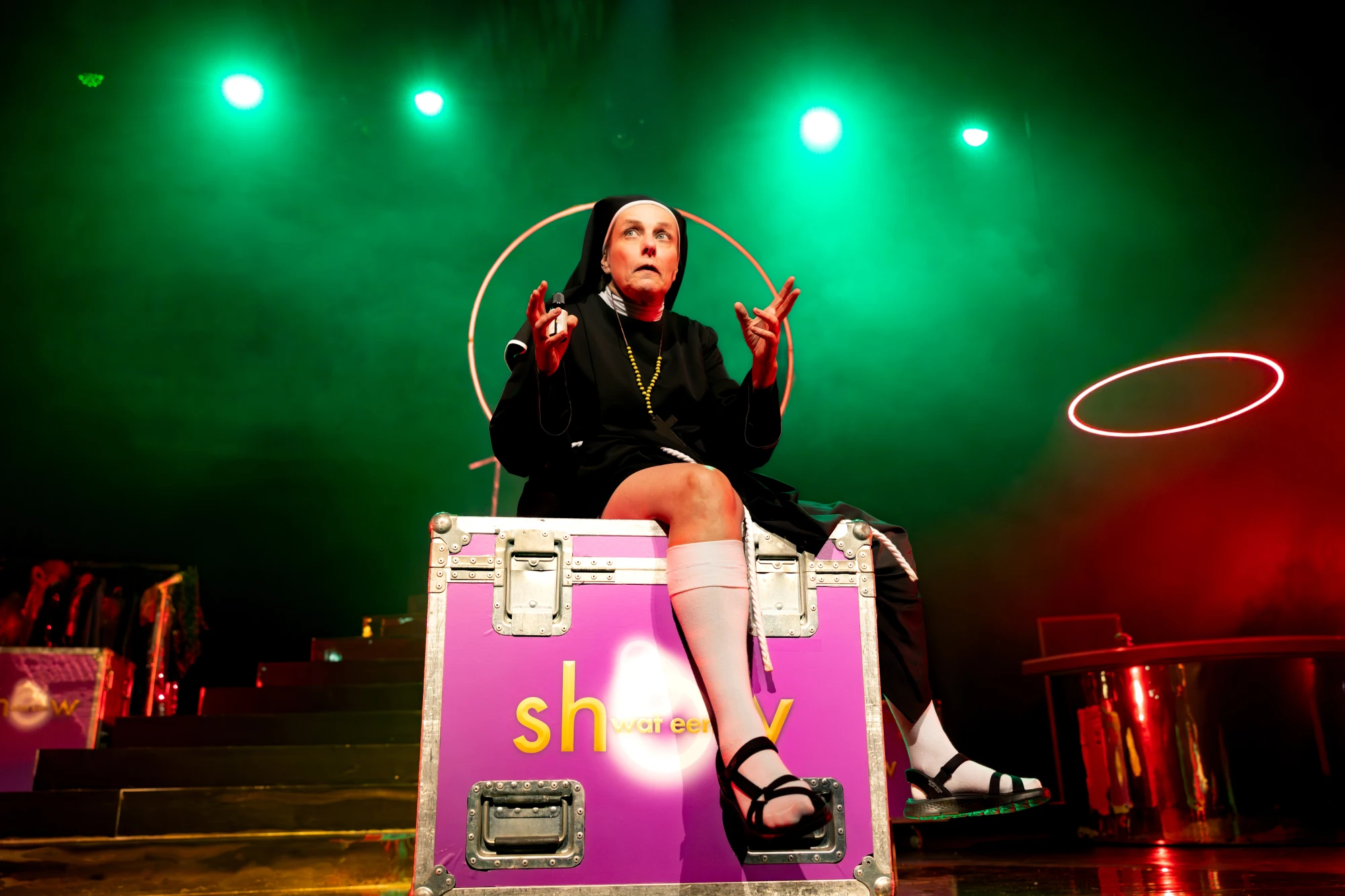
In this musical farce, five remaining nuns attempt to raise money to bury their deceased sisters. What begins as a charity performance quickly spirals out of control as each nun reveals her own ambitions and personality traits.
Set Design Concept
The original set design relied on the tension that was historically created by placing the nun within a semi-sexualized context, staging their charity performance within a Grease-inspired environment.
In our version, we approached the design from the perspective of the nun in relation to pop culture, while simultaneously observing the nun through that same cultural lens. This dual perspective is expressed by placing the nuns within a talent-show setting, creating a scenographic framework in which spectacle culture and religious restraint meet.
Production
Pretpakhuis
Direction
Caroline Frerichs
Cast
Mylène d’Anjou
Linda Verstraten
Lisanne Dijkstra
Ger Otte
Christiaan Schreuder
Premiere
1 March 2026
Synopsis
In this musical farce, five remaining nuns attempt to raise money to bury their deceased sisters. What begins as a charity performance quickly spirals out of control as each nun reveals her own ambitions and personality traits.
Set Design Concept
The original set design relied on the tension that was historically created by placing the nun within a semi-sexualized context, staging their charity performance within a Grease-inspired environment.
In our version, we approached the design from the perspective of the nun in relation to pop culture, while simultaneously observing the nun through that same cultural lens. This dual perspective is expressed by placing the nuns within a talent-show setting, creating a scenographic framework in which spectacle culture and religious restraint meet.
Production
Pretpakhuis
Direction
Caroline Frerichs
Cast
Mylène d’Anjou
Linda Verstraten
Lisanne Dijkstra
Ger Otte
Christiaan Schreuder


Opening
14 April 2025
Exhibition Concept
The new National Museum Eighty Years’ War in Groenlo is housed in the historic Calixtus Church, which has stood as a witness to this history since the period of the Eighty Years’ War.
Designer Johan Akkerman and his team, consisting of media producer Paul van der Ham and performer/writer Sara van Gennip, won the original pitch with their exhibition concept in which visitors, equipped with a press card, headphones, and a microphone, take on the role of war correspondents searching for truth within the Eighty Years’ War.
A design studio that had been involved in the development process for three years and had been asked to act as a “flying keeper” subsequently invited Studio Daniel Ament to develop the spatial design and concept, based on Akkerman’s original ideas and bastion-based floor plan.
The spatial concept consists of a bombarded exhibition landscape in which exhibition walls, showcases, and spatial elements appear as fragments functioning as carriers of the collection. Sightlines, plinths, panels, drawers, cabinets, showcases, exhibits, and interactives together form a layered environment in which every detail contributes to the experience of a museum battlefield through which visitors move as war correspondents.
Decor Concept
Historic press conference with participation
Opening
14 April 2025
Exhibition Concept
The new National Museum Eighty Years’ War in Groenlo is housed in the historic Calixtus Church, which has stood as a witness to this history since the period of the Eighty Years’ War.
Designer Johan Akkerman and his team, consisting of media producer Paul van der Ham and performer/writer Sara van Gennip, won the original pitch with their exhibition concept in which visitors, equipped with a press card, headphones, and a microphone, take on the role of war correspondents searching for truth within the Eighty Years’ War.
A design studio that had been involved in the development process for three years and had been asked to act as a “flying keeper” subsequently invited Studio Daniel Ament to develop the spatial design and concept, based on Akkerman’s original ideas and bastion-based floor plan.
The spatial concept consists of a bombarded exhibition landscape in which exhibition walls, showcases, and spatial elements appear as fragments functioning as carriers of the collection. Sightlines, plinths, panels, drawers, cabinets, showcases, exhibits, and interactives together form a layered environment in which every detail contributes to the experience of a museum battlefield through which visitors move as war correspondents.
Decor Concept
Historic press conference with participation


Opening
2022
Exhibition Concept
For Naturalis Biodiversity Center, Studio Daniel Ament developed the “Rexperience,” a museum installation in which narrative, scenography, and technology merge into a single spatial experience.
The assignment was not merely to create a spectacular attraction aimed at drawing a specific audience, but also to add a layer of substantive depth—using accessible, everyday language—to scientific knowledge.
The iconic T. rex, named Trix, excavated by Naturalis, is displayed in the adjacent gallery.
Visitors enter a futuristic time travel agency, followed by a time capsule in which a journey back to 66 million years ago is staged. Light, sound, stereoscopic film, motion, and animatronics are controlled by a show control system and were integrally designed and directed to create a layered and holistic experience.
Guided by a virtual host, a compelling narrative unfolds, culminating in the moment of the meteorite impact. The installation combines immersion with content, connecting education to emotion.
The Rexperience is conceived as an additional museum layer within the broader visitor route.
From content and scenography to sound design and technical integration, the project was designed in-house and realized down to the smallest detail.
Review / Article
Both the design and execution processes are highly complex due to the holistic concept, where every 5 minutes, 25 visitors are guided through a fully automated experiential journey. Light, design, animatronics, film, decor, and effects work seamlessly together to complete the experience.
Set Design
Spectacular time travel to the Cretaceous
Opening
2022
Exhibition Concept
For Naturalis Biodiversity Center, Studio Daniel Ament developed the “Rexperience,” a museum installation in which narrative, scenography, and technology merge into a single spatial experience.
The assignment was not merely to create a spectacular attraction aimed at drawing a specific audience, but also to add a layer of substantive depth—using accessible, everyday language—to scientific knowledge.
The iconic T. rex, named Trix, excavated by Naturalis, is displayed in the adjacent gallery.
Visitors enter a futuristic time travel agency, followed by a time capsule in which a journey back to 66 million years ago is staged. Light, sound, stereoscopic film, motion, and animatronics are controlled by a show control system and were integrally designed and directed to create a layered and holistic experience.
Guided by a virtual host, a compelling narrative unfolds, culminating in the moment of the meteorite impact. The installation combines immersion with content, connecting education to emotion.
The Rexperience is conceived as an additional museum layer within the broader visitor route.
From content and scenography to sound design and technical integration, the project was designed in-house and realized down to the smallest detail.
Review / Article
Both the design and execution processes are highly complex due to the holistic concept, where every 5 minutes, 25 visitors are guided through a fully automated experiential journey. Light, design, animatronics, film, decor, and effects work seamlessly together to complete the experience.
Set Design
Spectacular time travel to the Cretaceous


Opening
2020-01-01
Concept
This project is a pioneering work in self-building and sustainability, achieving net-zero energy through the integration of wind, water, and sunlight as natural energy sources. It combines architectural aesthetics with technical innovations, such as a greenhouse with plant filters for air purification, rainwater management, an energy-generating facade, and the use of varying solar angles to heat the building in winter and cool it in summer.
As the gap between nature and urban dwellers grows, this project introduces innovative solutions to bridge that divide. It integrates nature into the daily lives of city residents, bringing it into their living spaces.
Opening
2020-01-01
Concept
This project is a pioneering work in self-building and sustainability, achieving net-zero energy through the integration of wind, water, and sunlight as natural energy sources. It combines architectural aesthetics with technical innovations, such as a greenhouse with plant filters for air purification, rainwater management, an energy-generating facade, and the use of varying solar angles to heat the building in winter and cool it in summer.
As the gap between nature and urban dwellers grows, this project introduces innovative solutions to bridge that divide. It integrates nature into the daily lives of city residents, bringing it into their living spaces.


Premiere
December 1, 2019
Synopsis
The red-haired orphan Annie returns in a new production by Theateralliantie and Mark Vijn Theaterproductions, returning to the origins of Annie in Harold Lincoln Gray’s comic strip.
Annie lives in an orphanage run by the cruel Miss Hannigan, until millionaire Oliver Warbucks chooses her to spend Christmas with him. Warbucks initiates a search for Annie’s parents, leading to unexpected twists and colorful characters.
Set Design
Drawn sets and comic colors
Direction
Pim Veulings
Cast
Willemijn Verkaik: Miss Hannigan
Edwin Jonker: Oliver ‘Daddy’ Warbucks
Doris Baaten: President
Eva van Gessel: Grace Farrell
Myrthe Huber: Lily
Sjoerd Spruijt: Rooster Hannigan
Dieter Spileers: ensemble
Melinda de Vries: ensemble
Danny Houtkooper: ensemble
Amanda Payne: ensemble
Michael Muyderman: ensemble
Sammy Uivel: ensemble
Sterre Verschoor: ensemble
Creative Team
Authors: Thomas Meehan
Translation: Rob de Graaf, Roy Peters
Lyrics: Martin Charnin
Music: Charles Strouse
Musical direction: Jeroen Sleyfer
Children: Herma van Piekeren, Simone van Gog
Choreography: Pim Veulings
Direction: Pim Veulings
Coaching: Michiel de Regt (acting coach)
Set design: Daniël Ament (design)
Costumes: Sabine Snijders (design)
Make-up, hair: Cynthia van der Linden
Lighting: Marc Heinz (design)
Sound: Maarten Houdijk (design)
Premiere
December 1, 2019
Synopsis
The red-haired orphan Annie returns in a new production by Theateralliantie and Mark Vijn Theaterproductions, returning to the origins of Annie in Harold Lincoln Gray’s comic strip.
Annie lives in an orphanage run by the cruel Miss Hannigan, until millionaire Oliver Warbucks chooses her to spend Christmas with him. Warbucks initiates a search for Annie’s parents, leading to unexpected twists and colorful characters.
Set Design
Drawn sets and comic colors
Direction
Pim Veulings
Cast
Willemijn Verkaik: Miss Hannigan
Edwin Jonker: Oliver ‘Daddy’ Warbucks
Doris Baaten: President
Eva van Gessel: Grace Farrell
Myrthe Huber: Lily
Sjoerd Spruijt: Rooster Hannigan
Dieter Spileers: ensemble
Melinda de Vries: ensemble
Danny Houtkooper: ensemble
Amanda Payne: ensemble
Michael Muyderman: ensemble
Sammy Uivel: ensemble
Sterre Verschoor: ensemble
Creative Team
Authors: Thomas Meehan
Translation: Rob de Graaf, Roy Peters
Lyrics: Martin Charnin
Music: Charles Strouse
Musical direction: Jeroen Sleyfer
Children: Herma van Piekeren, Simone van Gog
Choreography: Pim Veulings
Direction: Pim Veulings
Coaching: Michiel de Regt (acting coach)
Set design: Daniël Ament (design)
Costumes: Sabine Snijders (design)
Make-up, hair: Cynthia van der Linden
Lighting: Marc Heinz (design)
Sound: Maarten Houdijk (design)


Opening
2019-09-01
Exhibition Concept
The Earthquake, designed by Studio Daniel Ament, is an intense experience within the hall “The Earth”. In this event, a puppet play about a Japanese mythology explaining earthquakes brings an actual earthquake to life. The puppet theatre begins to collapse, and visitors must find their way out through the debris to escape the peril.
Combining soundscapes, lighting design, and dynamic effects – such as a cracking and moving floor and a falling ceiling – this experience immerses visitors in the destructive force of the earth.
The hall “The Earth” itself is a tribute to the immense power of our planet. Visitors journey through awe-inspiring locations like volcanoes in Hawaii, earthquakes in Japan, and the rifts of Iceland, making the raw force of nature tangible.
Set Design
Realistic natural forces with dynamic effects.
Award
N/A
Opening
2019-09-01
Exhibition Concept
The Earthquake, designed by Studio Daniel Ament, is an intense experience within the hall “The Earth”. In this event, a puppet play about a Japanese mythology explaining earthquakes brings an actual earthquake to life. The puppet theatre begins to collapse, and visitors must find their way out through the debris to escape the peril.
Combining soundscapes, lighting design, and dynamic effects – such as a cracking and moving floor and a falling ceiling – this experience immerses visitors in the destructive force of the earth.
The hall “The Earth” itself is a tribute to the immense power of our planet. Visitors journey through awe-inspiring locations like volcanoes in Hawaii, earthquakes in Japan, and the rifts of Iceland, making the raw force of nature tangible.
Set Design
Realistic natural forces with dynamic effects.
Award
N/A


Opening
August 31, 2019
Exhibition Concept
For an exhibition on prehistory, Studio Daniel Ament designed The Ice Age: an installation in which the ecosystem of the Netherlands around 40,000 years ago can be experienced immersively.
At the center of the space stands a large-scale model of the Netherlands, depicting the landscape as it existed during the last Ice Age, the Weichselian. Using specially developed 3D viewers, visitors suddenly find themselves within this landscape, surrounded by animals, experiencing what was once a frozen scene now brought to life in motion.
From different viewpoints, visitors observe the same cinematic scenes. These scenes are all ecologically interconnected, allowing visitors—through their own observation and exploration—to understand how this ecological system functioned.
The ecosystem is based on the prehistoric “Big Five” that inhabited the landscape: the woolly mammoth, woolly rhinoceros, steppe bison, steppe lion, and cave hyena. Each represents fundamental themes of existence: birth and death, reproduction, migration, hunting, and feeding.
For the flora and fauna represented in the model, Studio Daniel Ament conducted in-depth research in close collaboration with various scientists—down to the level of individual grains of sand and soil composition—and translated this knowledge into the scale of the model.
The walls surrounding the model consist of floor-to-ceiling storage racks, effectively bringing the collection depot into the exhibition space. The fossils displayed within connect the cinematic reconstructions to archaeological evidence, revealing how scientific research has shaped our understanding of this ecosystem.
In the outer zone, between the building walls and the storage structures, lies the domain of scientists. Visitors occasionally see them moving through the space with carts and ladders, retrieving and returning collection items for research.
In this way, The Ice Age unfolds as a layered experience in which imagination and science reinforce one another. The combination of model, film, fossils, and live research demonstrates how knowledge of the past is constructed, while inviting visitors to draw their own connections.
By looking, listening, discovering, and actively participating, visitors gain a new perspective on a vanished landscape that suddenly feels strikingly close.
Set Design
Realistic prehistoric dioramas with film projections
Opening
August 31, 2019
Exhibition Concept
For an exhibition on prehistory, Studio Daniel Ament designed The Ice Age: an installation in which the ecosystem of the Netherlands around 40,000 years ago can be experienced immersively.
At the center of the space stands a large-scale model of the Netherlands, depicting the landscape as it existed during the last Ice Age, the Weichselian. Using specially developed 3D viewers, visitors suddenly find themselves within this landscape, surrounded by animals, experiencing what was once a frozen scene now brought to life in motion.
From different viewpoints, visitors observe the same cinematic scenes. These scenes are all ecologically interconnected, allowing visitors—through their own observation and exploration—to understand how this ecological system functioned.
The ecosystem is based on the prehistoric “Big Five” that inhabited the landscape: the woolly mammoth, woolly rhinoceros, steppe bison, steppe lion, and cave hyena. Each represents fundamental themes of existence: birth and death, reproduction, migration, hunting, and feeding.
For the flora and fauna represented in the model, Studio Daniel Ament conducted in-depth research in close collaboration with various scientists—down to the level of individual grains of sand and soil composition—and translated this knowledge into the scale of the model.
The walls surrounding the model consist of floor-to-ceiling storage racks, effectively bringing the collection depot into the exhibition space. The fossils displayed within connect the cinematic reconstructions to archaeological evidence, revealing how scientific research has shaped our understanding of this ecosystem.
In the outer zone, between the building walls and the storage structures, lies the domain of scientists. Visitors occasionally see them moving through the space with carts and ladders, retrieving and returning collection items for research.
In this way, The Ice Age unfolds as a layered experience in which imagination and science reinforce one another. The combination of model, film, fossils, and live research demonstrates how knowledge of the past is constructed, while inviting visitors to draw their own connections.
By looking, listening, discovering, and actively participating, visitors gain a new perspective on a vanished landscape that suddenly feels strikingly close.
Set Design
Realistic prehistoric dioramas with film projections


Opening
March 29, 2019
Exhibition Concept
Explore six fascinating sea creatures with the whole family in the Sea Monsters exhibition. Take a closer look at the Loch Ness monster, meet the mega-octopus Kraken, a giant crab, and mermaids. There’s also a massive turtle pretending to be an island and even the whale that swallowed Jonah. Sea Monsters is an interactive exhibition at the Maritime Museum in Rotterdam, specially designed for families with children aged 4 and up, where nothing is as it seems.
Set Design
A whimsical underwater world filled with mythical sea creatures
Opening
March 29, 2019
Exhibition Concept
Explore six fascinating sea creatures with the whole family in the Sea Monsters exhibition. Take a closer look at the Loch Ness monster, meet the mega-octopus Kraken, a giant crab, and mermaids. There’s also a massive turtle pretending to be an island and even the whale that swallowed Jonah. Sea Monsters is an interactive exhibition at the Maritime Museum in Rotterdam, specially designed for families with children aged 4 and up, where nothing is as it seems.
Set Design
A whimsical underwater world filled with mythical sea creatures


In première
November 3, 2018, DeLaMar Theater, Amsterdam
Synopsis
Later Was Everything Better is Peter Pannekoek’s second full-length show, where he invites the audience, through humor and wit, to view the world from a different perspective. The program explores the ‘in-between time,’ a period when the old is dying and the new is yet to be born. Pannekoek dissects stereotypes, power, and misuse, calling for compassion rather than judgment. With a playful approach and a light tone, he provokes thought about revolutionary times and those who become victims in such eras.
Review
“There’s always another story, another joke”
— Volkskrant, ★★★★
Set Design
Slaughterhouse of time
Creative Team
Director: Ruut Weissman
In première
November 3, 2018, DeLaMar Theater, Amsterdam
Synopsis
Later Was Everything Better is Peter Pannekoek’s second full-length show, where he invites the audience, through humor and wit, to view the world from a different perspective. The program explores the ‘in-between time,’ a period when the old is dying and the new is yet to be born. Pannekoek dissects stereotypes, power, and misuse, calling for compassion rather than judgment. With a playful approach and a light tone, he provokes thought about revolutionary times and those who become victims in such eras.
Review
“There’s always another story, another joke”
— Volkskrant, ★★★★
Set Design
Slaughterhouse of time
Creative Team
Director: Ruut Weissman


Opening
April 20, 2018
Exhibition Concept
For Helmond Castle, Studio Daniel Ament developed Castle on Fire: a narrative and theatrical installation in the castle attic, a space that had been closed to the public for nearly 700 years.
The project demonstrates how heritage presentation can transform from static explanation into a sensory and dramaturgical experience in which history becomes tangible.
The concept The Castle’s Nightmare formed the dramaturgical foundation. Instead of a linear historical reconstruction, a layered narrative was created in the form of a “whodunit.”
Visitors wander through the imagination of the castle itself, where shadows, voices, and memories guide them across creaking floors, ancient beams, and hidden passages.
The existing interior was not concealed, but used as a scenographic foundation.
Lighting design, sound design, and special effects heighten the tension and mark the transition between reality and dream. Historical facts and fictional layers are carefully interwoven, culminating in the fire as the climax.
Film elements, spatial interventions, and theatrical effects were developed as part of one integrated design process.
Set Design
The nightmare of the castle
Creative Team
Special FX: Studio Daniel Ament
Soundscape: Wim Conradi
Lighting Design: Tom Verheijen
AV Design: Rapenburg Plaza
Opening
April 20, 2018
Exhibition Concept
For Helmond Castle, Studio Daniel Ament developed Castle on Fire: a narrative and theatrical installation in the castle attic, a space that had been closed to the public for nearly 700 years.
The project demonstrates how heritage presentation can transform from static explanation into a sensory and dramaturgical experience in which history becomes tangible.
The concept The Castle’s Nightmare formed the dramaturgical foundation. Instead of a linear historical reconstruction, a layered narrative was created in the form of a “whodunit.”
Visitors wander through the imagination of the castle itself, where shadows, voices, and memories guide them across creaking floors, ancient beams, and hidden passages.
The existing interior was not concealed, but used as a scenographic foundation.
Lighting design, sound design, and special effects heighten the tension and mark the transition between reality and dream. Historical facts and fictional layers are carefully interwoven, culminating in the fire as the climax.
Film elements, spatial interventions, and theatrical effects were developed as part of one integrated design process.
Set Design
The nightmare of the castle
Creative Team
Special FX: Studio Daniel Ament
Soundscape: Wim Conradi
Lighting Design: Tom Verheijen
AV Design: Rapenburg Plaza


In première
January 29, 2018
Synopsis
Pesetas, the cabaret show by Van der Laan & Woe, is a virtuosic, astounding, and hilariously witty performance that received five stars from de Volkskrant. The show features sharp humor and breathtaking sketches that consistently surprise the audience.
Review
“Virtuosic, astounding, and hilariously witty”
— de Volkskrant, ★★★★★
Graphic Design
Hand-painted poster and flyer by Studio Daniel Ament
In première
January 29, 2018
Synopsis
Pesetas, the cabaret show by Van der Laan & Woe, is a virtuosic, astounding, and hilariously witty performance that received five stars from de Volkskrant. The show features sharp humor and breathtaking sketches that consistently surprise the audience.
Review
“Virtuosic, astounding, and hilariously witty”
— de Volkskrant, ★★★★★
Graphic Design
Hand-painted poster and flyer by Studio Daniel Ament


Opening
November 1, 2017
Exhibition Concept
Fake news! Filter bubbles! Everyone is a journalist! The impact of the daily news flow is greater than ever. The exhibition News or Nonsense at the Museum of Beeld & Geluid takes visitors on an interactive journey through the phenomenon of fake news. Let Eva Cleven and Lex Uiting guide you out of your filter bubble, create your own clickbait, and hold up a mirror to yourself.
The exhibition explores the influence of fake news and the media that spread it, asking: what is real and what is fake? Learn how fact-checkers, news outlets, and schools fight against trolls, clickbait factories, and vlogging fakers. Discover how you can deal with fake news and the power of critical thinking.
Set Design
An interactive mirror on the media landscape
Opening
November 1, 2017
Exhibition Concept
Fake news! Filter bubbles! Everyone is a journalist! The impact of the daily news flow is greater than ever. The exhibition News or Nonsense at the Museum of Beeld & Geluid takes visitors on an interactive journey through the phenomenon of fake news. Let Eva Cleven and Lex Uiting guide you out of your filter bubble, create your own clickbait, and hold up a mirror to yourself.
The exhibition explores the influence of fake news and the media that spread it, asking: what is real and what is fake? Learn how fact-checkers, news outlets, and schools fight against trolls, clickbait factories, and vlogging fakers. Discover how you can deal with fake news and the power of critical thinking.
Set Design
An interactive mirror on the media landscape


Opening
January 16, 2017
Exhibition Concept
For Humanity House, Studio Daniel Ament developed an exhibition in which migration is presented not primarily as statistics or political discourse, but as a human experience.
The spatial and conceptual structure is built around three pillars: conflict, flight, and arrival. This tripartite structure forms both the dramaturgical line and the physical routing of the exhibition.
Visitors move not only thematically, but emotionally through these phases.
At the core are eight personal stories of refugees. Their experiences are conveyed not abstractly, but through familiar elements from everyday life: a stuffed toy, a hobby, a friendship, a memory of home.
These small details form the bridge between visitor and storyteller, making complex geopolitical realities tangible.
What does conflict mean on a global scale? When is someone defined as a refugee according to international standards? How do personal experiences relate to global statistics?
Data on displaced populations, residence permits, and historical developments are integrated into the spatial scenography. Data and personal narratives are deliberately interwoven.
Lighting, sound, and spatial transitions mark the different phases—from disruption to arrival. Visitors experience contrasts between uncertainty and stability, loss and perspective.
The result is an exhibition that both informs and fosters empathy.
Content, dramaturgy, design, and audiovisual media were developed as one integrated system, aiming to create a layered audience experience in which knowledge and emotion reinforce each other.
Set Design
Living in a transport crate
Opening
January 16, 2017
Exhibition Concept
For Humanity House, Studio Daniel Ament developed an exhibition in which migration is presented not primarily as statistics or political discourse, but as a human experience.
The spatial and conceptual structure is built around three pillars: conflict, flight, and arrival. This tripartite structure forms both the dramaturgical line and the physical routing of the exhibition.
Visitors move not only thematically, but emotionally through these phases.
At the core are eight personal stories of refugees. Their experiences are conveyed not abstractly, but through familiar elements from everyday life: a stuffed toy, a hobby, a friendship, a memory of home.
These small details form the bridge between visitor and storyteller, making complex geopolitical realities tangible.
What does conflict mean on a global scale? When is someone defined as a refugee according to international standards? How do personal experiences relate to global statistics?
Data on displaced populations, residence permits, and historical developments are integrated into the spatial scenography. Data and personal narratives are deliberately interwoven.
Lighting, sound, and spatial transitions mark the different phases—from disruption to arrival. Visitors experience contrasts between uncertainty and stability, loss and perspective.
The result is an exhibition that both informs and fosters empathy.
Content, dramaturgy, design, and audiovisual media were developed as one integrated system, aiming to create a layered audience experience in which knowledge and emotion reinforce each other.
Set Design
Living in a transport crate


Opening
May 15, 2016, National Tour
Exhibition Concept
WeAreData (launched May 15, 2016) is a traveling installation that makes the public debate on data, privacy, and security spatially tangible.
At a time when technological developments increasingly normalize the collection and analysis of personal data, the project raises a fundamental question: what do we reveal, and when?
Commissioned by initiator and producer Tijl Akkermans, Studio Daniel Ament designed the Mirror Room: an immersive space in which the visitor becomes the subject of analysis.
Rather than discussing Big Data abstractly, the installation makes the physical and emotional dimensions of data collection visible.
Using sensors and cameras, the installation registers subtle visitor responses. Gaze direction, micro-expressions, and emotional signals are measured and fed back afterward.
The software, developed by VicarVision, uses FaceReader technology to analyze facial expressions, revealing not only that data is collected, but how deeply personal this analysis can be.
The spatial design reinforces this concept. Reflective surfaces, screens, and controlled lighting conditions create an environment in which observing and being observed converge.
Visitors experience a subtle shift in control: from observer to observed.
Set Design
Interactive installation
Opening
May 15, 2016, National Tour
Exhibition Concept
WeAreData (launched May 15, 2016) is a traveling installation that makes the public debate on data, privacy, and security spatially tangible.
At a time when technological developments increasingly normalize the collection and analysis of personal data, the project raises a fundamental question: what do we reveal, and when?
Commissioned by initiator and producer Tijl Akkermans, Studio Daniel Ament designed the Mirror Room: an immersive space in which the visitor becomes the subject of analysis.
Rather than discussing Big Data abstractly, the installation makes the physical and emotional dimensions of data collection visible.
Using sensors and cameras, the installation registers subtle visitor responses. Gaze direction, micro-expressions, and emotional signals are measured and fed back afterward.
The software, developed by VicarVision, uses FaceReader technology to analyze facial expressions, revealing not only that data is collected, but how deeply personal this analysis can be.
The spatial design reinforces this concept. Reflective surfaces, screens, and controlled lighting conditions create an environment in which observing and being observed converge.
Visitors experience a subtle shift in control: from observer to observed.
Set Design
Interactive installation

Opening
17-12-2015
Exhibition Concept
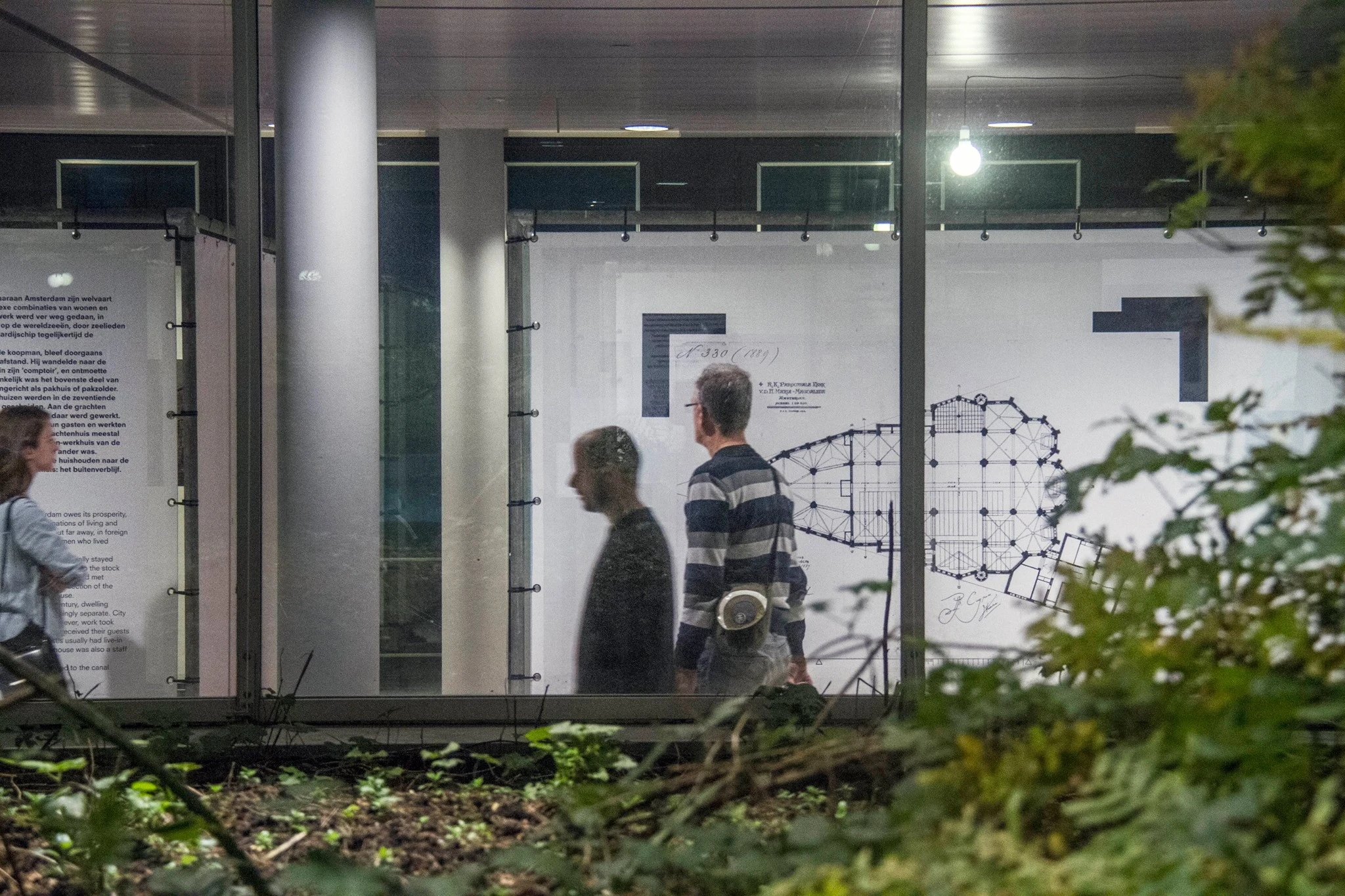
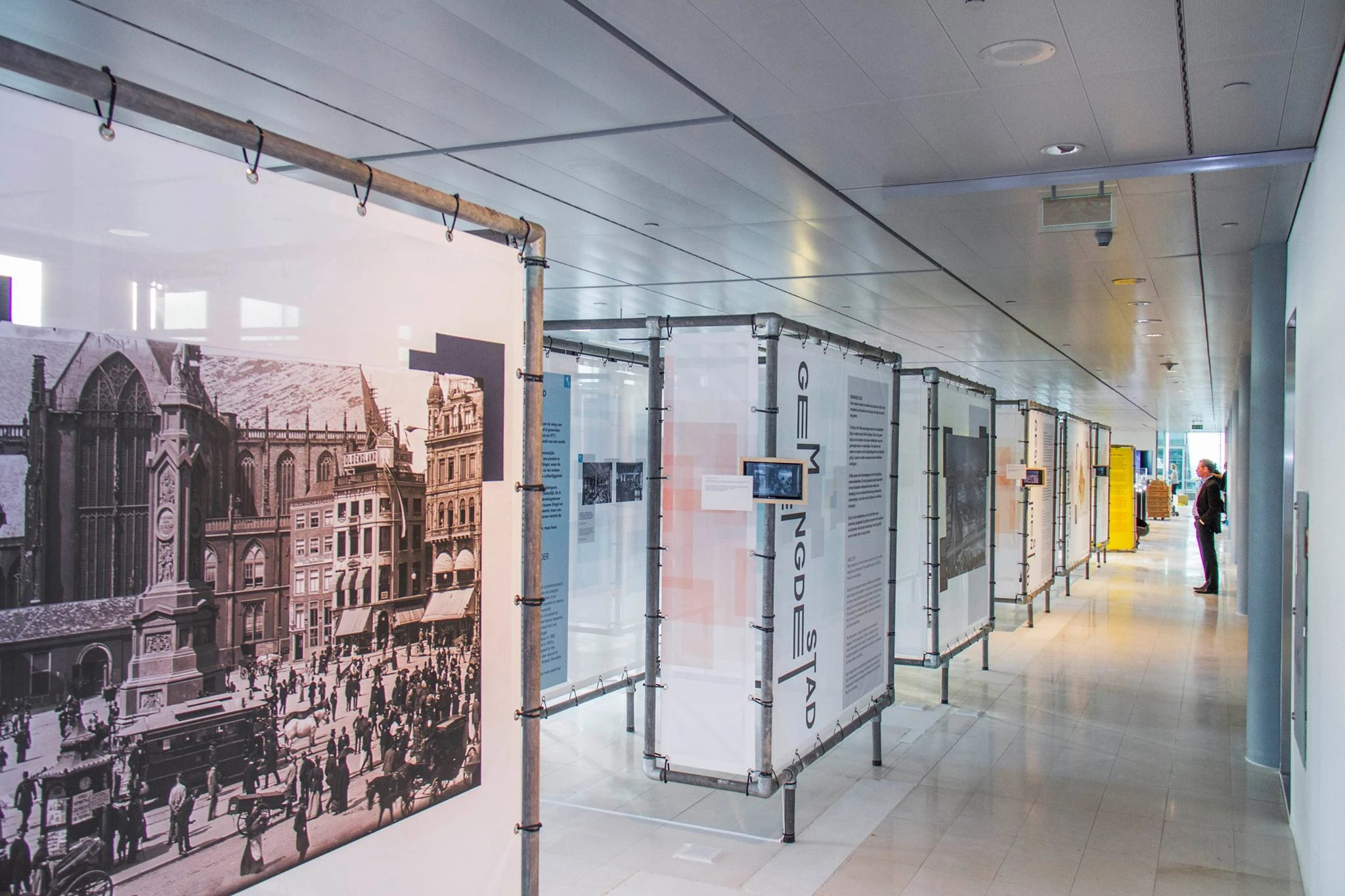
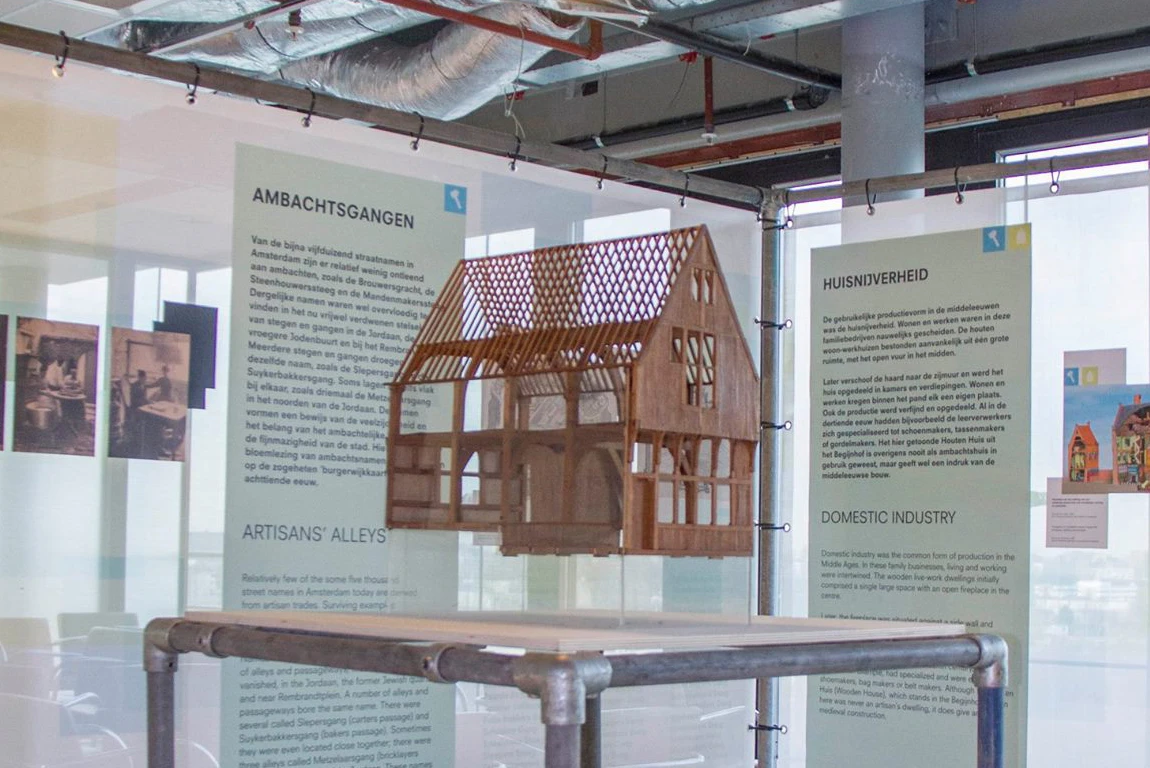
For the Architecture Center Amsterdam, Studio Daniel Ament developed Working Apart Together: an exhibition exploring the relationship between living and working as a societal and urban design challenge.
The starting point was a simple opposition: living and working as separate domains. The exhibition demonstrates that while this division has historical roots, it has never been absolute.
From home-based studios to large-scale industrial zones, and from hybrid urban blocks to new live-work concepts, the interaction between these spheres proves fundamental to urban development.
Amsterdam serves as the underlying case: how do regulations, changing housing preferences, economic structures, and mobility influence the relationship between functions? And how does this translate into the physical city?
The spatial design is conceived as a three-dimensional analysis. Diagrams, models, maps, and audiovisual layers are interwoven.
Visitors gain insight into how design decisions directly affect everyday life and urban dynamics.
Lighting, graphic elements, and spatial interventions structure the narrative, making abstract regulatory processes tangible and perceptible.
From concept to realization, the project was developed in-house, integrating analytical content, graphic design, and technical execution into one coherent whole.
Set Design
Exhibition design focused on the interplay between living and working
Opening
17-12-2015
Exhibition Concept
For the Architecture Center Amsterdam, Studio Daniel Ament developed Working Apart Together: an exhibition exploring the relationship between living and working as a societal and urban design challenge.
The starting point was a simple opposition: living and working as separate domains. The exhibition demonstrates that while this division has historical roots, it has never been absolute.
From home-based studios to large-scale industrial zones, and from hybrid urban blocks to new live-work concepts, the interaction between these spheres proves fundamental to urban development.
Amsterdam serves as the underlying case: how do regulations, changing housing preferences, economic structures, and mobility influence the relationship between functions? And how does this translate into the physical city?
The spatial design is conceived as a three-dimensional analysis. Diagrams, models, maps, and audiovisual layers are interwoven.
Visitors gain insight into how design decisions directly affect everyday life and urban dynamics.
Lighting, graphic elements, and spatial interventions structure the narrative, making abstract regulatory processes tangible and perceptible.
From concept to realization, the project was developed in-house, integrating analytical content, graphic design, and technical execution into one coherent whole.
Set Design
Exhibition design focused on the interplay between living and working


In première
October 19, 2014
Synopsis
In celebration of the 35th anniversary of the famous children’s choir Kinderen voor Kinderen, the first family musical Waanzinnig Gedroomd was created, a lively show full of music and creative set designs.
Review
“Even more fun is that the adult actors play the music themselves, in a simple but highly effective set made up of giant moving boxes that smoothly transform from a classroom to a living room or kitchen.” Theaterkrant (Henri Drost), October 25, 2014
“All of this takes place in an amazing set. Huge boxes that look like cardboard form the foundation. These blocks move throughout the show, forming a classroom and a kitchen. The actors play instruments while sitting inside these boxes.” Ilovetheater, October 22, 2014
“The set of Waanzinnig Gedroomd is a creative piece. We see three gigantic moving boxes that, with a small change, can depict different locations. Additionally, they serve as a home base for the band.” Musical Vibes (Anna Stam), October 22, 2014
Set Design
Moving boxes as multifunctional sets
Director
Ruut Weissman
Cast
Kinderen voor Kinderen
In première
October 19, 2014
Synopsis
In celebration of the 35th anniversary of the famous children’s choir Kinderen voor Kinderen, the first family musical Waanzinnig Gedroomd was created, a lively show full of music and creative set designs.
Review
“Even more fun is that the adult actors play the music themselves, in a simple but highly effective set made up of giant moving boxes that smoothly transform from a classroom to a living room or kitchen.” Theaterkrant (Henri Drost), October 25, 2014
“All of this takes place in an amazing set. Huge boxes that look like cardboard form the foundation. These blocks move throughout the show, forming a classroom and a kitchen. The actors play instruments while sitting inside these boxes.” Ilovetheater, October 22, 2014
“The set of Waanzinnig Gedroomd is a creative piece. We see three gigantic moving boxes that, with a small change, can depict different locations. Additionally, they serve as a home base for the band.” Musical Vibes (Anna Stam), October 22, 2014
Set Design
Moving boxes as multifunctional sets
Director
Ruut Weissman
Cast
Kinderen voor Kinderen


Synopsis
Farewell concert of Acda en De Munnik. The duo Acda en De Munnik is coming to an end. This theater season, Thomas Acda and Paul de Munnik will visit Dutch theaters one last time for a joint tour. Supported by their regular band, they will play the best of what they have created in seventeen years.
Premiere
2014-09-11
Director
Ruut Weissman
Cast
Thomas Acda Paul de Munnik David Middelhoff
Set Concept
Something that was good stays with you.
Synopsis
Farewell concert of Acda en De Munnik. The duo Acda en De Munnik is coming to an end. This theater season, Thomas Acda and Paul de Munnik will visit Dutch theaters one last time for a joint tour. Supported by their regular band, they will play the best of what they have created in seventeen years.
Premiere
2014-09-11
Director
Ruut Weissman
Cast
Thomas Acda Paul de Munnik David Middelhoff
Set Concept
Something that was good stays with you.


Synopsis
The Last Friend of Napoleon tells the story of the French military leader, war enthusiast, and charmer Pierre Maufroy. He entrenches himself in the stronghold of Delfzijl and refuses to surrender. Stans Roggepol, leader of the pro-Orange resistance, does everything possible to drive the bully from the northern Groningen ground.
Premiere
2014-05-29
Director
Ruut Weissman
Cast
Ellen ten Damme
Arjan Ederveen
Rianne Botma
Theatre School Amsterdam
Royal Military Band Johan Willem Friso
Set Concept
Site-specific theater; transshipment warehouse, quay, turning basin, sea dike.
Synopsis
The Last Friend of Napoleon tells the story of the French military leader, war enthusiast, and charmer Pierre Maufroy. He entrenches himself in the stronghold of Delfzijl and refuses to surrender. Stans Roggepol, leader of the pro-Orange resistance, does everything possible to drive the bully from the northern Groningen ground.
Premiere
2014-05-29
Director
Ruut Weissman
Cast
Ellen ten Damme
Arjan Ederveen
Rianne Botma
Theatre School Amsterdam
Royal Military Band Johan Willem Friso
Set Concept
Site-specific theater; transshipment warehouse, quay, turning basin, sea dike.


Opening
28 march 2014
Exhibition Concept
Stories of manor residents and their impact
Review / Article “On Friday, March 28, 2014, Museum Nienoord will open the new exhibition Hidden Stories on the upper floor of the manor. The exhibition tells the exciting stories of the manor, its residents, and their influence on the surrounding landscape through images and sound—stories that have remained hidden for a long time. Visitors can follow the three families who ruled the surrounding areas as lords of Nienoord. Special animated films for both young and old bring the past to life in a creative way. Visitors will also learn about the wealth that once existed in Nienoord, as well as the turbulent times, wars, and personal dramas. Additionally, some myths are debunked, such as the myth of the 1850 fire that supposedly severely damaged the manor. There are many activities for children, including learning a court dance, discovering how peat forms underground, and hearing the walls speak about the past.
The exhibition was designed by Daniel Ament, who has previously designed exhibitions for the Rijksmuseum and the Tropenmuseum. His design for Museum Nienoord gives the upper floor of the manor a contemporary touch. Instead of period rooms, modern audiovisual techniques are used, distinguishing the manor from other estates in Groningen. This new exhibition becomes a permanent part of Museum Nienoord, showcasing the museum’s new identity as a Groninger country estate of distinction, where regional cultural history has a natural place alongside the unique national carriage collection.” — Infoleek, 20-03-2014
Set Design
If the walls could talk
Opening
28 march 2014
Exhibition Concept
Stories of manor residents and their impact
Review / Article “On Friday, March 28, 2014, Museum Nienoord will open the new exhibition Hidden Stories on the upper floor of the manor. The exhibition tells the exciting stories of the manor, its residents, and their influence on the surrounding landscape through images and sound—stories that have remained hidden for a long time. Visitors can follow the three families who ruled the surrounding areas as lords of Nienoord. Special animated films for both young and old bring the past to life in a creative way. Visitors will also learn about the wealth that once existed in Nienoord, as well as the turbulent times, wars, and personal dramas. Additionally, some myths are debunked, such as the myth of the 1850 fire that supposedly severely damaged the manor. There are many activities for children, including learning a court dance, discovering how peat forms underground, and hearing the walls speak about the past.
The exhibition was designed by Daniel Ament, who has previously designed exhibitions for the Rijksmuseum and the Tropenmuseum. His design for Museum Nienoord gives the upper floor of the manor a contemporary touch. Instead of period rooms, modern audiovisual techniques are used, distinguishing the manor from other estates in Groningen. This new exhibition becomes a permanent part of Museum Nienoord, showcasing the museum’s new identity as a Groninger country estate of distinction, where regional cultural history has a natural place alongside the unique national carriage collection.” — Infoleek, 20-03-2014
Set Design
If the walls could talk


In première
February 21, 2014, Schouwburg Utrecht
Synopsis
Teerling is a theatrical production by Claudia de Breij, directed by Ruut Weissman. The show combines De Breij’s personal stories with visually impressive set designs. Themes range from personal life stories to larger societal issues.
Review
“In what is arguably the most beautiful set design of this cabaret season – which also includes a tribute to her hero Herman van Veen – De Breij tells her small and big stories.” Trouw (Rinske Wels), February 25, 2014
“It is a critical but contagiously optimistic speech, nestled in a stunning set and adorned with numerous surprises, small jokes, and intelligent connections.” Parool (Mike Preek), February 25, 2014
“In a spectacular set, she once again delivers a flawless program with themes that matter, never losing sight of the current events.” Telegraaf (Esther Kleuver), February 24, 2014
Set Design
Spectacular and visually stunning
Director
Ruut Weissman
Cast
Claudia de Breij
In première
February 21, 2014, Schouwburg Utrecht
Synopsis
Teerling is a theatrical production by Claudia de Breij, directed by Ruut Weissman. The show combines De Breij’s personal stories with visually impressive set designs. Themes range from personal life stories to larger societal issues.
Review
“In what is arguably the most beautiful set design of this cabaret season – which also includes a tribute to her hero Herman van Veen – De Breij tells her small and big stories.” Trouw (Rinske Wels), February 25, 2014
“It is a critical but contagiously optimistic speech, nestled in a stunning set and adorned with numerous surprises, small jokes, and intelligent connections.” Parool (Mike Preek), February 25, 2014
“In a spectacular set, she once again delivers a flawless program with themes that matter, never losing sight of the current events.” Telegraaf (Esther Kleuver), February 24, 2014
Set Design
Spectacular and visually stunning
Director
Ruut Weissman
Cast
Claudia de Breij


Opening
08-01-2014, het Rijks
Exhibition Concept
Following the exhibition “You & the Golden Age,” the Rijksmuseum expanded upon the concept of the ‘Society of Rijksgeheimen,’ which consists of eccentric scientists and historians living and working within the exhibition. One of the society’s members invented the ‘Vanallesreiniger,’ used by the cleaner Ali Dingendoek. The actual Vanallesreiniger was designed by Studio Daniel Ament.
Set Design
All-purpose cleaner
Opening
08-01-2014, het Rijks
Exhibition Concept
Following the exhibition “You & the Golden Age,” the Rijksmuseum expanded upon the concept of the ‘Society of Rijksgeheimen,’ which consists of eccentric scientists and historians living and working within the exhibition. One of the society’s members invented the ‘Vanallesreiniger,’ used by the cleaner Ali Dingendoek. The actual Vanallesreiniger was designed by Studio Daniel Ament.
Set Design
All-purpose cleaner




Exhibition Concept
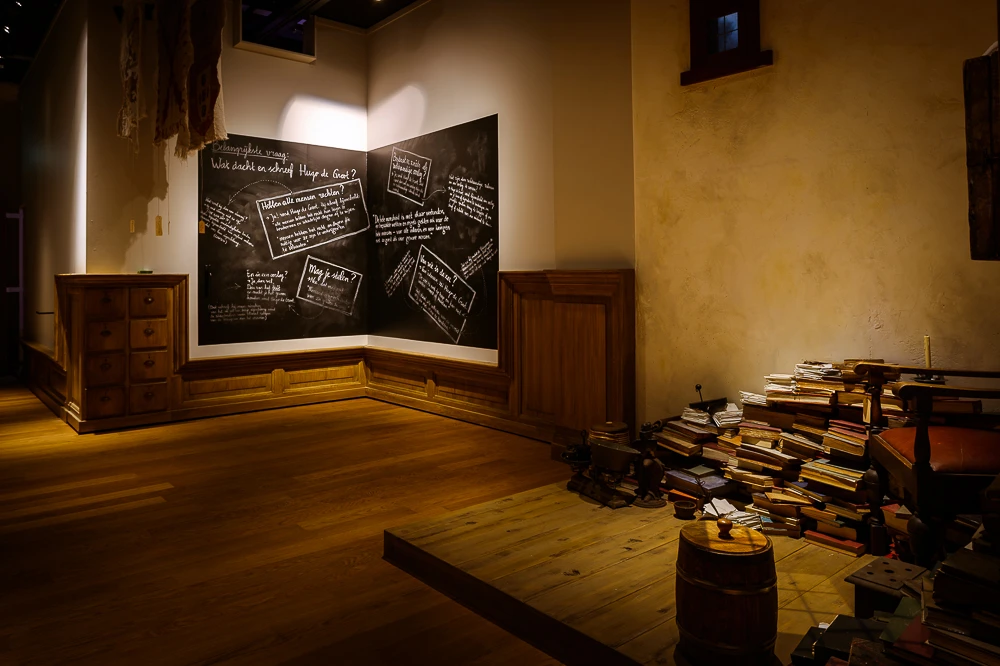
In collaboration with the Rijksmuseum, Studio Daniel Ament developed the curriculum-replacing program You & the Dutch Golden Age: an educational installation in which history is not simply told, but actively explored.
During the development of the spatial concept, we created a fictional narrative: during the renovation, when walls were demolished, a so-called secret society was discovered.
The installation approaches the Dutch Golden Age as a layered journey of discovery. Students are not spectators, but participants. By stepping into the roles of various historical figures, they reconstruct the period from multiple perspectives.
They encounter Rembrandt van Rijn and, as it were, step inside his mind: seeing through his eyes and hearing through his ears. In this way, they experience dramatic moments from his life up close, such as the birth of his son, the death of his wife, and the creation of The Night Watch. They relive Hugo Grotius’s escape in the book chest and experience the hardships of the Behouden Huys during the expedition to Nova Zembla.
Without realizing it, the students ultimately arrive at a hidden 17th-century theatre that emerges from the wall, where they perform stories for one another—half on stage, while the other half operates the theatre technology.
Scenography, lighting, sound, movement, animatronics, and interactive elements were integrally designed to elevate the educational program into a spatial experience. Museum objects functioned not as illustrations, but as anchor points. By linking physical experience with critical reflection, the result is a history lesson that combines analysis and imagination.
From concept development to spatial execution, the project was realized in-house, with content, dramaturgy, and technology designed as one cohesive system.
Award
On March 27, 2014, the educational program You & the Golden Age won the Best Practice Award, as well as the NOT innovation awards, both public and jury prizes.
Set Design Concept
A hidden space
Opening: April 9, 2014
Exhibition Concept
In collaboration with the Rijksmuseum, Studio Daniel Ament developed the curriculum-replacing program You & the Dutch Golden Age: an educational installation in which history is not simply told, but actively explored.
During the development of the spatial concept, we created a fictional narrative: during the renovation, when walls were demolished, a so-called secret society was discovered.
The installation approaches the Dutch Golden Age as a layered journey of discovery. Students are not spectators, but participants. By stepping into the roles of various historical figures, they reconstruct the period from multiple perspectives.
They encounter Rembrandt van Rijn and, as it were, step inside his mind: seeing through his eyes and hearing through his ears. In this way, they experience dramatic moments from his life up close, such as the birth of his son, the death of his wife, and the creation of The Night Watch. They relive Hugo Grotius’s escape in the book chest and experience the hardships of the Behouden Huys during the expedition to Nova Zembla.
Without realizing it, the students ultimately arrive at a hidden 17th-century theatre that emerges from the wall, where they perform stories for one another—half on stage, while the other half operates the theatre technology.
Scenography, lighting, sound, movement, animatronics, and interactive elements were integrally designed to elevate the educational program into a spatial experience. Museum objects functioned not as illustrations, but as anchor points. By linking physical experience with critical reflection, the result is a history lesson that combines analysis and imagination.
From concept development to spatial execution, the project was realized in-house, with content, dramaturgy, and technology designed as one cohesive system.
Award
On March 27, 2014, the educational program You & the Golden Age won the Best Practice Award, as well as the NOT innovation awards, both public and jury prizes.
Set Design Concept
A hidden space
Opening: April 9, 2014


Synopsis
An Iranian woman, who fled her country after her beloved was murdered during the early days of the revolution, seeks revenge on the former Empress of Persia (Iran), Farah Diba. She poses as a journalist and manages to secure an interview with the Empress. However, the truth seems to be different than she initially thought.
Set concept
A continuously shifting reality.
Premiere October 19, 2012
Production & Direction
The Glasshouse/Kees Roorda
Premiered on 19-10-2012
Featuring
Liz Snoijink
Harriët Stroet
Ali Wishka
Synopsis
An Iranian woman, who fled her country after her beloved was murdered during the early days of the revolution, seeks revenge on the former Empress of Persia (Iran), Farah Diba. She poses as a journalist and manages to secure an interview with the Empress. However, the truth seems to be different than she initially thought.
Set concept
A continuously shifting reality.
Premiere October 19, 2012
Production & Direction
The Glasshouse/Kees Roorda
Premiered on 19-10-2012
Featuring
Liz Snoijink
Harriët Stroet
Ali Wishka


Broeikas was a graduation performance of the 2011/2012 graduation year Theatre School. AHK. Under the direction of Stephen Liebman, Harold Pinter’s ‘Hot House’ script was adapted.
Synopsis
The professionalism and even sanity of the institution’s director, Roote, are undermined by his subordinates: the efficient and ambitious Gibbs, the aptly named alcoholic Lush, and Miss Cutts, Roote’s calculating and shrewd mistress who is also involved with Gibbs. After the reported murder of one patient and the rape and resulting pregnancy of another, Roote orders Gibbs to find the perpetrator(s), who it appears is Roote himself, and Gibbs supplants his boss as administrator of the corrupt “rest home,” whose inmates converge upon the staff, resulting in mayhem.
Meaning
The play has been interpreted as a searingly comic indictment of institutional bureaucracy; its black comedy and absurdism exposing hierarchical power structures anticipate Pinter’s later, more overtly political dramatic sketches and plays, such as “The New World Order” (1983), “One for the Road” (1984), and “Mountain Language” (1988).
Cast
Stephen Liebman
Britte Lachner
Geza Weiss
Sinan Eroglu
Beau Scheider
Jip Smit
Set concept
The inner world of Roote.
Broeikas was a graduation performance of the 2011/2012 graduation year Theatre School. AHK. Under the direction of Stephen Liebman, Harold Pinter’s ‘Hot House’ script was adapted.
Synopsis
The professionalism and even sanity of the institution’s director, Roote, are undermined by his subordinates: the efficient and ambitious Gibbs, the aptly named alcoholic Lush, and Miss Cutts, Roote’s calculating and shrewd mistress who is also involved with Gibbs. After the reported murder of one patient and the rape and resulting pregnancy of another, Roote orders Gibbs to find the perpetrator(s), who it appears is Roote himself, and Gibbs supplants his boss as administrator of the corrupt “rest home,” whose inmates converge upon the staff, resulting in mayhem.
Meaning
The play has been interpreted as a searingly comic indictment of institutional bureaucracy; its black comedy and absurdism exposing hierarchical power structures anticipate Pinter’s later, more overtly political dramatic sketches and plays, such as “The New World Order” (1983), “One for the Road” (1984), and “Mountain Language” (1988).
Cast
Stephen Liebman
Britte Lachner
Geza Weiss
Sinan Eroglu
Beau Scheider
Jip Smit
Set concept
The inner world of Roote.


Show concept
Using the medium of television, the comedian and TV maker discusses his feelings of bewilderment, his moments of happiness, and the rest of his life. In the hour before the break, you will get a comedic behind-the-scenes look at television and Ruben himself. After the break, the attendees will work with the provided materials to create their own TV program, something that Hilversum could only dream of. Because if Wim Bosboom can do it, surely you can too?
Premiere
September 1, 2012
Directed by
Ruben Nicolaï
Set concept
At home, in and on the tube.
Show concept
Using the medium of television, the comedian and TV maker discusses his feelings of bewilderment, his moments of happiness, and the rest of his life. In the hour before the break, you will get a comedic behind-the-scenes look at television and Ruben himself. After the break, the attendees will work with the provided materials to create their own TV program, something that Hilversum could only dream of. Because if Wim Bosboom can do it, surely you can too?
Premiere
September 1, 2012
Directed by
Ruben Nicolaï
Set concept
At home, in and on the tube.


Premiere
01-03-2012
Review
Review by Joukje Akveld
Published: March 27, 2012
Seen: March 26, 2012, DeLaMar Amsterdam
That little dance by Thomas Acda. How he bounces around the stage like a happy puppy. How he spins and twirls, swinging his hip into the air. How he skips, whirls, flutters, flaps, and leaps – as if he loves nothing more. All to the enchanting sounds of “Hoor de wind waait door de bomen,” performed by Gordon (yes, indeed). That dance can be written into the history of cabaret.
It’s a bit of a fremdkörper in “’t Heerst,” this exuberant choreography in the new theater show by Acda and De Munnik. The show actually deals with quite serious matters: people trying to catch their breath in a society that just keeps moving forward. Indifference, no longer listening to each other, avoiding responsibilities.
Thomas Acda and Paul de Munnik chose a theatrical setting to bring their story to light: the eye of an apocalyptic storm, where everything has come to a standstill. The Ford they were driving, the cow flying through the air, the man, the umbrella – everything is frozen in a visually exuberant set by Daniel Ament. As contemporary versions of Vladimir and Estragon from Beckett’s “Waiting for Godot” (high shoes, big coats, bowler hats), the duo stands still and passes the time with nonsensical games, aimless wandering, philosophical reflections, and wistful listening songs. It’s pure cabaret: a balanced mix of music and personal stories with a theatrical touch.
What becomes clear again in this sixth theater program is that Acda is the real actor of the two, the comedian, who manages to infuse humor even in casually messing around with a walking stick. Just as he did in his song about the prostitute Esmee, he now conducts a cleverly thought-out conversation with an invisible listener, where you only hear his half of the dialogue. Moments later, he loses himself in an incomparable monologue about sex with Zwarte Piet and what that does to a child’s soul.
His seemingly casual chatter is full of linguistically humorous asides. De Munnik is the sounding board, the friendly giant who occasionally tries to make a point but never insistently stands his ground. He is the rock that is not blown over by Acda’s capriciousness and more importantly: he is the musical counterpoint. Without De Munnik’s sonorous voice, there is no harmonious unity, no soulful polyphony, no beautifully quieting piano solos.
“’t Heerst” is not fundamentally different from what Acda and De Munnik did in their previous programs, not innovative as you might hope after so many years of collaboration, but the craftsmanship of this feel-good theater show seeps through in every aspect. From the guitar playing of the hidden David Middelhoff in the set to the mild irony with which they poke fun at each other and themselves. From the musically and lyrically beautiful “Jij hoort bij mij” to the fine James Taylor adaptation. And that little dance, it deserves an extra star.
Director
Ruut Weissmann
Cast
Thomas Acda
Paul de Munnik
David Middelhoff
Premiere
01-03-2012
Review
Review by Joukje Akveld
Published: March 27, 2012
Seen: March 26, 2012, DeLaMar Amsterdam
That little dance by Thomas Acda. How he bounces around the stage like a happy puppy. How he spins and twirls, swinging his hip into the air. How he skips, whirls, flutters, flaps, and leaps – as if he loves nothing more. All to the enchanting sounds of “Hoor de wind waait door de bomen,” performed by Gordon (yes, indeed). That dance can be written into the history of cabaret.
It’s a bit of a fremdkörper in “’t Heerst,” this exuberant choreography in the new theater show by Acda and De Munnik. The show actually deals with quite serious matters: people trying to catch their breath in a society that just keeps moving forward. Indifference, no longer listening to each other, avoiding responsibilities.
Thomas Acda and Paul de Munnik chose a theatrical setting to bring their story to light: the eye of an apocalyptic storm, where everything has come to a standstill. The Ford they were driving, the cow flying through the air, the man, the umbrella – everything is frozen in a visually exuberant set by Daniel Ament. As contemporary versions of Vladimir and Estragon from Beckett’s “Waiting for Godot” (high shoes, big coats, bowler hats), the duo stands still and passes the time with nonsensical games, aimless wandering, philosophical reflections, and wistful listening songs. It’s pure cabaret: a balanced mix of music and personal stories with a theatrical touch.
What becomes clear again in this sixth theater program is that Acda is the real actor of the two, the comedian, who manages to infuse humor even in casually messing around with a walking stick. Just as he did in his song about the prostitute Esmee, he now conducts a cleverly thought-out conversation with an invisible listener, where you only hear his half of the dialogue. Moments later, he loses himself in an incomparable monologue about sex with Zwarte Piet and what that does to a child’s soul.
His seemingly casual chatter is full of linguistically humorous asides. De Munnik is the sounding board, the friendly giant who occasionally tries to make a point but never insistently stands his ground. He is the rock that is not blown over by Acda’s capriciousness and more importantly: he is the musical counterpoint. Without De Munnik’s sonorous voice, there is no harmonious unity, no soulful polyphony, no beautifully quieting piano solos.
“’t Heerst” is not fundamentally different from what Acda and De Munnik did in their previous programs, not innovative as you might hope after so many years of collaboration, but the craftsmanship of this feel-good theater show seeps through in every aspect. From the guitar playing of the hidden David Middelhoff in the set to the mild irony with which they poke fun at each other and themselves. From the musically and lyrically beautiful “Jij hoort bij mij” to the fine James Taylor adaptation. And that little dance, it deserves an extra star.
Director
Ruut Weissmann
Cast
Thomas Acda
Paul de Munnik
David Middelhoff


In première
October 17th, 2012
Synopsis
Aap and Bear is a bold road trip through Wim Hofman’s ABC book. In this physical and captivating show filled with hilarious confrontations, absurd dialogues, and unexpected spectacle, Aap and Bear are on a quest for a mysterious treasure. Along the way, they encounter various monosyllabic things and animals, in an adventure that starts with A and ends with Z.
Review
“With cabaret-style flair, Raaijmakers and Geerlings race through the letters of the alphabet. Slapstick, humor, clever dialogue, letter jokes at kindergarten level, philosophical bits, puppetry, and visual spectacle – it all breathes an original and fresh energy.”
— VSCD Youth Theater Jury
“Rarely has the alphabet been approached as unconventionally as by the young theater makers Job Raaijmakers and René Geerlings.”
— Het Parool (Joukje Akveld), ★★★★
“Hilarious mime art at the highest level.”
— De Volkskrant (Annette Embrechts), ★★★★
Set Design
All the letters of the alphabet
Director
Martin Hofstra
Cast
Job Raaijmakers
René Geerlings
In première
October 17th, 2012
Synopsis
Aap and Bear is a bold road trip through Wim Hofman’s ABC book. In this physical and captivating show filled with hilarious confrontations, absurd dialogues, and unexpected spectacle, Aap and Bear are on a quest for a mysterious treasure. Along the way, they encounter various monosyllabic things and animals, in an adventure that starts with A and ends with Z.
Review
“With cabaret-style flair, Raaijmakers and Geerlings race through the letters of the alphabet. Slapstick, humor, clever dialogue, letter jokes at kindergarten level, philosophical bits, puppetry, and visual spectacle – it all breathes an original and fresh energy.”
— VSCD Youth Theater Jury
“Rarely has the alphabet been approached as unconventionally as by the young theater makers Job Raaijmakers and René Geerlings.”
— Het Parool (Joukje Akveld), ★★★★
“Hilarious mime art at the highest level.”
— De Volkskrant (Annette Embrechts), ★★★★
Set Design
All the letters of the alphabet
Director
Martin Hofstra
Cast
Job Raaijmakers
René Geerlings


In première
September 2011
Synopsis
In Fugu betreedt de ‘koningin van de mime’, Karina Holla, het podium samen met de Japanse danser Kenzo Kusuda. Het gedachtegoed van Kafka en Murakami komt samen in een verhaal over leven, ziekte, liefde, en dood, waarbij genezing en verzoening centraal staan. De titel Fugu verwijst naar de giftige kogelvis, maar kan ook worden uitgesproken als Fuku, wat geluk betekent. Karina Holla speelt al vijfentwintig jaar een belangrijke rol in het mimetheater.
Decorconcept
Minimalistisch en symbolisch
Regie
Rob Ligthert
Choreografie
Kenzo Kusuda & Karina Holla
Lichtontwerp
Andre Pronk
Fotografie
Ben van Duin & Andre Pronk
In première
September 2011
Synopsis
In Fugu betreedt de ‘koningin van de mime’, Karina Holla, het podium samen met de Japanse danser Kenzo Kusuda. Het gedachtegoed van Kafka en Murakami komt samen in een verhaal over leven, ziekte, liefde, en dood, waarbij genezing en verzoening centraal staan. De titel Fugu verwijst naar de giftige kogelvis, maar kan ook worden uitgesproken als Fuku, wat geluk betekent. Karina Holla speelt al vijfentwintig jaar een belangrijke rol in het mimetheater.
Decorconcept
Minimalistisch en symbolisch
Regie
Rob Ligthert
Choreografie
Kenzo Kusuda & Karina Holla
Lichtontwerp
Andre Pronk
Fotografie
Ben van Duin & Andre Pronk




Opening
June 15, 2011
Exhibition Concept
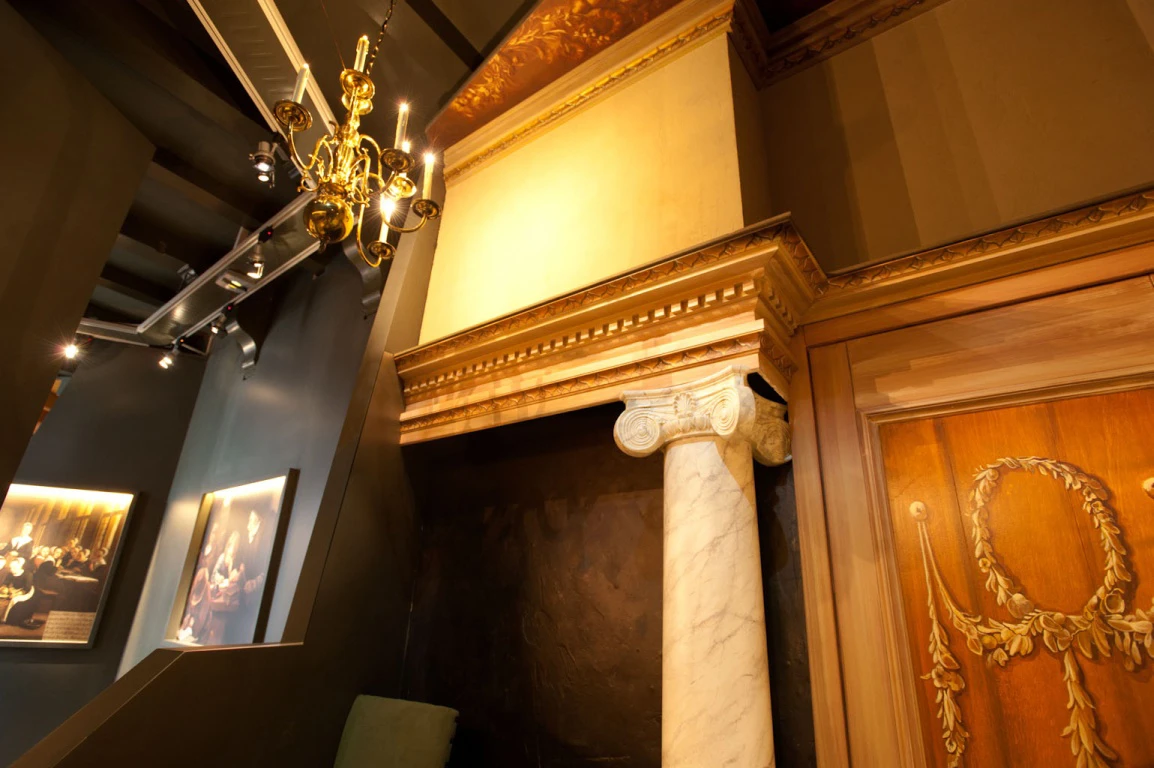
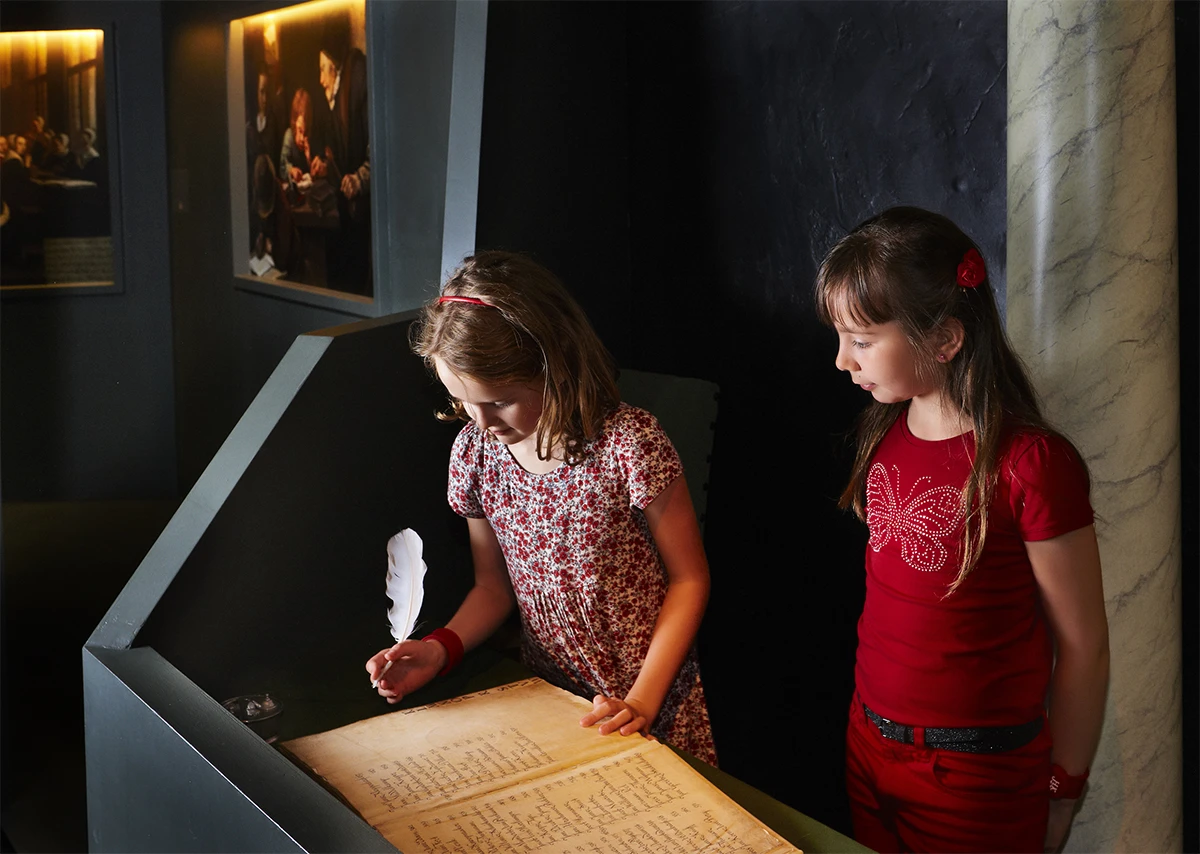
The Little Orphanage was a children’s presentation at the Amsterdam Museum, specially created for families with children aged 4 and up, which brings life in the 17th-century Civic Orphanage to life in an exciting way.
Scenario
The visitors report to the doorman, but he is not there for a moment. While they wait for him, they are whispered to through the cracks in the floor above them. It is Jurriaan, a little orphan boy. He has a secret and a problem and asks the visitors to help him. To do so, they must sneak inside before the doorman returns. Jurriaan completes carpentry training and may end up working at the VOC shipyard if he does not receive adoptive parents, but he cannot believe that his parents might no longer exist. He has all sorts of clues to this effect and asks the visitor to help search in areas of the orphanage where he is not allowed to go. How does this end?
Script
The visitors must set out unseen, so hold your breath and be completely silent. With a special token on a wristband (RFID tag), the visitors bring objects to life by whispering, learn about life in the orphanage and the customs of the past, and receive hints, answers, and instructions from the objects on an individual basis. A complex show-control system runs that precisely tracks what an individual visitor already knows and determines, per individual, which information the visitor will hear at the next whispering object that is activated. In this way, the visitor becomes part of the story on a dramaturgical level. For the very youngest visitors, there are all kinds of crawl-throughs and sneak-throughs where they discover hidden (stuffed) animals in a fabulous setting, end up behind paintings in walls and cupboards, and can secretly spy on each other, while children aged 7 and up go on an adventure with the orphan boy Jurriaan to find his parents.
Review / Article
“In a tasteful decor designed with much love and an eye for detail, the small sub-stories in the thematically arranged discovery corners, together with small puzzles, form the puzzle pieces for the big story.” — Jury Report Golden Heron Awards 2012
Award
Nomination Golden Heron 2012 for meticulousness and creativity on a small budget
Decor Concept
Fragments of the Past
Opening
June 15, 2011
Exhibition Concept
The Little Orphanage was a children’s presentation at the Amsterdam Museum, specially created for families with children aged 4 and up, which brings life in the 17th-century Civic Orphanage to life in an exciting way.
Scenario
The visitors report to the doorman, but he is not there for a moment. While they wait for him, they are whispered to through the cracks in the floor above them. It is Jurriaan, a little orphan boy. He has a secret and a problem and asks the visitors to help him. To do so, they must sneak inside before the doorman returns. Jurriaan completes carpentry training and may end up working at the VOC shipyard if he does not receive adoptive parents, but he cannot believe that his parents might no longer exist. He has all sorts of clues to this effect and asks the visitor to help search in areas of the orphanage where he is not allowed to go. How does this end?
Script
The visitors must set out unseen, so hold your breath and be completely silent. With a special token on a wristband (RFID tag), the visitors bring objects to life by whispering, learn about life in the orphanage and the customs of the past, and receive hints, answers, and instructions from the objects on an individual basis. A complex show-control system runs that precisely tracks what an individual visitor already knows and determines, per individual, which information the visitor will hear at the next whispering object that is activated. In this way, the visitor becomes part of the story on a dramaturgical level. For the very youngest visitors, there are all kinds of crawl-throughs and sneak-throughs where they discover hidden (stuffed) animals in a fabulous setting, end up behind paintings in walls and cupboards, and can secretly spy on each other, while children aged 7 and up go on an adventure with the orphan boy Jurriaan to find his parents.
Review / Article
“In a tasteful decor designed with much love and an eye for detail, the small sub-stories in the thematically arranged discovery corners, together with small puzzles, form the puzzle pieces for the big story.” — Jury Report Golden Heron Awards 2012
Award
Nomination Golden Heron 2012 for meticulousness and creativity on a small budget
Decor Concept
Fragments of the Past


In première
March 10, 2016, Theater De Flint, Amersfoort
Synopsis
In High Season, Lenette van Dongen, with humor and self-deprecation, tackles the collective pressure to be happy. After her thorough cleaning in NIKÈ, she finally gets to go on vacation but quickly becomes lost in a parade of inflatable crocodiles, coolers, and flip-flops. Lenette challenges the façade of forced joy and explores the difference between happiness and contentment. Her performance is filled with hilarious observations and touching moments.
Review
Volkskrant (****):
“Lenette van Dongen comes uncomfortably close to answering big questions with her program. With an attractive combination of coarse language and charm, Van Dongen keeps the audience fully engaged.”
“Strong punchline. She expertly plays on the familiarity of daily clumsiness. Joke after joke after joke, leading to a near-constant wave of laughter in the hall.”
“A master tamer.”
Telegraaf (****):
“Lenette van Dongen shines in High Season. High Season is a captivating show. Van Dongen effortlessly captivates the audience with her eighth program.”
NRC (****):
“Everyone truly happy every day. When it comes to everyday inconveniences and daily worries, Lenette van Dongen is often at her best. That’s once again evident in her new program High Season. There aren’t many who can do it like she does: effortlessly switching between exuberant and subtle. Waves of hilarity.”
Trouw:
“Van Dongen’s show is a highlight. Few of her fellow comedians master the art of interaction with the audience as she does. Such courage. And how quick-witted!”
Set Design
An impossible-to-climb mountain
In première
March 10, 2016, Theater De Flint, Amersfoort
Synopsis
In High Season, Lenette van Dongen, with humor and self-deprecation, tackles the collective pressure to be happy. After her thorough cleaning in NIKÈ, she finally gets to go on vacation but quickly becomes lost in a parade of inflatable crocodiles, coolers, and flip-flops. Lenette challenges the façade of forced joy and explores the difference between happiness and contentment. Her performance is filled with hilarious observations and touching moments.
Review
Volkskrant (****):
“Lenette van Dongen comes uncomfortably close to answering big questions with her program. With an attractive combination of coarse language and charm, Van Dongen keeps the audience fully engaged.”
“Strong punchline. She expertly plays on the familiarity of daily clumsiness. Joke after joke after joke, leading to a near-constant wave of laughter in the hall.”
“A master tamer.”
Telegraaf (****):
“Lenette van Dongen shines in High Season. High Season is a captivating show. Van Dongen effortlessly captivates the audience with her eighth program.”
NRC (****):
“Everyone truly happy every day. When it comes to everyday inconveniences and daily worries, Lenette van Dongen is often at her best. That’s once again evident in her new program High Season. There aren’t many who can do it like she does: effortlessly switching between exuberant and subtle. Waves of hilarity.”
Trouw:
“Van Dongen’s show is a highlight. Few of her fellow comedians master the art of interaction with the audience as she does. Such courage. And how quick-witted!”
Set Design
An impossible-to-climb mountain

In première
January 28, 2011
Synopsis
In search of oil, geologist Herbert Kahmer, his wife Eva, and engineer Edgar Bron find themselves in an imaginary third-world country plagued by war and inhabited by reindeer, mosquitoes, and nomads. Most of the natural resources have already been extracted by multinationals, but the remaining bit of oil must still be taken.
While the men spend three years searching for oil, Eva waits in a provincial town, living in fear of attacks. She resides in the basement of their home, surrounded by alcohol, her helper Gomua, and a guilty conscience. On the day the men finally strike oil, catastrophe ensues.
Explanation of the Effect
Due to excessive drinking, the story increasingly feels as though it is being seen through the lens of a delirium. Gomua cries on the couch as Eva lashes out at her. She becomes increasingly aggressive and storms towards Gomua, who cowers in fear of being struck. But when Eva grabs her shoulder, suddenly, it is another woman.
Set Design
Set design: Bernhard Hammer
Special FX: Daniel Ament
Director
Theu Boermans
Cast
Tamar van den Dop
Marcel Hensema
Myranda Jongeling
Eva Marie de Waal
Joris Smit
In première
January 28, 2011
Synopsis
In search of oil, geologist Herbert Kahmer, his wife Eva, and engineer Edgar Bron find themselves in an imaginary third-world country plagued by war and inhabited by reindeer, mosquitoes, and nomads. Most of the natural resources have already been extracted by multinationals, but the remaining bit of oil must still be taken.
While the men spend three years searching for oil, Eva waits in a provincial town, living in fear of attacks. She resides in the basement of their home, surrounded by alcohol, her helper Gomua, and a guilty conscience. On the day the men finally strike oil, catastrophe ensues.
Explanation of the Effect
Due to excessive drinking, the story increasingly feels as though it is being seen through the lens of a delirium. Gomua cries on the couch as Eva lashes out at her. She becomes increasingly aggressive and storms towards Gomua, who cowers in fear of being struck. But when Eva grabs her shoulder, suddenly, it is another woman.
Set Design
Set design: Bernhard Hammer
Special FX: Daniel Ament
Director
Theu Boermans
Cast
Tamar van den Dop
Marcel Hensema
Myranda Jongeling
Eva Marie de Waal
Joris Smit


Premiere
16 September 2010
Synopsis
With knees, feet, hands, and heads wrapped in white bandages, three women sit in an entirely white space, staring into the distance as the audience enters the Bovenzaal of Haarlem’s Toneelschuur. A man sings a lullaby, accompanied by the soft groaning of the three women. What follows is a dreamlike sequence of humorous and poetic images, in which the three women demonstrate that they have not lost any of their strength.
In Swan Song, Karina Holla continues her personal approach. This performance about the strength and vulnerability of the aging body was created with three ‘senior’ performers: Pauline Daniëls, Bambi Uden, and Elsje de Wijn. The show is an associative presentation of a state of being, blending personal memories with choreography that references classical ballets like Swan Lake. Despite the aging of their bodies, the women’s graceful suppleness shines through in the dance sequences.
Review
At first, this ‘state of being’ is mostly a mournful and pitiable affair. In a hospital-like space, we find the three women confined to wheelchairs and hospital beds, wrapped in white bandages. But gradually, their bodies begin to move. Dancer Andreas Denk removes their bandages, restoring their youthfulness and femininity. He invites them to partake in playful dances, lifting them like light feathers. The power of the performance lies in its poetic moments – to grow old like this!
By Erica Smits
Set Design Concept
White, clinical space as hospital or afterlife
Direction
Karina Holla and Gerardjan Rijnders
Cast
Pauline Daniëls
Bambi Uden
Elsje de Wijn
Andreas Denk
Premiere
16 September 2010
Synopsis
With knees, feet, hands, and heads wrapped in white bandages, three women sit in an entirely white space, staring into the distance as the audience enters the Bovenzaal of Haarlem’s Toneelschuur. A man sings a lullaby, accompanied by the soft groaning of the three women. What follows is a dreamlike sequence of humorous and poetic images, in which the three women demonstrate that they have not lost any of their strength.
In Swan Song, Karina Holla continues her personal approach. This performance about the strength and vulnerability of the aging body was created with three ‘senior’ performers: Pauline Daniëls, Bambi Uden, and Elsje de Wijn. The show is an associative presentation of a state of being, blending personal memories with choreography that references classical ballets like Swan Lake. Despite the aging of their bodies, the women’s graceful suppleness shines through in the dance sequences.
Review
At first, this ‘state of being’ is mostly a mournful and pitiable affair. In a hospital-like space, we find the three women confined to wheelchairs and hospital beds, wrapped in white bandages. But gradually, their bodies begin to move. Dancer Andreas Denk removes their bandages, restoring their youthfulness and femininity. He invites them to partake in playful dances, lifting them like light feathers. The power of the performance lies in its poetic moments – to grow old like this!
By Erica Smits
Set Design Concept
White, clinical space as hospital or afterlife
Direction
Karina Holla and Gerardjan Rijnders
Cast
Pauline Daniëls
Bambi Uden
Elsje de Wijn
Andreas Denk


Campaign Image for the SP
An oversized scouring sponge as a campaign prop commissioned by the graphic design agency Thonik.
Campaign Image for the SP
An oversized scouring sponge as a campaign prop commissioned by the graphic design agency Thonik.


Premiere
February 12, 2010
Synopsis
With merely the image of an opening scene in which a child on a tricycle with a porcelain head is shattered by a demon and the theme of “jealousy,” Daniel developed the concept of designing a scenography where one enters the other side of the mirror as a metaphor for the unconscious mental space within our ego. In this reality, we only see what a sliver of light falls upon, with the context consistently disappearing into the great nothingness. As with almost every set by Daniel, this set also represents the protagonist’s interior, in which even the dark side or antagonist of the self is portrayed.
Set Design Concept
Imagining the unconscious space
Direction
Jakop Ahlbom
Lighting Design
In collaboration with Stefan Dijkman
Premiere
February 12, 2010
Synopsis
With merely the image of an opening scene in which a child on a tricycle with a porcelain head is shattered by a demon and the theme of “jealousy,” Daniel developed the concept of designing a scenography where one enters the other side of the mirror as a metaphor for the unconscious mental space within our ego. In this reality, we only see what a sliver of light falls upon, with the context consistently disappearing into the great nothingness. As with almost every set by Daniel, this set also represents the protagonist’s interior, in which even the dark side or antagonist of the self is portrayed.
Set Design Concept
Imagining the unconscious space
Direction
Jakop Ahlbom
Lighting Design
In collaboration with Stefan Dijkman


In première
December 11, 2009, location: DeLaMar Theater, Amsterdam
Synopsis
The Architect follows the life of Edith and her tyrannical husband Arthur, who forces his wife, originally named Rosa, to change her name. The sterile and white set design of their home reflects their cold relationship, which is put to the test with the arrival of a young couple next door. As surreal elements infiltrate the set, Edith’s latent feelings of hatred are awakened, and her desire for revenge on Arthur grows. The play explores the effects of years of oppression and concludes with an unexpected twist as Edith cunningly dismantles her domineering husband.
Review
“The Architect is a play that grips you, with a stellar performance by Leny Breederveld as Edith/Rosa.”
Set Design
Sleek and sterile, with surreal elements
Creative Team
Director: Jakop Ahlbom
Cast: Leny Breederveld, Aat Ceelen, Sandra Mattie, Harpert Michielsen
Text: Marijke Schermer
Scenography: Daniël Ament
Dramaturgy: Jeroen van den Berg
Costumes: Zita Winnubst
Sound Design: Wim Conradi
Lighting Design: Rob Galdermans
Technical Team: Rob Galdermans, Dirk Houthoff, Bas Standaar/ André Goos
Props: Benedict Altena, Smids & Hooijboer
Hair and Makeup: Pilo Pilkes
Set Construction: Brinkman Decor Zaandam
Production and Management: Alles voor de Kunsten; Meeke Beumer, Wilma Kuite, Markell Helmann, Eva Bosgraaf
Publicity: Eva Schneider
Stage Photography: Stephan van Hesteren
In première
December 11, 2009, location: DeLaMar Theater, Amsterdam
Synopsis
The Architect follows the life of Edith and her tyrannical husband Arthur, who forces his wife, originally named Rosa, to change her name. The sterile and white set design of their home reflects their cold relationship, which is put to the test with the arrival of a young couple next door. As surreal elements infiltrate the set, Edith’s latent feelings of hatred are awakened, and her desire for revenge on Arthur grows. The play explores the effects of years of oppression and concludes with an unexpected twist as Edith cunningly dismantles her domineering husband.
Review
“The Architect is a play that grips you, with a stellar performance by Leny Breederveld as Edith/Rosa.”
Set Design
Sleek and sterile, with surreal elements
Creative Team
Director: Jakop Ahlbom
Cast: Leny Breederveld, Aat Ceelen, Sandra Mattie, Harpert Michielsen
Text: Marijke Schermer
Scenography: Daniël Ament
Dramaturgy: Jeroen van den Berg
Costumes: Zita Winnubst
Sound Design: Wim Conradi
Lighting Design: Rob Galdermans
Technical Team: Rob Galdermans, Dirk Houthoff, Bas Standaar/ André Goos
Props: Benedict Altena, Smids & Hooijboer
Hair and Makeup: Pilo Pilkes
Set Construction: Brinkman Decor Zaandam
Production and Management: Alles voor de Kunsten; Meeke Beumer, Wilma Kuite, Markell Helmann, Eva Bosgraaf
Publicity: Eva Schneider
Stage Photography: Stephan van Hesteren


Opening
October 9, 2009
Exhibition Concept
For the former Tropenmuseum (now Wereldmuseum), Studio Daniel Ament, together with the Tropenmuseum Junior team, developed The Qi of China: an interactive exhibition in which culture is presented as a living practice.
At its core is the concept of Qi, the energy that, according to Chinese tradition, flows through everything and everyone.
Through participation, abstract philosophical concepts are made physically tangible for school groups (ages 6–13) and families across three different programs.
Nothing in this exhibition is behind glass. Objects and spaces are part of an active parcours in which visitors act, move, and create.
Spaces such as a tea house, calligraphy studio, umbrella factory, traditional Chinese medicine room, afterlife space, Feng Shui office, restaurant kitchen, karaoke room, and Kung Fu city parcours function as scenographic environments where cultural practices are experienced.
Visitors engage in activities such as tai chi, kung fu, Feng Shui design, calligraphy, karaoke, cooking, and healing—each contributing to the flow of Qi.
Facilitators act not only as guides, but as performers within the spatial narrative.
A key element was the integration of media and participation: the so-called Qi jump was filmed and linked to an online game, extending the experience beyond the physical exhibition.
Set Design
Air of concrete.
Opening
October 9, 2009
Exhibition Concept
For the former Tropenmuseum (now Wereldmuseum), Studio Daniel Ament, together with the Tropenmuseum Junior team, developed The Qi of China: an interactive exhibition in which culture is presented as a living practice.
At its core is the concept of Qi, the energy that, according to Chinese tradition, flows through everything and everyone.
Through participation, abstract philosophical concepts are made physically tangible for school groups (ages 6–13) and families across three different programs.
Nothing in this exhibition is behind glass. Objects and spaces are part of an active parcours in which visitors act, move, and create.
Spaces such as a tea house, calligraphy studio, umbrella factory, traditional Chinese medicine room, afterlife space, Feng Shui office, restaurant kitchen, karaoke room, and Kung Fu city parcours function as scenographic environments where cultural practices are experienced.
Visitors engage in activities such as tai chi, kung fu, Feng Shui design, calligraphy, karaoke, cooking, and healing—each contributing to the flow of Qi.
Facilitators act not only as guides, but as performers within the spatial narrative.
A key element was the integration of media and participation: the so-called Qi jump was filmed and linked to an online game, extending the experience beyond the physical exhibition.
Set Design
Air of concrete.


Opening
November 15, 2008
Exhibition Concept
The Marco Polo in Amsterdam project by the Dutch Opera, led by Anthony Heidweiller, brings art into the community through mini-operas and choir projects. With a focus on the city’s diversity and intercultural connections, activities ranged from music performances and cultural encounters to a Silk Route Bus featuring opera music and documentary screenings.
Studio Daniel Ament was loaned a city bus, with the condition that it had to be returned in its exact original form post-project. They transformed it into a reflective vehicle that mirrored its surroundings, blending in like a chameleon, and capturing the attention of passersby. Inside, visitors were welcomed with coffee and invited to explore mini-documentaries through view boxes, showcasing projects where various schools collaborated intensely with international musicians from key Silk Route regions. At the back of the bus, a small cinema allowed visitors to experience the full documentary of the performances.
Set Design Concept
Community art: connecting art within the city.
Award
Winner of the National Events Prize for Most Innovative Event in 2008.
Opening
November 15, 2008
Exhibition Concept
The Marco Polo in Amsterdam project by the Dutch Opera, led by Anthony Heidweiller, brings art into the community through mini-operas and choir projects. With a focus on the city’s diversity and intercultural connections, activities ranged from music performances and cultural encounters to a Silk Route Bus featuring opera music and documentary screenings.
Studio Daniel Ament was loaned a city bus, with the condition that it had to be returned in its exact original form post-project. They transformed it into a reflective vehicle that mirrored its surroundings, blending in like a chameleon, and capturing the attention of passersby. Inside, visitors were welcomed with coffee and invited to explore mini-documentaries through view boxes, showcasing projects where various schools collaborated intensely with international musicians from key Silk Route regions. At the back of the bus, a small cinema allowed visitors to experience the full documentary of the performances.
Set Design Concept
Community art: connecting art within the city.
Award
Winner of the National Events Prize for Most Innovative Event in 2008.


Opening
November 15, 2008
Exhibition Concept
The Marco Polo in Amsterdam project by the Dutch Opera, led by Anthony Heidweiller, brings art into the community through mini-operas and choir projects. The focus is on the city’s diversity and intercultural connections. From the Zeedijk to the Silk Route, activities include music performances, cultural encounters, a Silk Route bus featuring opera music and documentary screenings, and a Song Pillar installed at various semi-public locations. Passersby are invited to spontaneously sing, record, and become part of the “vocal map” of the Netherlands. Studio Daniel Ament translated this challenge into a functional installation, designing the Song Pillar to be intuitive and inviting for these locations, encouraging participants to sing wholeheartedly while subtly experiencing that their voice became quieter to the surrounding area as they approached the pillar.
Set Design Concept
Community art: connecting art within the city.
Award
Winner of the National Events Prize for Most Innovative Event in 2005.
Opening
November 15, 2008
Exhibition Concept
The Marco Polo in Amsterdam project by the Dutch Opera, led by Anthony Heidweiller, brings art into the community through mini-operas and choir projects. The focus is on the city’s diversity and intercultural connections. From the Zeedijk to the Silk Route, activities include music performances, cultural encounters, a Silk Route bus featuring opera music and documentary screenings, and a Song Pillar installed at various semi-public locations. Passersby are invited to spontaneously sing, record, and become part of the “vocal map” of the Netherlands. Studio Daniel Ament translated this challenge into a functional installation, designing the Song Pillar to be intuitive and inviting for these locations, encouraging participants to sing wholeheartedly while subtly experiencing that their voice became quieter to the surrounding area as they approached the pillar.
Set Design Concept
Community art: connecting art within the city.
Award
Winner of the National Events Prize for Most Innovative Event in 2005.

Premiere
7 May 2008
Synopsis
A visit to the production Bombay is like a fantasy journey to a slum in India’s largest city. Upon entering the Hague’s Theater Zwembad de Regentes, Indian girls give the audience a lucky bracelet and a number, after which a friendly guide leads you through long corridors to a cardboard-built neighborhood full of shops, living rooms, bars, clotheslines, and garbage. Under the direction of Liesbeth Coltof and choreography by Sassan Saghar Yagmahi, twelve actors, dancers, and singers bring to life the hectic existence in a city where fate determines your future. The performance addresses themes such as poverty, exploitation, and child labor, while it remains full of vitality and imagination.
Review
The production showcases the art of survival between Bollywood and the garbage dump, offering a glimpse behind the scenes of Bombay. With captivating music, dance, masks, and puppetry, Huis aan de Amstel bridges the gap between the Netherlands and India. It delivers an explosive and realistic portrayal of the city.
Set Design Concept
Crowded city of cardboard.
Direction
Liesbeth Coltof
Choreography
Sassan Saghar Yagmahi
Cast
Twelve actors, dancers, and singers
Premiere
7 May 2008
Synopsis
A visit to the production Bombay is like a fantasy journey to a slum in India’s largest city. Upon entering the Hague’s Theater Zwembad de Regentes, Indian girls give the audience a lucky bracelet and a number, after which a friendly guide leads you through long corridors to a cardboard-built neighborhood full of shops, living rooms, bars, clotheslines, and garbage. Under the direction of Liesbeth Coltof and choreography by Sassan Saghar Yagmahi, twelve actors, dancers, and singers bring to life the hectic existence in a city where fate determines your future. The performance addresses themes such as poverty, exploitation, and child labor, while it remains full of vitality and imagination.
Review
The production showcases the art of survival between Bollywood and the garbage dump, offering a glimpse behind the scenes of Bombay. With captivating music, dance, masks, and puppetry, Huis aan de Amstel bridges the gap between the Netherlands and India. It delivers an explosive and realistic portrayal of the city.
Set Design Concept
Crowded city of cardboard.
Direction
Liesbeth Coltof
Choreography
Sassan Saghar Yagmahi
Cast
Twelve actors, dancers, and singers


Opening
April 1, 2008
Exhibition Concept
An exhibition full of stories about love, trickery, and courage. This is a true family exhibition. Young and old can listen to boundless stories of love, trickery, and courage.
The three universal themes of love, trickery, and courage are central in the interactive exhibition Journey of Stories. Discover more about the cunning animals Kantjil and Anansi, or put on the headphones and listen to the story of the brave Hanuman and the beautiful Sita. We hope you take these stories with you and pass them on.
Set Design
Interactive and immersive.
Opening
April 1, 2008
Exhibition Concept
An exhibition full of stories about love, trickery, and courage. This is a true family exhibition. Young and old can listen to boundless stories of love, trickery, and courage.
The three universal themes of love, trickery, and courage are central in the interactive exhibition Journey of Stories. Discover more about the cunning animals Kantjil and Anansi, or put on the headphones and listen to the story of the brave Hanuman and the beautiful Sita. We hope you take these stories with you and pass them on.
Set Design
Interactive and immersive.


Premiere
2007-09-20
Synopsis
A Kafkaesque performance about surveillance and paranoia. Based on the life of the Russian inventor Lev Theremin, creator of the first electronic instrument.
Set Design
Folding of reality
Director
Karina Holla
Music
Stanko Juzbasic
Lighting
Kees van de Lagemaat
Cast
Andrea Beugger
Dries van der Post
Péter Kádár
Premiere
2007-09-20
Synopsis
A Kafkaesque performance about surveillance and paranoia. Based on the life of the Russian inventor Lev Theremin, creator of the first electronic instrument.
Set Design
Folding of reality
Director
Karina Holla
Music
Stanko Juzbasic
Lighting
Kees van de Lagemaat
Cast
Andrea Beugger
Dries van der Post
Péter Kádár


Premiere
22 February 2007
Original synopsis
In a small French provincial town, the proud, intellectual Jean and the shy, good-hearted drunkard Bérenger meet in the town square. Suddenly, two rhinoceroses storm through the streets, causing great commotion. When even a cat is trampled, the townspeople indignantly call for action. Bérenger and Jean argue about what they saw, after which Jean angrily leaves.
At Bérenger’s workplace at the local newspaper, another rhinoceros appears and destroys the exit, trapping him and his colleagues. When it turns out that the rhinoceros is actually Mrs. Bœuf’s husband, she fearlessly jumps on his back and disappears. Bérenger seeks out Jean to apologize but discovers that Jean has changed: he is starting to become a rhinoceros himself and rejects humanity.
At home, Bérenger is haunted by the fear of his own transformation. More and more people choose to become rhinoceroses, including his colleague Dudard and eventually his beloved Daisy. Isolated and lonely, Bérenger doubts his own identity. He tries to change, but he cannot. With renewed determination, he swears to remain steadfastly human and declares that he will never give in.
Set Design
The advancing machine. The set is a massive concrete wall with a staircase built into it, posing the question of whether you ascend or descend, to heaven or hell, while during the performance, it forces all props and actors to the edge of the stage. At the beginning, it is positioned at the back of the stage, and during the performance, it moves so slowly towards the audience that the movement is imperceptible.
Director
Aram Adriaanse
Production & Direction
De Nieuw Amsterdam
Cast
Sabri Saad el Hamus (Bérenger)\
Sanne Vogel (Daisy / Woman on the street)\
Carl Ridders (Jean / Mrs. Jansen)\
Gustav Borreman (Dudard / Man on the street)\
Dunya Khayame (Mrs. Papillon / Sociologist)\
Hossein Mardani (Botard / Waiter)\
Noraly Beyer (Newsreader)
Creative Team
Author: Eugène Ionesco
Adaptation: Justus van Oel
Dramaturgy: Caspar Nieuwenhuis
Set Design: Daniël Ament
Costumes: Rien Bekkers
Lighting: Matthijs van Muiden
Premiere
22 February 2007
Original synopsis
In a small French provincial town, the proud, intellectual Jean and the shy, good-hearted drunkard Bérenger meet in the town square. Suddenly, two rhinoceroses storm through the streets, causing great commotion. When even a cat is trampled, the townspeople indignantly call for action. Bérenger and Jean argue about what they saw, after which Jean angrily leaves.
At Bérenger’s workplace at the local newspaper, another rhinoceros appears and destroys the exit, trapping him and his colleagues. When it turns out that the rhinoceros is actually Mrs. Bœuf’s husband, she fearlessly jumps on his back and disappears. Bérenger seeks out Jean to apologize but discovers that Jean has changed: he is starting to become a rhinoceros himself and rejects humanity.
At home, Bérenger is haunted by the fear of his own transformation. More and more people choose to become rhinoceroses, including his colleague Dudard and eventually his beloved Daisy. Isolated and lonely, Bérenger doubts his own identity. He tries to change, but he cannot. With renewed determination, he swears to remain steadfastly human and declares that he will never give in.
Set Design
The advancing machine. The set is a massive concrete wall with a staircase built into it, posing the question of whether you ascend or descend, to heaven or hell, while during the performance, it forces all props and actors to the edge of the stage. At the beginning, it is positioned at the back of the stage, and during the performance, it moves so slowly towards the audience that the movement is imperceptible.
Director
Aram Adriaanse
Production & Direction
De Nieuw Amsterdam
Cast
Sabri Saad el Hamus (Bérenger)\
Sanne Vogel (Daisy / Woman on the street)\
Carl Ridders (Jean / Mrs. Jansen)\
Gustav Borreman (Dudard / Man on the street)\
Dunya Khayame (Mrs. Papillon / Sociologist)\
Hossein Mardani (Botard / Waiter)\
Noraly Beyer (Newsreader)
Creative Team
Author: Eugène Ionesco
Adaptation: Justus van Oel
Dramaturgy: Caspar Nieuwenhuis
Set Design: Daniël Ament
Costumes: Rien Bekkers
Lighting: Matthijs van Muiden


Opening
September 28, 2006
Exhibition Concept
For the former Tropenmuseum (now Wereldmuseum), Studio Daniel Ament, together with the Tropenmuseum Junior team, developed The Qi of China: an interactive exhibition in which culture is presented as a living practice.
At its core is the concept of Qi, the energy that, according to Chinese tradition, flows through everything and everyone.
Through participation, abstract philosophical concepts are made physically tangible for school groups (ages 6–13) and families across three different programs.
Nothing in this exhibition is behind glass. Objects and spaces are part of an active parcours in which visitors act, move, and create.
Spaces such as a tea house, calligraphy studio, umbrella factory, traditional Chinese medicine room, afterlife space, Feng Shui office, restaurant kitchen, karaoke room, and Kung Fu city parcours function as scenographic environments where cultural practices are experienced.
Visitors engage in activities such as tai chi, kung fu, Feng Shui design, calligraphy, karaoke, cooking, and healing—each contributing to the flow of Qi.
Facilitators act not only as guides, but as performers within the spatial narrative.
A key element was the integration of media and participation: the so-called Qi jump was filmed and linked to an online game, extending the experience beyond the physical exhibition.
Set Design
Interweaving of formal and informal economy
Additional Information
The exhibition is accompanied by the book Dancing on One Leg, which takes readers on a journey to find a star in the city. The book is filled with photographs and offers a deeper look into life in Bombay.
Opening
September 28, 2006
Exhibition Concept
For the former Tropenmuseum (now Wereldmuseum), Studio Daniel Ament, together with the Tropenmuseum Junior team, developed The Qi of China: an interactive exhibition in which culture is presented as a living practice.
At its core is the concept of Qi, the energy that, according to Chinese tradition, flows through everything and everyone.
Through participation, abstract philosophical concepts are made physically tangible for school groups (ages 6–13) and families across three different programs.
Nothing in this exhibition is behind glass. Objects and spaces are part of an active parcours in which visitors act, move, and create.
Spaces such as a tea house, calligraphy studio, umbrella factory, traditional Chinese medicine room, afterlife space, Feng Shui office, restaurant kitchen, karaoke room, and Kung Fu city parcours function as scenographic environments where cultural practices are experienced.
Visitors engage in activities such as tai chi, kung fu, Feng Shui design, calligraphy, karaoke, cooking, and healing—each contributing to the flow of Qi.
Facilitators act not only as guides, but as performers within the spatial narrative.
A key element was the integration of media and participation: the so-called Qi jump was filmed and linked to an online game, extending the experience beyond the physical exhibition.
Set Design
Interweaving of formal and informal economy
Additional Information
The exhibition is accompanied by the book Dancing on One Leg, which takes readers on a journey to find a star in the city. The book is filled with photographs and offers a deeper look into life in Bombay.


Premiere
28 September 2006
Synopsis
A magician makes a woman disappear. She does not return. Her husband does everything to find his beloved and steps into the magician’s magical world. He ends up in a surreal maze where illusion and reality blur. Every time he seems to find her, she slips away from him. The man gets lost deeper and deeper into the magician’s mind.
Set Design Concept
Magical and surreal maze world.
Production & Direction
Jakop Ahlbom / Jeroen van den Berg
Lighting
Rob Galdermans
Production
Meeke Beumer
Costumes
Susann Rittermann
Music
Wim Conradi
Cast
Jakop Ahlbom
Reinier Schimmel
Kelly Hirina
Irene Slotboom
Marie Groothof
Inez Almeida
Ariadna Rubio Lleo
Premiere
28 September 2006
Synopsis
A magician makes a woman disappear. She does not return. Her husband does everything to find his beloved and steps into the magician’s magical world. He ends up in a surreal maze where illusion and reality blur. Every time he seems to find her, she slips away from him. The man gets lost deeper and deeper into the magician’s mind.
Set Design Concept
Magical and surreal maze world.
Production & Direction
Jakop Ahlbom / Jeroen van den Berg
Lighting
Rob Galdermans
Production
Meeke Beumer
Costumes
Susann Rittermann
Music
Wim Conradi
Cast
Jakop Ahlbom
Reinier Schimmel
Kelly Hirina
Irene Slotboom
Marie Groothof
Inez Almeida
Ariadna Rubio Lleo


Premiere
Mid-May 2006
Synopsis
In Afkloppen!, Camilla Marienhof, a mime-trained performer, plays a woman with obsessive-compulsive disorders. Using sequences of numbers, she tries to ward off impending misfortune and control her life. Steel pipes form the skeleton of a subway, through which the woman travels the city. The graffiti on the seats, trash on the floor, and cold fluorescent light create a grim atmosphere. This environment, along with the conductor’s completely incomprehensible announcements, makes the fast-paced modern world feel overwhelming for this woman.
Set Design Concept
Steel skeleton of subway
Direction
Camilla Marienhof
Premiere
Mid-May 2006
Synopsis
In Afkloppen!, Camilla Marienhof, a mime-trained performer, plays a woman with obsessive-compulsive disorders. Using sequences of numbers, she tries to ward off impending misfortune and control her life. Steel pipes form the skeleton of a subway, through which the woman travels the city. The graffiti on the seats, trash on the floor, and cold fluorescent light create a grim atmosphere. This environment, along with the conductor’s completely incomprehensible announcements, makes the fast-paced modern world feel overwhelming for this woman.
Set Design Concept
Steel skeleton of subway
Direction
Camilla Marienhof


Opening
6 May 2006
Exhibition Concept
Layla & Majnun tells the story of Qays, also known as Majnun, and his unattainable love for Layla al-Aamiriya. After her father refuses their marriage, Majnun wanders the desert, writing poems out of love sickness. The exhibition employs interactive technology: when a visitor takes a seat, the storyteller appears on a screen, with relevant parts of the story highlighted visually. The narration is delivered through speakers near the visitor’s ears from the seat itself, ensuring that the sound remains localized, keeping the exhibition space free from repetitive storytelling noise.
Set Design Concept
Interactive storytelling
Opening
6 May 2006
Exhibition Concept
Layla & Majnun tells the story of Qays, also known as Majnun, and his unattainable love for Layla al-Aamiriya. After her father refuses their marriage, Majnun wanders the desert, writing poems out of love sickness. The exhibition employs interactive technology: when a visitor takes a seat, the storyteller appears on a screen, with relevant parts of the story highlighted visually. The narration is delivered through speakers near the visitor’s ears from the seat itself, ensuring that the sound remains localized, keeping the exhibition space free from repetitive storytelling noise.
Set Design Concept
Interactive storytelling
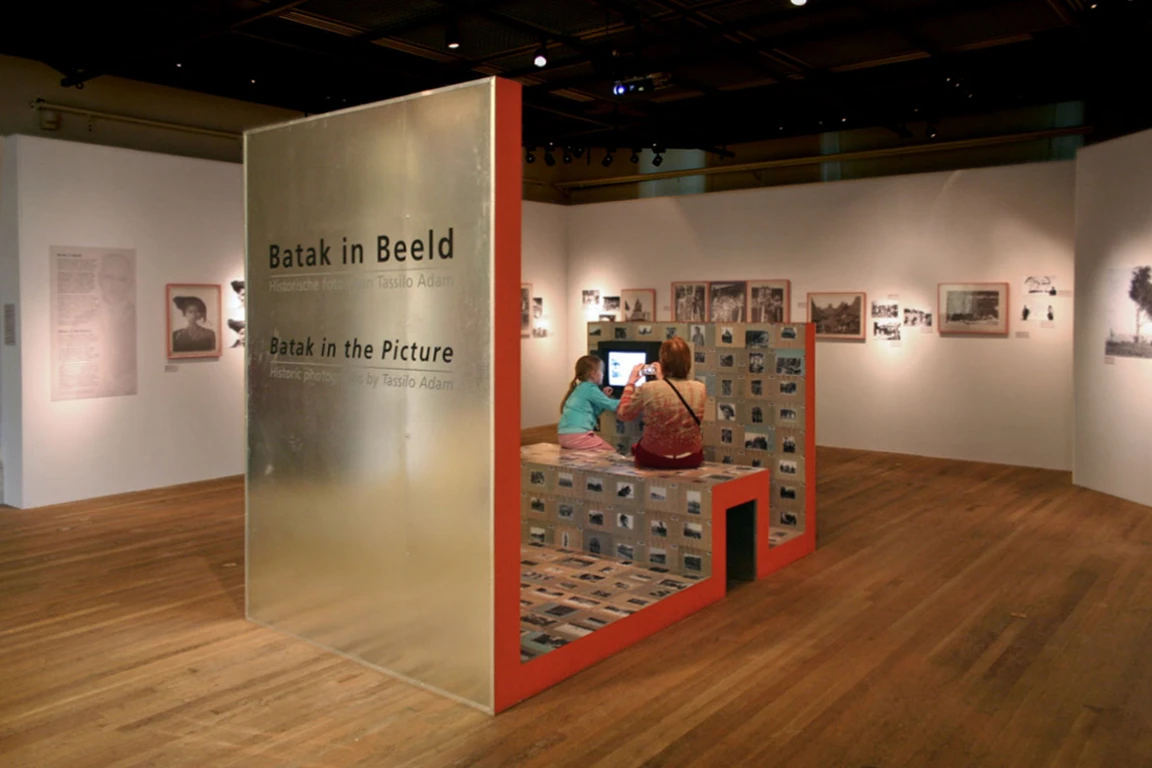
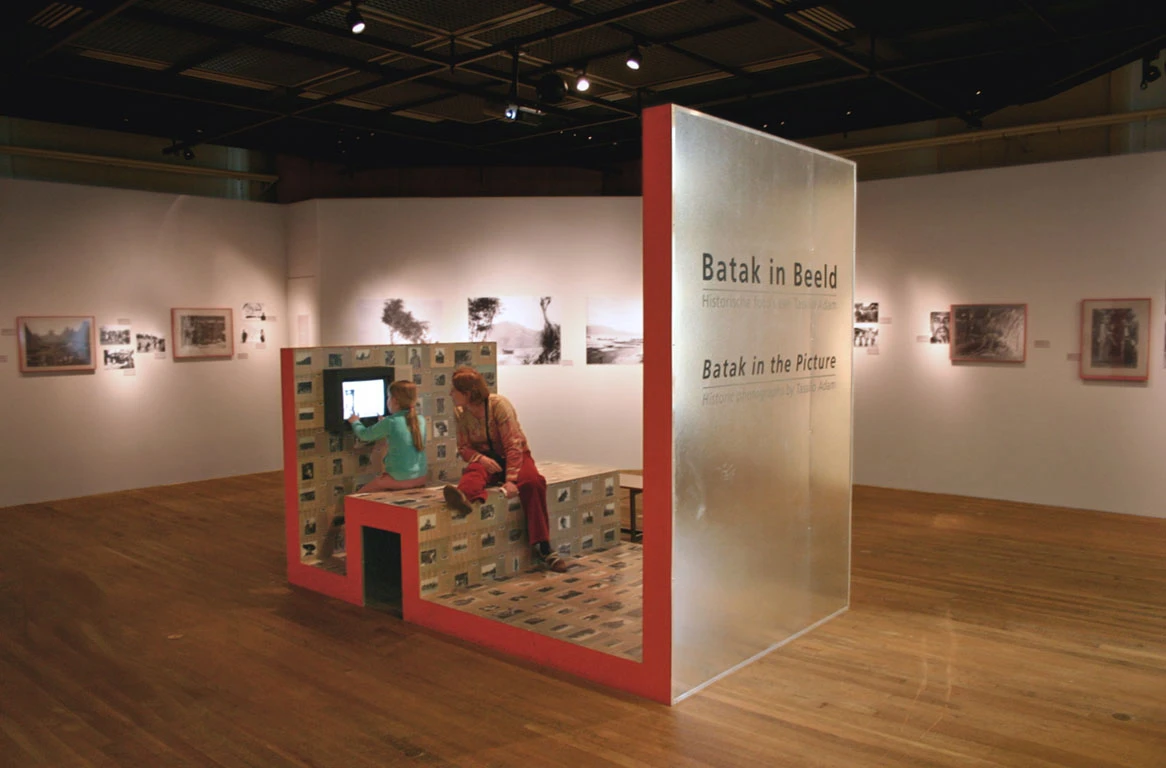
Opening
2006-02-15
Exhibition Concept
The photo exhibition “Batak in Focus” highlights the work of Tasilo Adam, a photographer renowned for documenting the Batak culture. Located in the Tropenmuseum, the exhibition provides a unique glimpse into the traditions, landscapes, and daily practices of the Batak community. The exhibition design emphasizes the visual narrative, bringing the historical photographs to life through thoughtful presentation.
Set Design
Historical photography in a contemporary design.
Opening
2006-02-15
Exhibition Concept
The photo exhibition “Batak in Focus” highlights the work of Tasilo Adam, a photographer renowned for documenting the Batak culture. Located in the Tropenmuseum, the exhibition provides a unique glimpse into the traditions, landscapes, and daily practices of the Batak community. The exhibition design emphasizes the visual narrative, bringing the historical photographs to life through thoughtful presentation.
Set Design
Historical photography in a contemporary design.


Opening
15 February 2006
Exhibition Concept
An exhibition about the influences of Western culture on the Batak community of Sumatra. Presented at the Tropenmuseum (KIT), this exhibition highlights the rich textile culture of the Batak people living in the region around Lake Toba in North Sumatra, Indonesia.
Set Design
Connection between culture and textiles.
Curator
Sandra Niessen, PhD (Leiden University, 1985)
Background
Sandra Niessen is a Canadian/Dutch cultural anthropologist. Her fieldwork focuses primarily on the clothing culture of the Batak people and the influence of Western culture on their traditions and practices.
Opening
15 February 2006
Exhibition Concept
An exhibition about the influences of Western culture on the Batak community of Sumatra. Presented at the Tropenmuseum (KIT), this exhibition highlights the rich textile culture of the Batak people living in the region around Lake Toba in North Sumatra, Indonesia.
Set Design
Connection between culture and textiles.
Curator
Sandra Niessen, PhD (Leiden University, 1985)
Background
Sandra Niessen is a Canadian/Dutch cultural anthropologist. Her fieldwork focuses primarily on the clothing culture of the Batak people and the influence of Western culture on their traditions and practices.


Opening
2005-11-09
Exhibition Concept
The “Ark of Hope” is a wooden chest created in 2001 by designer and painter Sally Linder to house the Earth Charter document. On its five panels are a series of paintings depicting artistic representations of Air, Water, Fire, Spirit, and Earth.
In the Kartini wing of the Wereldmuseum Amsterdam, Studio Daniel Ament designed a seating, exhibition, and activity corner within the pre-existing spatial concept based on the ‘golden grid,’ with “The Ark of Hope” as the central focus. This space invites visitors to engage with the message of the Earth Charter and delve into themes of sustainability and connection.
Opening
2005-11-09
Exhibition Concept
The “Ark of Hope” is a wooden chest created in 2001 by designer and painter Sally Linder to house the Earth Charter document. On its five panels are a series of paintings depicting artistic representations of Air, Water, Fire, Spirit, and Earth.
In the Kartini wing of the Wereldmuseum Amsterdam, Studio Daniel Ament designed a seating, exhibition, and activity corner within the pre-existing spatial concept based on the ‘golden grid,’ with “The Ark of Hope” as the central focus. This space invites visitors to engage with the message of the Earth Charter and delve into themes of sustainability and connection.


Opening
2005-05-15
Exhibition Concept
The exhibition “Kids at Iran” is part of a cultural exchange project between children from Amsterdam and Tehran, organized by Tropenmuseum Junior. The project was conducted via the internet, and the results of the collaborative efforts were showcased in the museum.
Through a website with video calling, children from Iran and the Netherlands gained insight into each other’s lives. Over two and a half years, kids from Amsterdam and Tehran wrote, chatted, and interacted via webcam. They asked each other questions, shared photos and videos about their lives, and expressed their ideas on everyday life themes through animations, paintings, and sculptures. These creative outputs were exhibited in the museum showcases.
Set Design
Cultural exchange through children’s art.
Opening
2005-05-15
Exhibition Concept
The exhibition “Kids at Iran” is part of a cultural exchange project between children from Amsterdam and Tehran, organized by Tropenmuseum Junior. The project was conducted via the internet, and the results of the collaborative efforts were showcased in the museum.
Through a website with video calling, children from Iran and the Netherlands gained insight into each other’s lives. Over two and a half years, kids from Amsterdam and Tehran wrote, chatted, and interacted via webcam. They asked each other questions, shared photos and videos about their lives, and expressed their ideas on everyday life themes through animations, paintings, and sculptures. These creative outputs were exhibited in the museum showcases.
Set Design
Cultural exchange through children’s art.


Premiere
2004-11-11
Synopsis
Joaquim Sabaté, a Catalan choreographer renowned in the Netherlands, transitioned to singing after twenty years in the dance world, specializing as a countertenor. Following a successful international tour, Sabaté now presents Ballo Cantabile in Barcelona, a choreographic work performed by himself and soprano Elena de Vega. The performance is accompanied by two live musicians, offering a modern interpretation of music from Italian Baroque masters.
Set Design
Modern interpretation of baroque forms.
Direction
Joaquim Sabaté
Cast
Joaquim Sabaté (concept, countertenor voice)
Elena de Vega (soprano voice)
Israël Golani (theorbo)
Eva Reiter (gamba-viola)
Creative Team
Costume: Françoise Magrangeas
Set Design: Daan Ament
Video: Roberta Marques
Editing: Caroline Dokter
Technical Support: Ingeborg Slaats
Production: Kees Koeman
Production Assistant: Mariken van Sitteren
Premiere
2004-11-11
Synopsis
Joaquim Sabaté, a Catalan choreographer renowned in the Netherlands, transitioned to singing after twenty years in the dance world, specializing as a countertenor. Following a successful international tour, Sabaté now presents Ballo Cantabile in Barcelona, a choreographic work performed by himself and soprano Elena de Vega. The performance is accompanied by two live musicians, offering a modern interpretation of music from Italian Baroque masters.
Set Design
Modern interpretation of baroque forms.
Direction
Joaquim Sabaté
Cast
Joaquim Sabaté (concept, countertenor voice)
Elena de Vega (soprano voice)
Israël Golani (theorbo)
Eva Reiter (gamba-viola)
Creative Team
Costume: Françoise Magrangeas
Set Design: Daan Ament
Video: Roberta Marques
Editing: Caroline Dokter
Technical Support: Ingeborg Slaats
Production: Kees Koeman
Production Assistant: Mariken van Sitteren


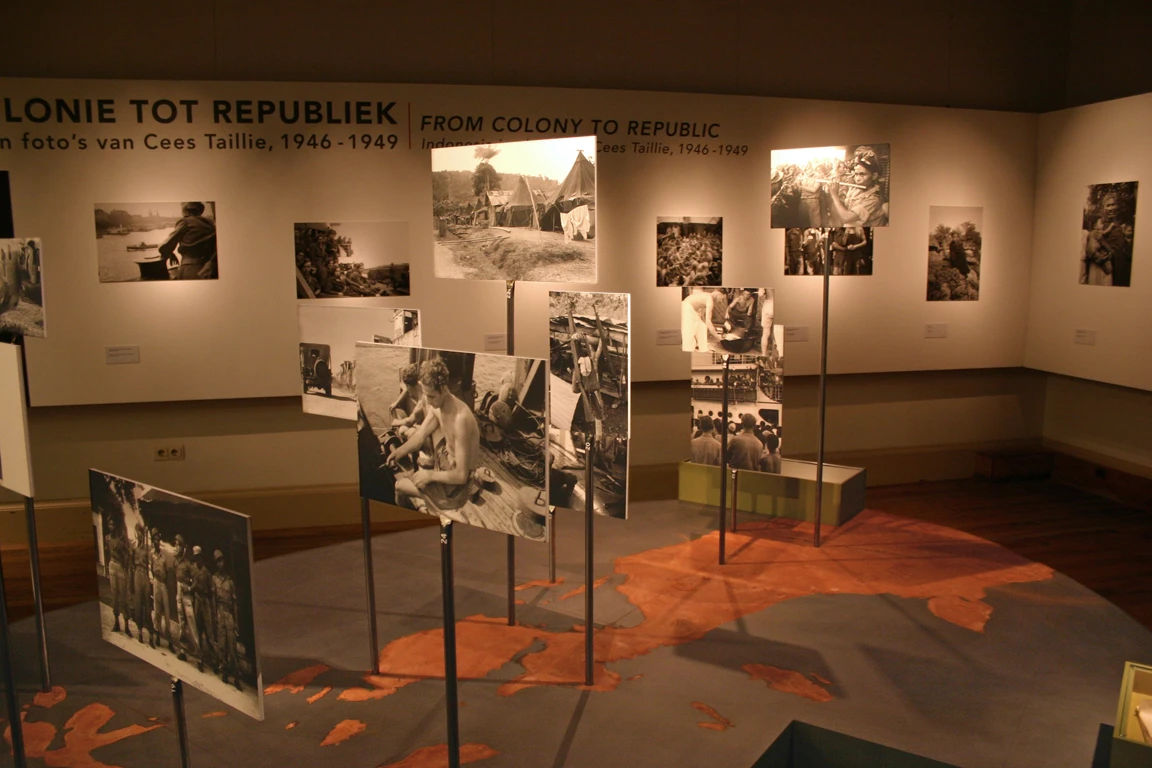


Opening
2004-10-21
Exhibition Concept
The exhibition “From Colony to Republic” showcases the work of military photographer Tallie, who documented the transition from colony to republic. Hosted at the Tropenmuseum, the photo and object exhibition provides a historical perspective on this transformative period, featuring compelling images that highlight the political, social, and cultural changes of the time. The exhibition design combines visual and tactile elements to bring the complexity of this era to life.
Set Design
Depicting the transition from colony to republic.
Opening
2004-10-21
Exhibition Concept
The exhibition “From Colony to Republic” showcases the work of military photographer Tallie, who documented the transition from colony to republic. Hosted at the Tropenmuseum, the photo and object exhibition provides a historical perspective on this transformative period, featuring compelling images that highlight the political, social, and cultural changes of the time. The exhibition design combines visual and tactile elements to bring the complexity of this era to life.
Set Design
Depicting the transition from colony to republic.


Opening
2004-07-10
Exhibition Concept
The overview exhibition of the Tropenmuseum provides a unique perspective on the museum’s rich and diverse collection. The spatial design and activity development are specially crafted to actively engage visitors with the stories behind the displayed objects. The exhibition combines modern and traditional elements to highlight the cultural and historical significance of the collection.
Set Design
Interaction between space, objects, and visitors.
Opening
2004-07-10
Exhibition Concept
The overview exhibition of the Tropenmuseum provides a unique perspective on the museum’s rich and diverse collection. The spatial design and activity development are specially crafted to actively engage visitors with the stories behind the displayed objects. The exhibition combines modern and traditional elements to highlight the cultural and historical significance of the collection.
Set Design
Interaction between space, objects, and visitors.


Premiere
2004-04-08
Synopsis
“Lost” is a dance-oriented movement performance about a man balancing on the edge of his existence. A man who feels lost and estranged. A man who can’t bear the pain, jumps out of the depths, only to return, relieve the pain, and fall asleep on the pavement 40 meters below.
In a world between life and death, a poetic collage of memories, fears, desires, loved ones, and family members unfolds. Through play, dance, magic, live music, visuals, and text, the audience is drawn into flashes of thoughts and images during the fall.
“Lost” explores the feeling of being lost, the mystery of suicide, and the impact on the surroundings when someone lets go.
Set Design
Waiting room/station without metro or train
Direction
Jakop Ahlbom
Cast
Carola Bärtschiger
Valentina Campora
Luc van Esch
Silke Hundertmark
Peter Kadar
Matthias Maat
Anja Sielaf/Irene van Geest
Roel Voorbij
Live Music
Solbakken (Empee Holwerda, Klaas Schippers, Jelle Buma)
Creative Team
Text: Emanuel Muris
Dramaturgy and Advice: Mischa van Dullemen
Set Design: Daniël Ament
Costumes: Susann Rittermann
Light Design and Technique: Vinny Jones
Photography: Oliver Helf
Production: Florian Hellwig
Premiere
2004-04-08
Synopsis
“Lost” is a dance-oriented movement performance about a man balancing on the edge of his existence. A man who feels lost and estranged. A man who can’t bear the pain, jumps out of the depths, only to return, relieve the pain, and fall asleep on the pavement 40 meters below.
In a world between life and death, a poetic collage of memories, fears, desires, loved ones, and family members unfolds. Through play, dance, magic, live music, visuals, and text, the audience is drawn into flashes of thoughts and images during the fall.
“Lost” explores the feeling of being lost, the mystery of suicide, and the impact on the surroundings when someone lets go.
Set Design
Waiting room/station without metro or train
Direction
Jakop Ahlbom
Cast
Carola Bärtschiger
Valentina Campora
Luc van Esch
Silke Hundertmark
Peter Kadar
Matthias Maat
Anja Sielaf/Irene van Geest
Roel Voorbij
Live Music
Solbakken (Empee Holwerda, Klaas Schippers, Jelle Buma)
Creative Team
Text: Emanuel Muris
Dramaturgy and Advice: Mischa van Dullemen
Set Design: Daniël Ament
Costumes: Susann Rittermann
Light Design and Technique: Vinny Jones
Photography: Oliver Helf
Production: Florian Hellwig


Premiere
03-05-2003
Synopsis
The voice with which Mother Dolores runs the pension is shrill and harsh. She constantly commands or scolds the people around her. At times, her speech transitions into raw flamenco singing. She is a proud star, this quintessentially Spanish woman in the production ‘Pension Dolores’ by Joaquim Sabaté. The pension is an inside-out caravan, featuring a kitchen, reception area, and numerous windows and doors from which people constantly emerge. In a chaotic yet cozy atmosphere, scenes of daily life—such as peeling potatoes and hanging laundry—alternate with dramatic dance eruptions and intriguing love stories.
Review
“Pension Dolores” is a lighthearted, unpretentious production with a natural and infectious play style. Despite its chaotic appearance, many dance sequences are surprisingly sharply choreographed.
Set Design Concept
Inside-out caravan
Direction
Joaquim Sabaté
Cast
Name 1\
Name 2\
Name 3
Premiere
03-05-2003
Synopsis
The voice with which Mother Dolores runs the pension is shrill and harsh. She constantly commands or scolds the people around her. At times, her speech transitions into raw flamenco singing. She is a proud star, this quintessentially Spanish woman in the production ‘Pension Dolores’ by Joaquim Sabaté. The pension is an inside-out caravan, featuring a kitchen, reception area, and numerous windows and doors from which people constantly emerge. In a chaotic yet cozy atmosphere, scenes of daily life—such as peeling potatoes and hanging laundry—alternate with dramatic dance eruptions and intriguing love stories.
Review
“Pension Dolores” is a lighthearted, unpretentious production with a natural and infectious play style. Despite its chaotic appearance, many dance sequences are surprisingly sharply choreographed.
Set Design Concept
Inside-out caravan
Direction
Joaquim Sabaté
Cast
Name 1\
Name 2\
Name 3
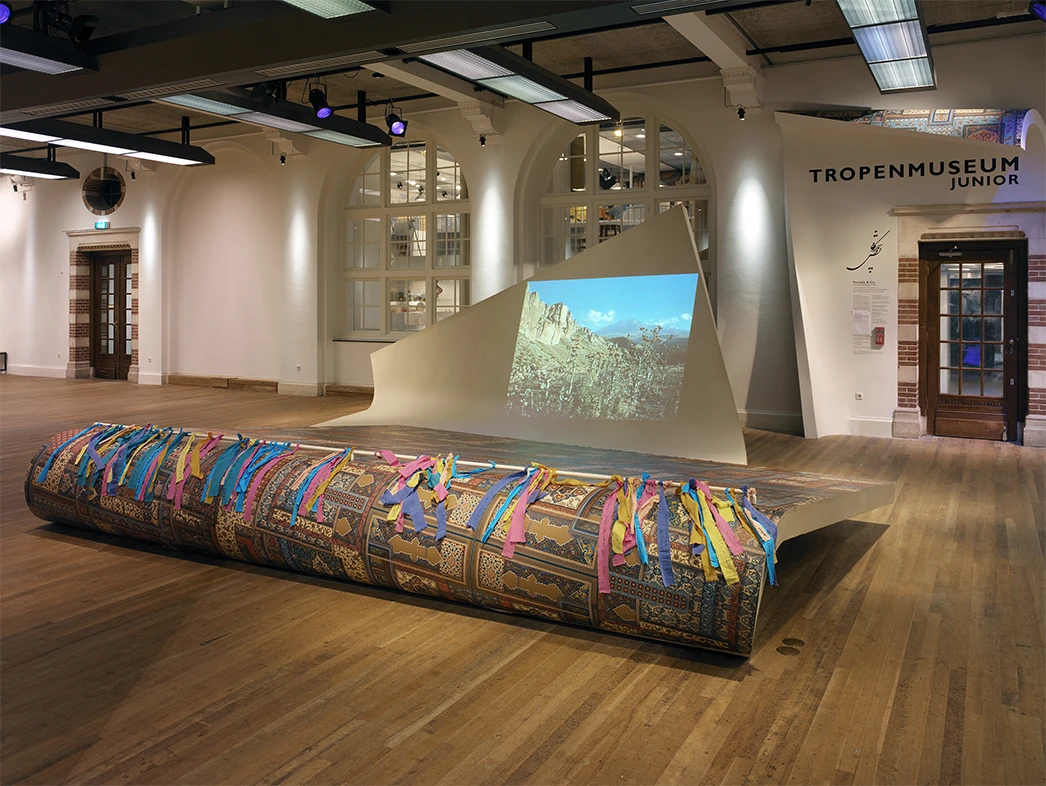
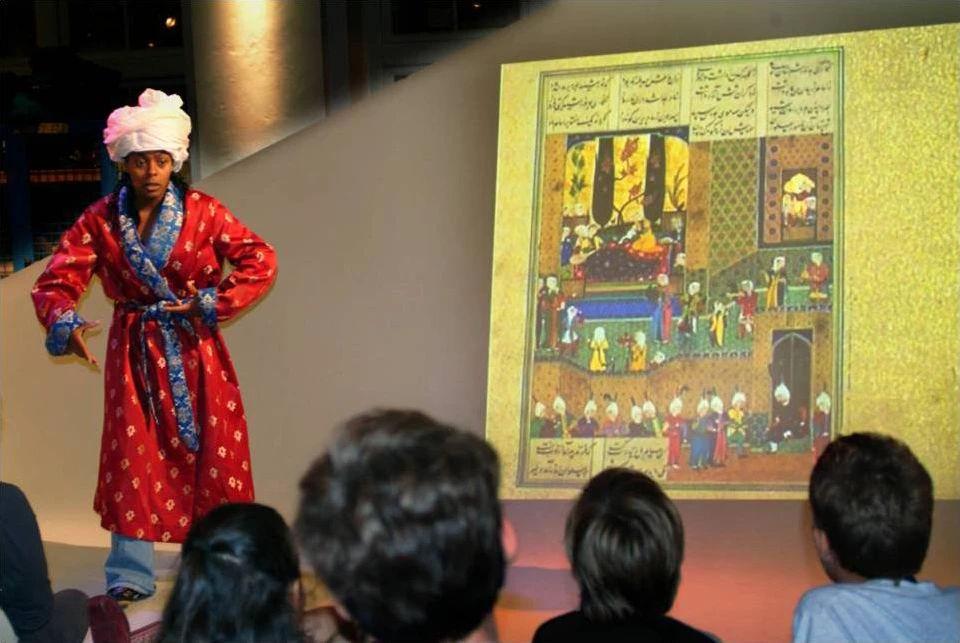
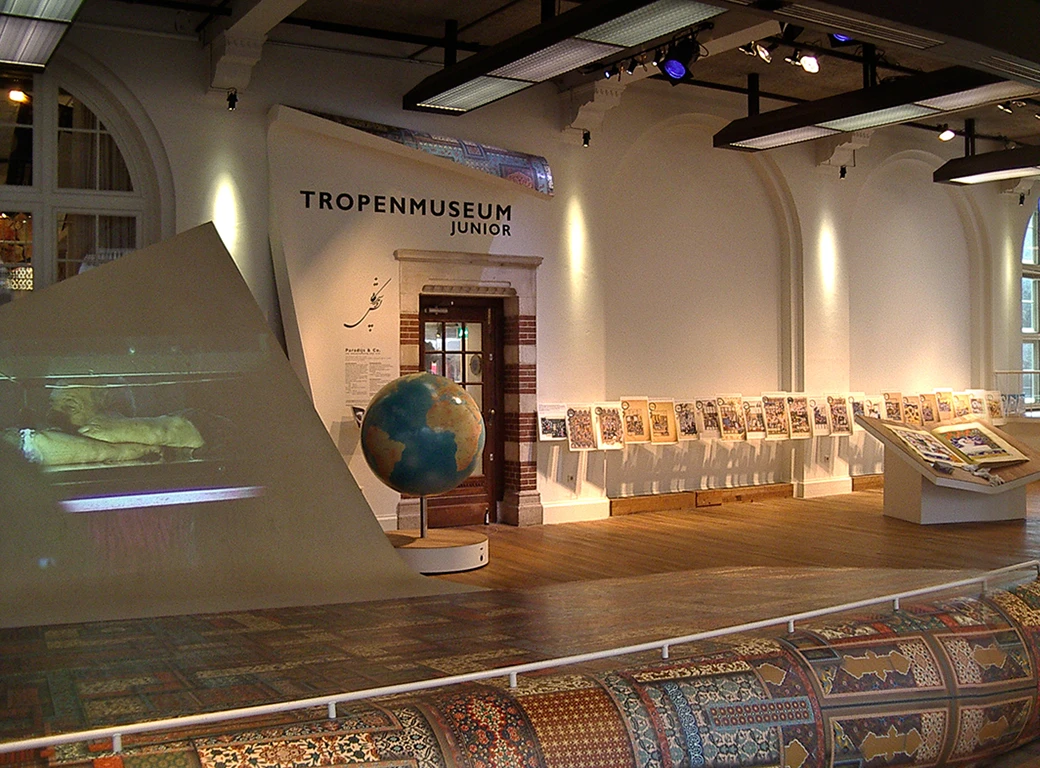
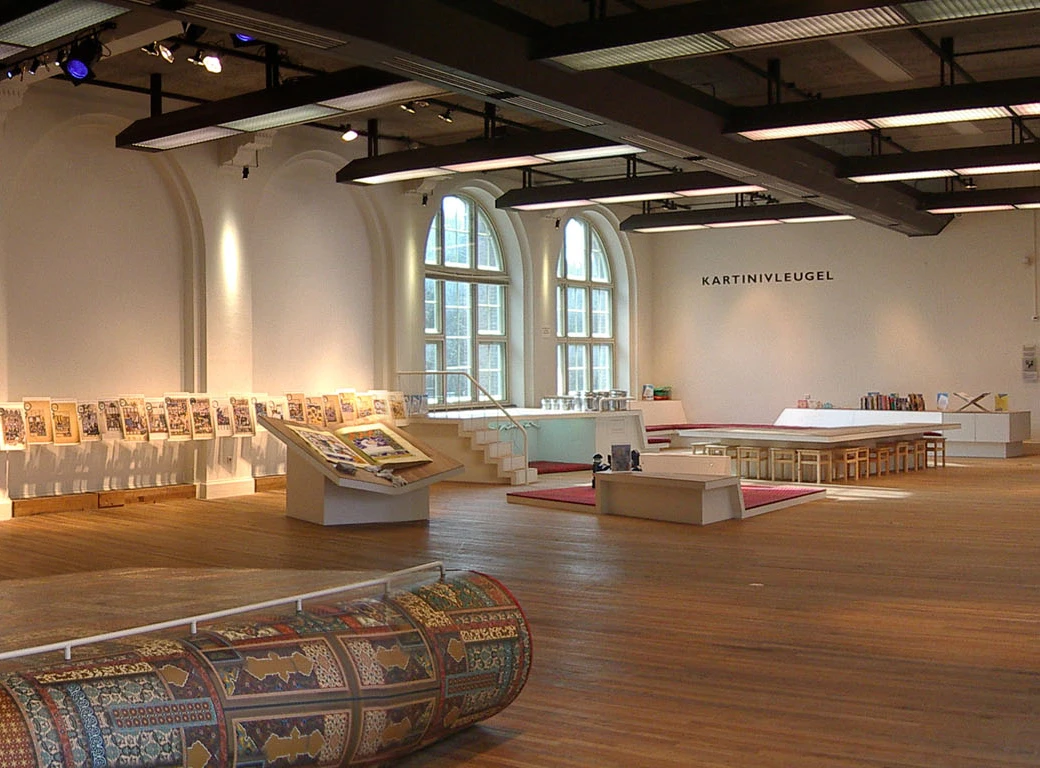

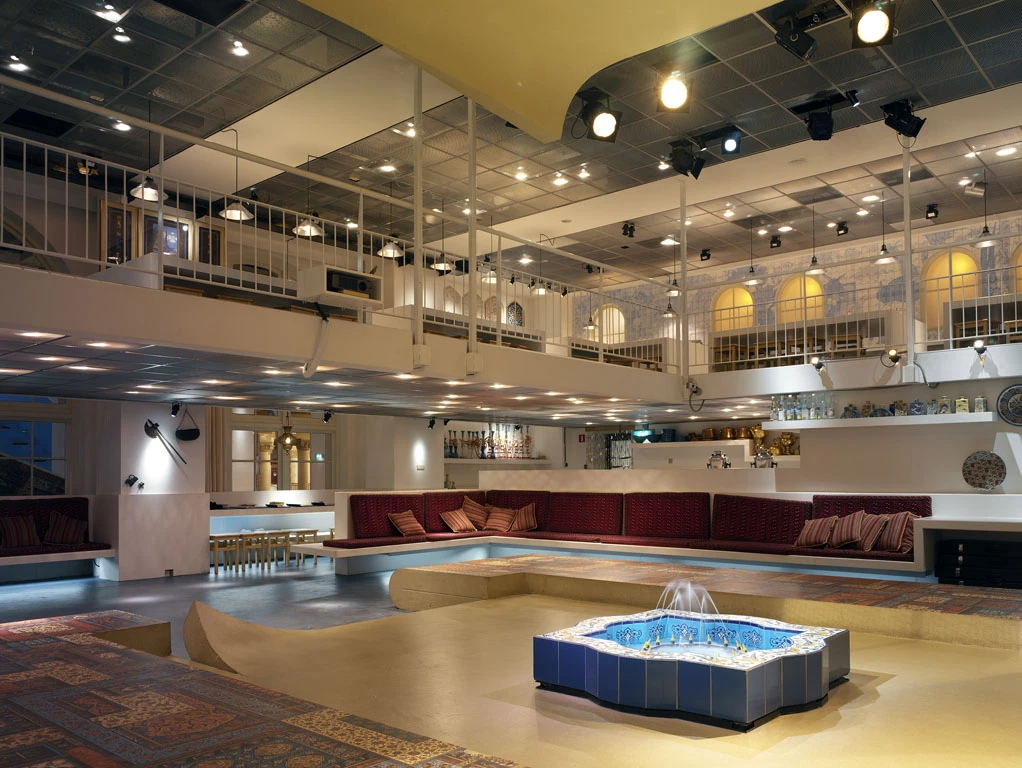
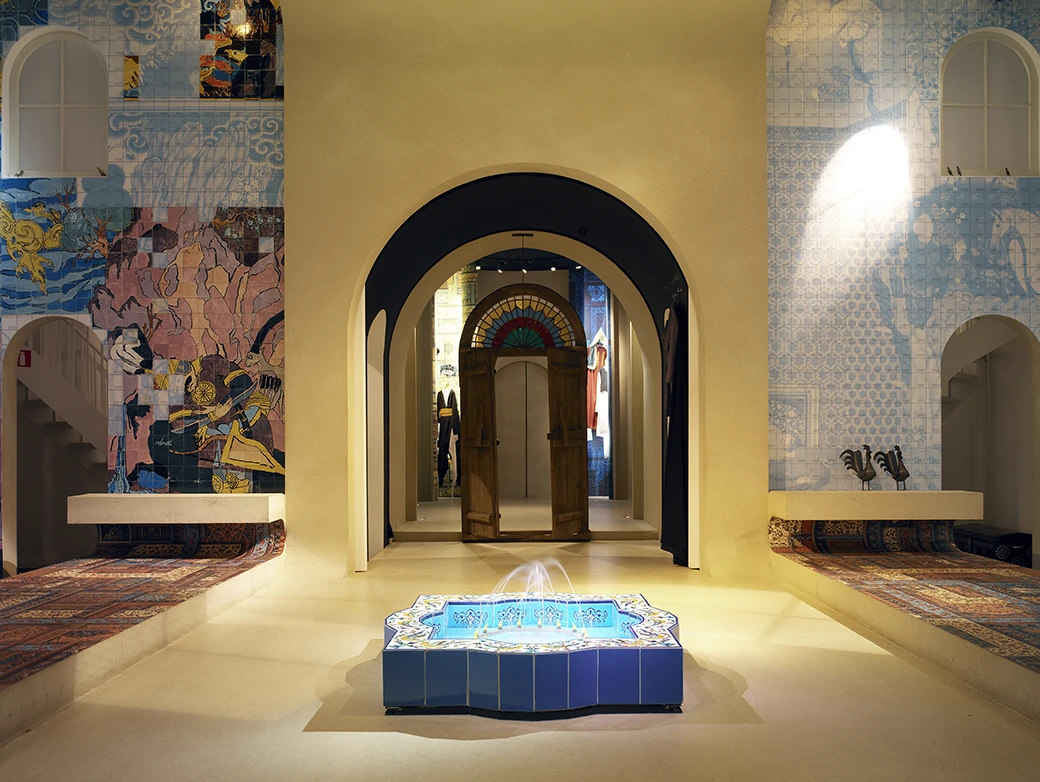
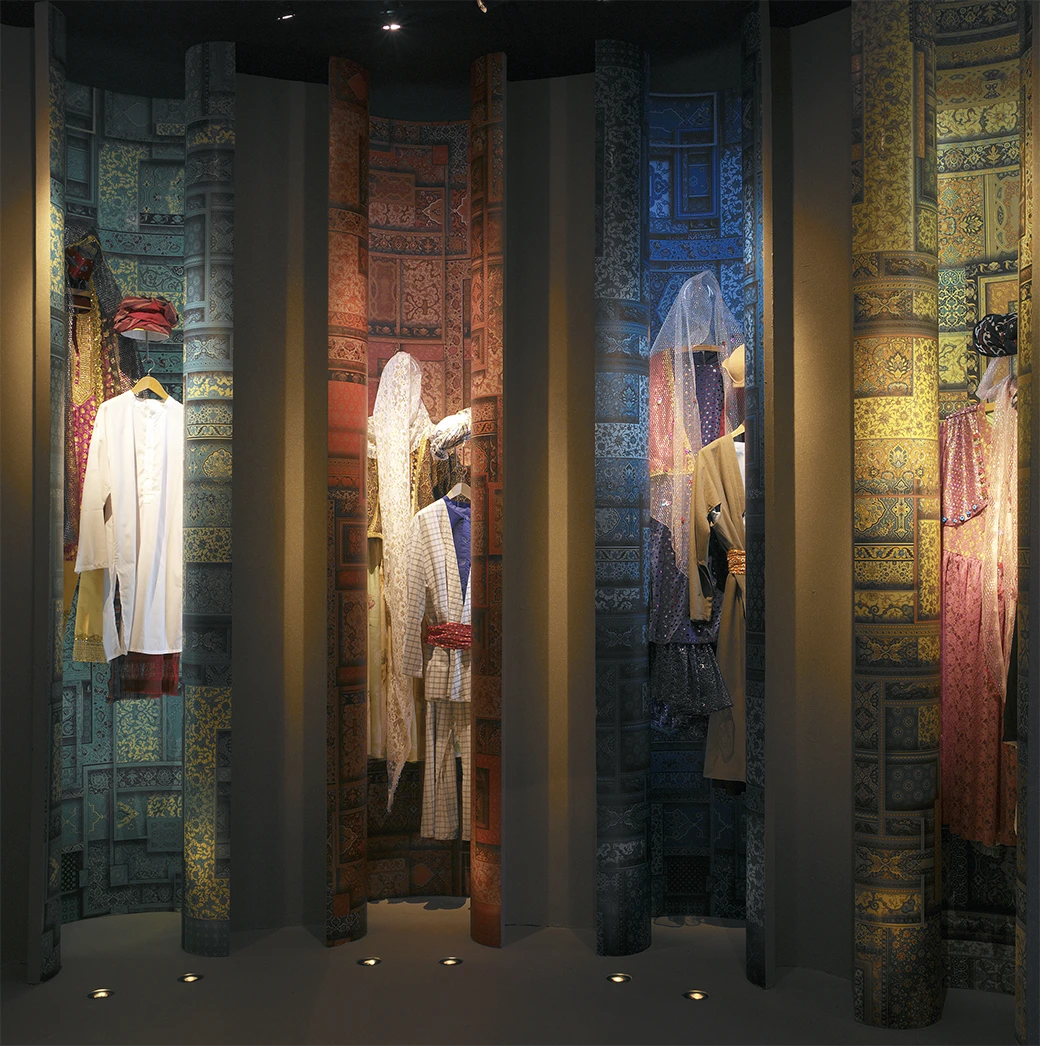
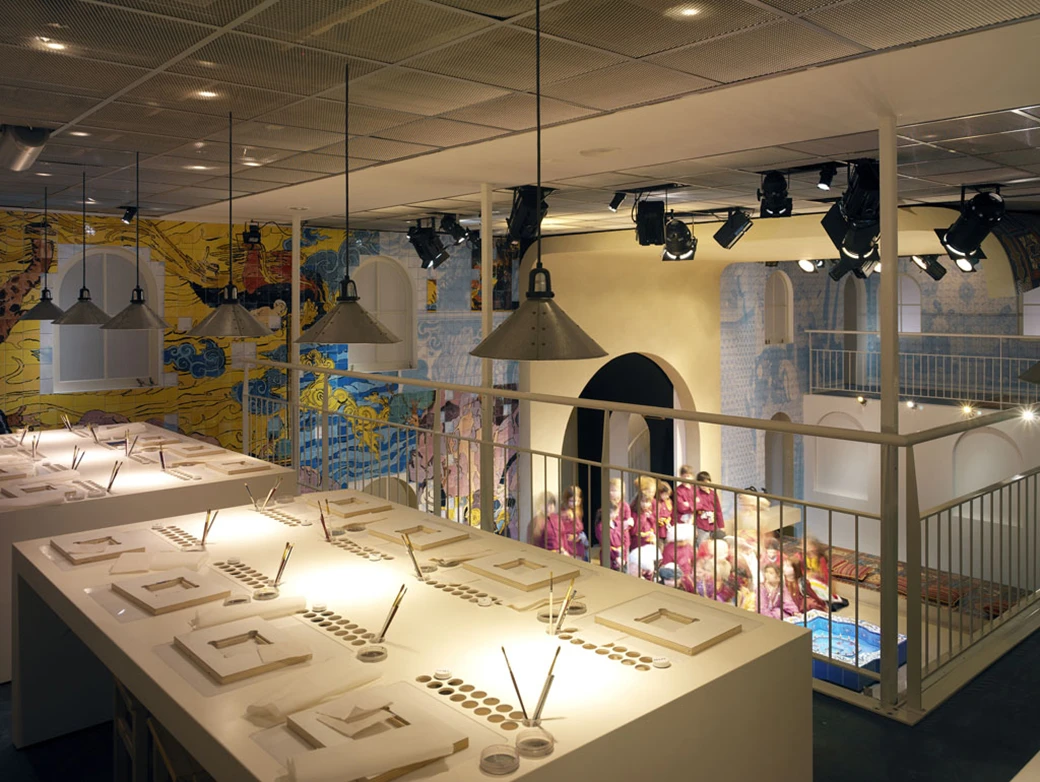
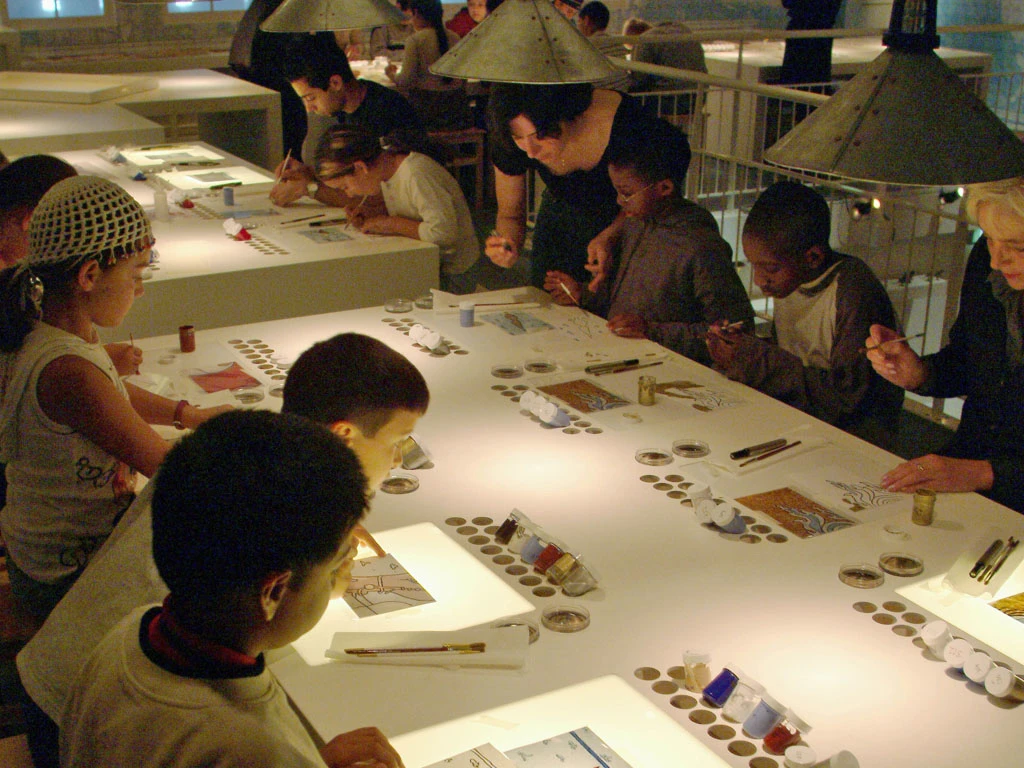
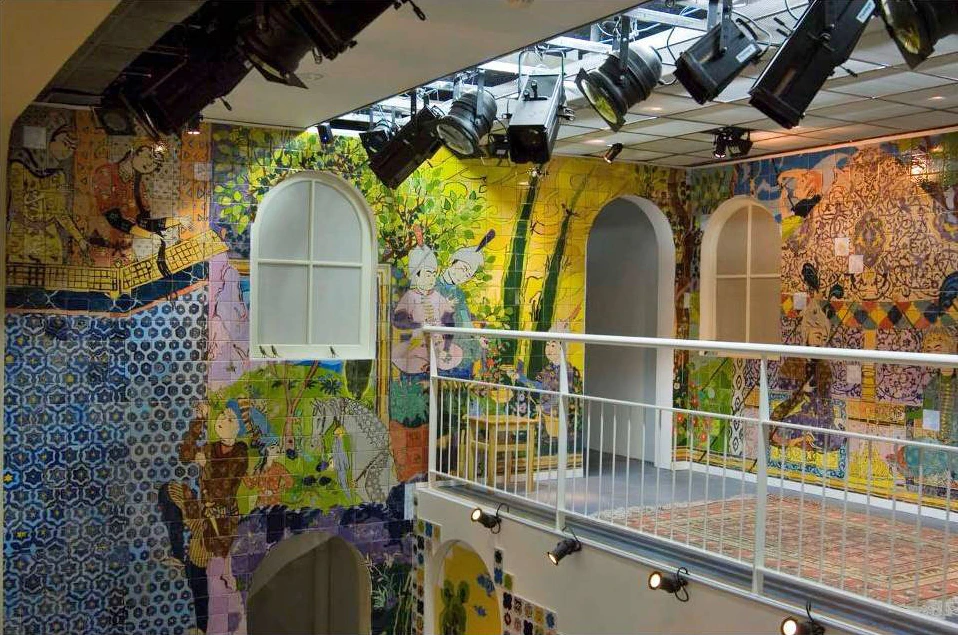
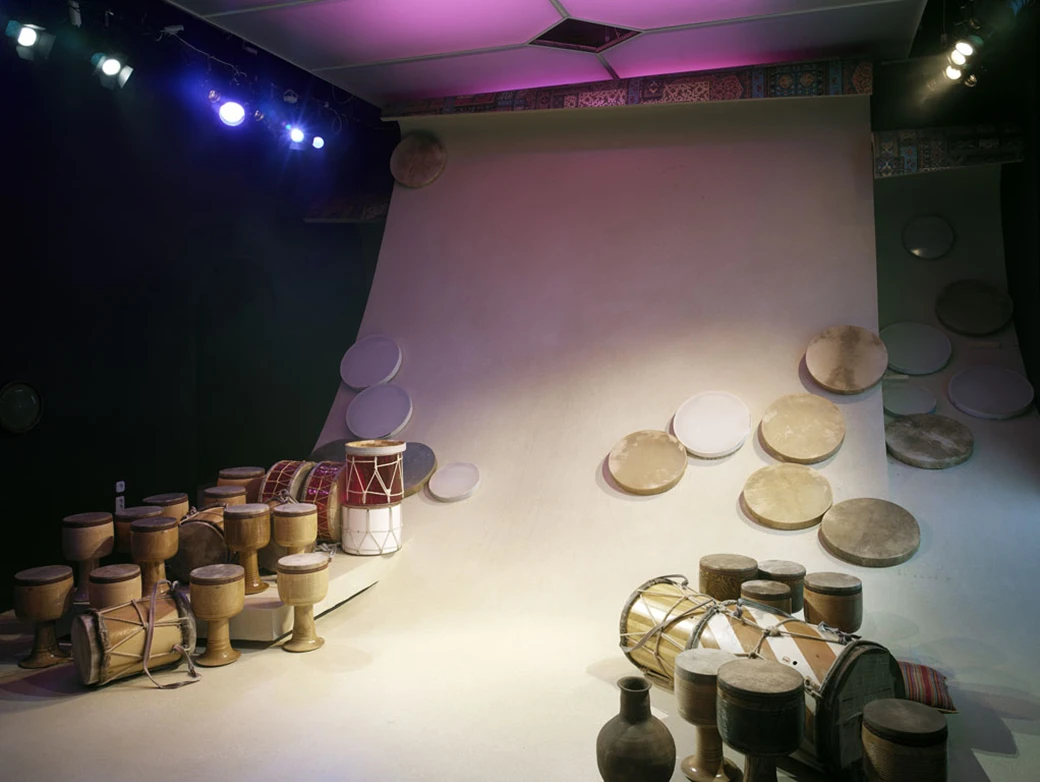
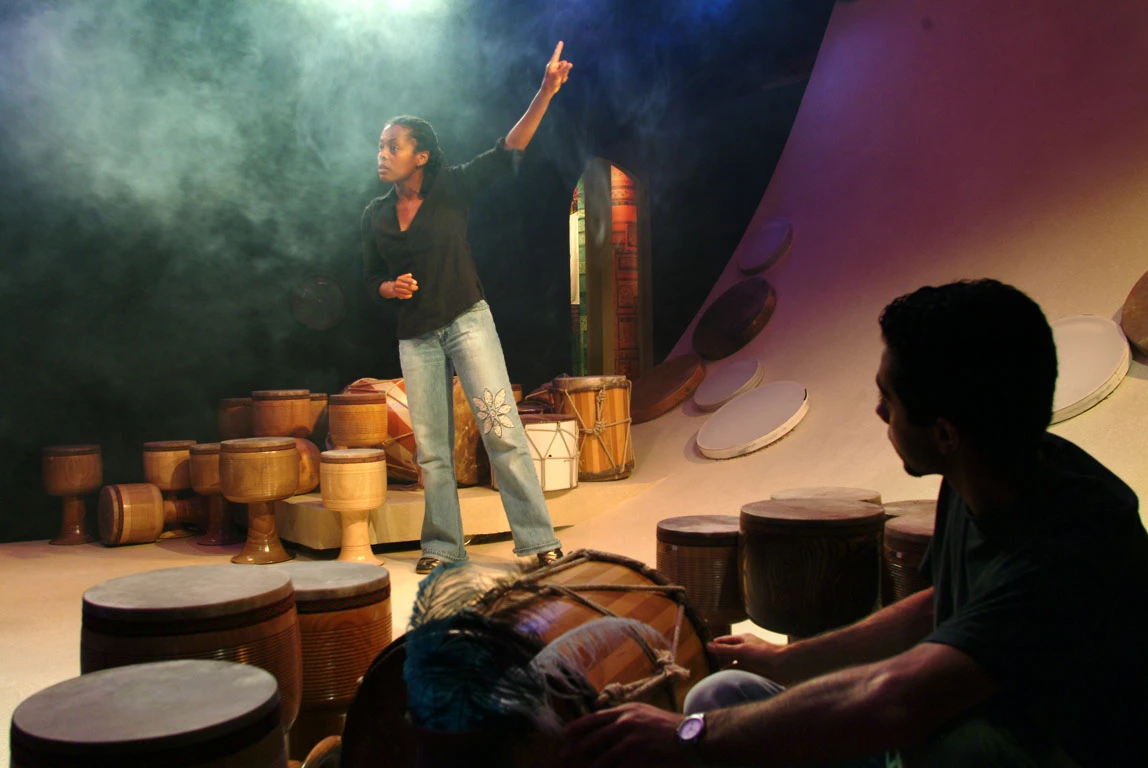
Opening
2003
Exhibition Concept
Paradise&Co is an exhibition about Iran, delving deep into history, with pre-Islamic Persia as a major source of inspiration. The seven regions of Iran are highlighted, and the Shahnameh, a poetry collection for kings, provides many of the stories for the exhibition.
In Amsterdam’s (formerly) Tropenmuseum Junior (now Wereldmuseum Junior), a tile artwork is growing. The museum walls are covered with scenes from the Shahnameh, a thousand-year-old Persian epic by the poet Ferdosi. In faint blue lines, like a pre-printed cross-stitch embroidery pattern, elegant miniatures are blown up to wall size.
The six thousand tiles are painted by children from all over the Netherlands in the temporary workshop, using pigments and glaze specifically intended for that precise square decimeter. According to the plan, the tiled wall would be completed in 2.5 years, coinciding with the end of the Paradise&Co exhibition.
Thousands of children beat drums in awkward rhythms, experienced wearing a veil, baked chickpea cookies in the reconstructed teahouse, practiced calligraphy, listened to stories, and sang a song in Farsi: «Beautiful flower, open up, darling, it’s spring». These activities allowed the children to engage all their senses to learn about Iran.
This aligns with the approach of Tropenmuseum Junior: always searching for «forms where objects, intangible culture, stories, activities, and children can be brought together in the most beautiful way possible».
Set Design
Tile artwork of 6,000 child-glazed tiles.
Opening
2003
Exhibition Concept
Paradise&Co is an exhibition about Iran, delving deep into history, with pre-Islamic Persia as a major source of inspiration. The seven regions of Iran are highlighted, and the Shahnameh, a poetry collection for kings, provides many of the stories for the exhibition.
In Amsterdam’s (formerly) Tropenmuseum Junior (now Wereldmuseum Junior), a tile artwork is growing. The museum walls are covered with scenes from the Shahnameh, a thousand-year-old Persian epic by the poet Ferdosi. In faint blue lines, like a pre-printed cross-stitch embroidery pattern, elegant miniatures are blown up to wall size.
The six thousand tiles are painted by children from all over the Netherlands in the temporary workshop, using pigments and glaze specifically intended for that precise square decimeter. According to the plan, the tiled wall would be completed in 2.5 years, coinciding with the end of the Paradise&Co exhibition.
Thousands of children beat drums in awkward rhythms, experienced wearing a veil, baked chickpea cookies in the reconstructed teahouse, practiced calligraphy, listened to stories, and sang a song in Farsi: «Beautiful flower, open up, darling, it’s spring». These activities allowed the children to engage all their senses to learn about Iran.
This aligns with the approach of Tropenmuseum Junior: always searching for «forms where objects, intangible culture, stories, activities, and children can be brought together in the most beautiful way possible».
Set Design
Tile artwork of 6,000 child-glazed tiles.


Première
28-09-2002
Synopsis
The production “Nur zur Erinnerung” is a typical example illustrating the design approach, methodology, and process of Studio Daniel Ament.
Mime performers trained at the AHK follow the tradition of famous founders of modern mime such as Etienne Decroux, Marcel Marceau, etc., creating material on an empty stage through improvisation, expression, intention, and impulse, without grand plans or concepts.
This approach offers the perfect synergistic situation for the conceptual design approach of Daniel Ament.
The overarching conceptual theme in Daniel Ament’s graduation work at the Rietveld Academy explored how people appropriate space and express (and shape) their identity through different layers of scale: the first layer being the body, the second layer clothing, the third interior, the fourth house, the street, the place, the province, the country, etc.
This concept continued as the conceptual basis for the set design of “Nur zur Erinnerung,” which consists of a massive cabinet made up of various smaller cabinets collected from the city. When this cabinet, or wall, opens like two doors, it reveals an abstract, white inner world—a tabula rasa with saw cuts functioning as scars—and symbolizes both the mental space of the protagonist and a statement about the construction of the ego’s identity through spatial elements and memories of the experiences that ‘marked’ you.
The choice of these cabinets, sourced from diverse origins, allows viewers to project personal memories, contributing to the audience’s meaning-making and providing both physical and conceptual inspiration and frameworks for the mime performers and choreography.
Set Design Concept
A cabinet as mental projection.
Director
Jakop Ahlblom
Cast
Jakop Ahlbom
Silke Hundertmark
Péter Kádár
Gabi Sund
Dramaturgy and Advice
Mischa van Dullemen
Lighting Design
Vinny Jones
Technical Crew
Vinny Jones
Wilfred Plum
Production
Florian Hellwig
Scenography
Daniel Ament
Sound
Jaap Lindijer
Première
28-09-2002
Synopsis
The production “Nur zur Erinnerung” is a typical example illustrating the design approach, methodology, and process of Studio Daniel Ament.
Mime performers trained at the AHK follow the tradition of famous founders of modern mime such as Etienne Decroux, Marcel Marceau, etc., creating material on an empty stage through improvisation, expression, intention, and impulse, without grand plans or concepts.
This approach offers the perfect synergistic situation for the conceptual design approach of Daniel Ament.
The overarching conceptual theme in Daniel Ament’s graduation work at the Rietveld Academy explored how people appropriate space and express (and shape) their identity through different layers of scale: the first layer being the body, the second layer clothing, the third interior, the fourth house, the street, the place, the province, the country, etc.
This concept continued as the conceptual basis for the set design of “Nur zur Erinnerung,” which consists of a massive cabinet made up of various smaller cabinets collected from the city. When this cabinet, or wall, opens like two doors, it reveals an abstract, white inner world—a tabula rasa with saw cuts functioning as scars—and symbolizes both the mental space of the protagonist and a statement about the construction of the ego’s identity through spatial elements and memories of the experiences that ‘marked’ you.
The choice of these cabinets, sourced from diverse origins, allows viewers to project personal memories, contributing to the audience’s meaning-making and providing both physical and conceptual inspiration and frameworks for the mime performers and choreography.
Set Design Concept
A cabinet as mental projection.
Director
Jakop Ahlblom
Cast
Jakop Ahlbom
Silke Hundertmark
Péter Kádár
Gabi Sund
Dramaturgy and Advice
Mischa van Dullemen
Lighting Design
Vinny Jones
Technical Crew
Vinny Jones
Wilfred Plum
Production
Florian Hellwig
Scenography
Daniel Ament
Sound
Jaap Lindijer


Première
17-09-2002
Synopsis
The Noord Nederlands Toneel has gained a remarkable reputation in recent years with its vibrant and socially engaged performances. Whether it’s Shakespeare, Brecht, or contemporary works, the NNT’s style appeals to a wide audience.
Martin McDonagh published “The Lieutenant of Inishmore” in 2001, a modern play that proves to be highly impactful. This ruthless satire filled with extreme violence showcases the blood-curdling world of Irish freedom fighters. All of this is presented in a Quentin Tarantino style: politically incorrect, over the top, and hilarious, with brilliant roles, razor-sharp dialogues, and a dangerous undertone.
The play’s strength lies in how it reduces terrorist extremism to a domestic level, sparking the thought that a monster resides within us all. Emotions run high: neither animals nor mothers are spared.
Special-fx
Daniel Ament
Set Design
Nelly Blessinga
Costumes
Roos van Geffen
Lighting Design
Robert Vonkeman
Cast
Martijn de Rijk (Padraic)
Loek Peters (Christy, James)
Mirjam Stolwijk (Conny)
Tibor Lukács (Joey, James)
Wolter Muller (Davey)
Nico van der Knaap (Brendan, James)
Lotje van Lunteren (Maureen)
Première
17-09-2002
Synopsis
The Noord Nederlands Toneel has gained a remarkable reputation in recent years with its vibrant and socially engaged performances. Whether it’s Shakespeare, Brecht, or contemporary works, the NNT’s style appeals to a wide audience.
Martin McDonagh published “The Lieutenant of Inishmore” in 2001, a modern play that proves to be highly impactful. This ruthless satire filled with extreme violence showcases the blood-curdling world of Irish freedom fighters. All of this is presented in a Quentin Tarantino style: politically incorrect, over the top, and hilarious, with brilliant roles, razor-sharp dialogues, and a dangerous undertone.
The play’s strength lies in how it reduces terrorist extremism to a domestic level, sparking the thought that a monster resides within us all. Emotions run high: neither animals nor mothers are spared.
Special-fx
Daniel Ament
Set Design
Nelly Blessinga
Costumes
Roos van Geffen
Lighting Design
Robert Vonkeman
Cast
Martijn de Rijk (Padraic)
Loek Peters (Christy, James)
Mirjam Stolwijk (Conny)
Tibor Lukács (Joey, James)
Wolter Muller (Davey)
Nico van der Knaap (Brendan, James)
Lotje van Lunteren (Maureen)